Categories

Jacar mascot — a curious laptop A friendly laptop whose eyes follow your cursor.

Madrid · ES/EN · async-first

DevOps &

Honest infrastructure for small teams. No theatre, no slides, with code that stays with you.

LEARNING PATHS

From first step to mastery, in order

Guided journeys through the best of the archive — without getting lost among hundreds of articles.

Explore all paths

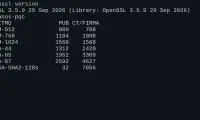
NIST PQC: The Post-Quantum Cryptography Standards

In August 2024, NIST published its first finalized post-quantum cryptography standards: FIPS 203 (ML-KEM) for key exchange, FIPS 204 (ML-DSA) for digital signatures, and FIPS 205 (SLH-DSA) as a hash-based alternative. They replace RSA and ECDSA before a quantum computer can break them, and hybrid implementations are already live in Chrome and Cloudflare.

Litestream: Near-Real-Time Replication for SQLite

Litestream is an open-source tool that replicates a SQLite database to an S3 bucket in near real time by reading the WAL SQLite already writes. It offers point-in-time recovery, overhead of only 1 to 3% CPU, and replaces the need for a separate database server in small apps.

LATEST POSTS Just out

Fresh from the oven

  1. Artificial Intelligence

    OpenRouter: A Gateway for AI Models

    OpenRouter is a hosted gateway that gathers more than 400 AI models from over 70 providers behind a single OpenAI-compatible API. You change the base URL, use one key and one balance, and gain automatic routing, failover and pass-through token pricing. Unlike a self-hosted proxy such as LiteLLM, you run no infrastructure at all.

  2. Artificial Intelligence

    browser-use: agents that browse the web

    browser-use is an open-source Python library that lets an AI agent drive a web browser the way you do: it opens pages, reads the DOM, clicks and fills in forms. It was born on Playwright and in 2025 switched to speaking Chrome's CDP protocol directly for speed. This guide explains how it works and when to use it.

  3. Artificial Intelligence

    Firecrawl: Web Data for Agents

    Firecrawl is an open-source API that turns any web page into clean Markdown, ready for a language model. With scrape and crawl endpoints plus schema-guided JSON extraction, it gives your AI agent reliable web data. This guide covers its formats, how to self-host it with Docker and when it beats a scraper of your own.

  4. Artificial Intelligence

    Composio: Tools and Integrations for Agents

    Composio connects your AI agent to more than a thousand applications (GitHub, Slack, Gmail, Notion) through pre-authenticated tools and managed OAuth authentication. Instead of writing each integration by hand, you request the tools by name and the agent acts on behalf of each user. This guide explains what it is, how it handles authentication and how to plug it into your agent framework.

  5. Artificial Intelligence

    Dify: a self-hosted LLMOps platform

    Dify is an open-source platform for building AI applications and agents, with a visual workflow canvas, prompt management, a RAG knowledge base and LLMOps layers. You can self-host the whole thing with Docker Compose on top of Postgres, Redis and a vector database. This guide explains how to deploy it and when it beats Flowise and Langflow.

  6. Artificial Intelligence

    Flowise: self-hosted low-code agents

    Flowise is an open-source tool that lets you build AI agents by dragging nodes onto a visual canvas, with barely any code. It is built on LangChain.js and you can self-host the whole thing with a single Docker container. This guide covers how to deploy it, the difference between chatflows and AgentFlow v2, and how it compares to Langflow and Dify.

  7. Artificial Intelligence

    Langflow: a visual agent builder

    Langflow is an open-source tool for building AI agents and workflows by dragging blocks onto a visual canvas, with barely any code. You can self-host it with Docker, wire up models, tools and vector databases, and publish every flow as an API or as an MCP server. This guide explains how to deploy it and build your first agent.

  8. Artificial Intelligence

    Building Your Own MCP Server

    Your own MCP server exposes your data and functions to any AI assistant through the Model Context Protocol. With the official Python SDK and its FastMCP class you write a server in about twenty lines: you define tools, resources and prompts as type-annotated functions, and you connect it to Claude, Cline or Goose over stdio or HTTP.

  9. Artificial Intelligence

    Durable Agent Execution with Temporal

    Durable execution lets an AI agent survive crashes, restarts and API rate limits without losing its progress. Temporal applies this model: your logic lives in a workflow that resumes exactly where it stopped, and every model or tool call runs as an activity that Temporal retries for you automatically on failure.

  10. Artificial Intelligence

    Deploying an AI Agent to Production

    Deploying an AI agent to production means turning your local script into a containerised service, with external state, observability and managed secrets. In this guide you package an agent inside a minimal Docker image, expose an HTTP endpoint with FastAPI and add health checks, retries and rate limits so it survives real traffic.

THE NEWSROOM

Most read, by category and trending

Most read

  1. Technology NIST PQC: The Post-Quantum Cryptography Standards 3.4K
  2. Artificial Intelligence How to install and tune oMLX on M5 Max 128 GB 2.8K
  3. Technology Next-generation NPUs: the hardware moving AI in 2026 2.4K
  4. Mac Essential Software for Your New M5 Mac (2026 guide) 1.9K

Most voted