Design Thinking: Methods and Strategies

Updated: 2026-07-12
Design thinking is not a consultancy fad. It is a structured method for solving complex problems by placing the user at the centre of every decision. Its power lies in its applicability to digital product design, internal process improvement, and business model redefinition alike.
Key takeaways
-
Design thinking is structured around five iterative phases: empathise, define, ideate, prototype, and test.
-
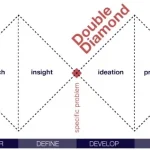
The Double Diamond (Design Council) adds visual clarity: first expand to discover, then contract to define, and the cycle repeats for the solution.
-
Iteration is not a flaw in the method — it is its essential improvement mechanism.
-
Tools (empathy maps, journey maps, paper prototypes) are secondary to the mindset; without it they become bureaucracy.
-
Its greatest organisational benefit is reducing the cost of error: failing early on paper costs far less than failing late in production.
The five phases in detail
The most widely cited framework, popularised by Stanford’s d.school, organises the process into five phases that are not strictly linear; the team can backtrack when a prototype reveals a definition problem:
1. Empathise Genuinely understand the user: what they do, think, feel, and say. The most effective tools are in-depth interviews, contextual observation, and empathy maps. The goal is to capture latent needs the user could not articulate in a survey.
2. Define Synthesise empathy findings into a clear problem. The problem statement ("How Might We…?") is the canonical tool. A well-defined problem guides all subsequent design decisions and stops the team from solving the symptom instead of the cause.
3. Ideate Generate as many ideas as possible without critical filtering. Brainstorming, SCAMPER, De Bono’s Six Hats, and affinity diagrams are common tools. The basic rule is to defer judgement: today’s "bad" idea can be tomorrow’s brilliant combination.
4. Prototype Materialise the most promising ideas with minimal investment. A paper prototype, wireframe, storyboard, or functional mockup is sufficient to learn. The prototype is a physical hypothesis, not the finished product: it can be shown to real users.
5. Test Observe how real users interact with the prototype, listen without intervening, and record friction points. Testing does not validate the design: it questions it in order to improve it. Findings feed the next iteration.
The double diamond
The UK Design Council formalised the process in the Double Diamond model: two successive cycles of divergence and convergence.
 Double Diamond model: discover, define, develop, and deliver as divergent and convergent cycles
The first diamond defines the right problem (discover → define). The second designs the right solution (develop → deliver). The most common trap is jumping straight to the second diamond without working the first, resulting in teams that build the wrong answer with precision.
This model connects well with prototyping tools like Figma: the first diamond can be worked in FigJam (empathy maps, journey maps) and the second directly in high-fidelity screens.
Tools by phase
Each phase has a specific repertoire. The most used in real projects:
-
Empathise: empathy map, contextual interviews, shadowing, qualitative surveys.
-
Define: user persona, HMW problem statement, stakeholder map.
-
Ideate: brainstorming, SCAMPER, crazy 8s, affinity diagram, dot voting.
-
Prototype: paper wireframes, Figma prototypes, storyboards, role-playing.
-
Test: moderated usability test, five-second test, heuristic analysis, A/B testing.
Tool choice depends on time available and required fidelity. A one-week design sprint can cover the full cycle; a deep redesign project may spend months on the first diamond.
Team application and iterative strategy
Design thinking works best as a multidisciplinary team practice, not as a process delegated to designers. When product, engineering, business, and users share the same workspace (even a virtual one), solutions are more complete and implementation buy-in is stronger.
Iteration is the most counter-intuitive principle for organisations used to linear plans. Each prototype-test cycle reduces uncertainty and accumulates evidence of what works. The number of iterations is not a problem — it is the improvement engine.
This mindset naturally connects with goal-definition methodologies like OKR: design thinking defines what needs solving, OKRs articulate measurable progress toward that solution.
Measurable benefits
When the process is applied rigorously, teams report three concrete improvements:
-
Reduced cost of error. Problems are caught in prototype, not in production.
-
Greater team cohesion. Shared work in empathy and ideation phases creates common understanding of the problem.
-
Solutions with higher adoption. Solutions born from real needs are used more than those designed from internal assumptions.
Conclusion
Design thinking is the most rigorous method available for ensuring a team solves the right problem before investing in the solution. It does not guarantee success (no method does), but it significantly reduces the probability of building something nobody needs. Its true value lies in making hidden assumptions visible before they become irreversible architecture or product decisions.