
Adversarial Machine Learning: Challenges and Solutions

Table of contents
- Key takeaways
- What is adversarial machine learning?
- Types of adversarial attacks
- Evasion attacks
- Poisoning attacks
- Extraction and inference attacks
- Solutions and defences
- Adversarial training
- Adversarial example detection
- Cryptography and differential privacy
- AML in critical applications
- Conclusion
- Sources
Updated: 2026-07-12
Adversarial Machine Learning (AML) is the branch of machine learning that studies the security of artificial intelligence systems against deliberate attacks. Its relevance has grown in parallel with the adoption of AI in critical applications: an autonomous vehicle that misclassifies a stop sign, a medical system that misses an anomaly, or a spam filter that approves malicious messages are direct consequences of unaddressed adversarial vulnerabilities.
Key takeaways
-
Adversarial attacks exploit the same mathematical properties that make machine learning models effective: sensitivity to statistical variations in feature space.
-
The three main attack types are: evasion (fooling the model at inference), poisoning (corrupting training), and extraction (stealing the model or its data).
-
No defence is universal: adversarial robustness involves trade-offs between accuracy, speed, and computational cost.
-
Adversarial training is the most effective documented defence, though it adds cost to the training process.
-
Production systems must include monitoring of input data distribution to detect attack attempts in real time.
What is adversarial machine learning?
AML addresses three intertwined problems:
-
Identifying vulnerabilities: understanding how an AI system can be attacked given its architecture and training data.
-
Creating attack mechanisms: developing systematic methods to exploit those vulnerabilities (necessary to evaluate robustness).
-
Designing defences: building models and systems that resist known attacks and are robust against unknown adversarial variations.
AI security differs from classical cybersecurity in that the "system to attack" is a probabilistic model, not a deterministic program. Attack vectors exploit the statistical nature of machine learning.
Types of adversarial attacks
Evasion attacks
Evasion attacks occur at inference time: the attacker modifies the input to fool the model without altering the model itself. The most well-known example is adversarial visual examples: images altered with perturbations imperceptible to the human eye that cause an image classifier to label them incorrectly with high confidence. The foundational case was Goodfellow, Shlens, and Szegedy’s 2014 paper[1]: a perturbation of magnitude 0.007 (invisible to the human eye) made GoogLeNet classify a panda photo as a gibbon with 99.3% confidence.
Types of evasion attacks:
-
FGSM (Fast Gradient Sign Method): perturbing the image in the gradient direction of the loss function, effective and fast to compute.
-
PGD (Projected Gradient Descent): iterative version of FGSM proposed in 2017 by Madry et al.[2], stronger and the usual benchmark for evaluating robustness.
-
Physical attacks: adversarial patches printed in the real world that fool vision systems (e.g., tricking a traffic sign detection system).
Poisoning attacks
Poisoning attacks occur during training: the attacker injects malicious data into the training set to degrade model performance or insert backdoor behaviours. In the context of federated learning, poisoning attacks are especially relevant because the central server cannot directly inspect participants’ training data.
Extraction and inference attacks
-
Model stealing: the attacker queries the model repeatedly and trains a substitute model that replicates its behaviour, potentially violating intellectual property.
-
Membership inference: determining whether a specific example was part of the training set, relevant for the privacy of data used.
-
Model inversion: reconstructing training data from the model’s predictions.
 Artificial neural network diagram: the neuron layers are the target of adversarial attacks that manipulate gradients and activations
Solutions and defences
Adversarial training
Adversarial training involves including adversarially generated examples during the training process itself. The model learns to classify both clean and perturbed examples correctly. It is the most effective defence documented in the literature, but:
-
Significantly increases training time.
-
Can reduce accuracy on clean examples.
-
Provides robustness against known attacks but does not guarantee protection against unknown adaptive attacks.
Adversarial example detection
Instead of making the model robust, a detection layer is added that identifies suspicious inputs before they reach the main classifier. Techniques:
-
Statistical distribution analysis: adversarial inputs often fall outside the training distribution; detecting this statistically can filter attacks.
-
Robustness certification: techniques such as randomized smoothing provide mathematical robustness guarantees for a given perturbation radius. Cohen, Rosenfeld, and Kolter showed in 2019[3] that this technique certifies 49% top-1 accuracy on ImageNet against perturbations with L2 norm below 0.5, the only certified method that works at that scale.
-
Activation anomaly detection: monitoring internal activation patterns of the network to detect inputs that produce unusual activations.
Cryptography and differential privacy
For defences focused on privacy (inversion attacks, membership inference):
-
Differential privacy: adding calibrated noise to gradients during training to limit the information the model memorises from each example.
-
Homomorphic encryption: allows performing inference on encrypted data without revealing the content, relevant for high-risk scenarios.
NIST published its adversarial machine learning taxonomy in January 2024[4] (AI 100-2), a reference catalogue of attacks and mitigations built with Northeastern University and Robust Intelligence. In parallel, the MITRE ATLAS[5] framework documents 16 tactics and 84 attack techniques observed against production AI systems, and the OWASP Machine Learning Security Top 10[6] project summarises the most common risks for teams deploying real models. All three are useful starting points for auditing a system of your own.
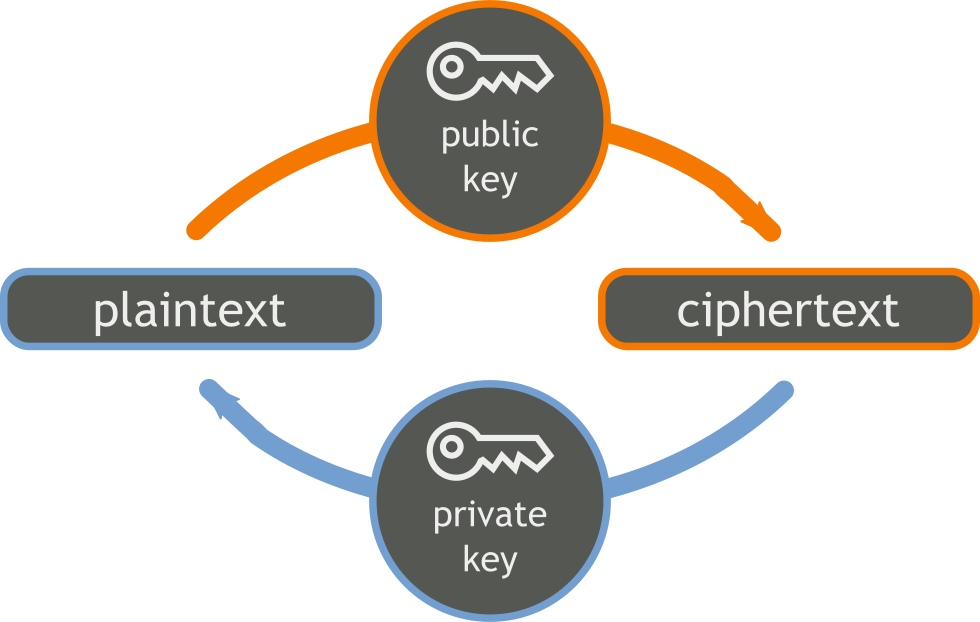 Public key cryptography: the asymmetric encryption model is the basis of differential privacy and homomorphic encryption techniques applied in AML
AML in critical applications
The urgency of AML is greatest in systems where an incorrect prediction has serious consequences:
-
Autonomous driving: vehicle vision systems must be robust against modified signs or extreme environmental conditions.
-
Medical diagnosis: image analysis models used in radiology must be auditable and resistant to adversarial examples.
-
Financial fraud detection: attackers may actively probe boundary cases to identify the model’s decision boundaries.
-
Content moderation systems: adversarial pressure is constant, malicious actors continuously search for variations that escape filters.
For systems with data distributed across multiple organisations, federated learning introduces additional adversarial robustness challenges that require specific defences in the aggregation process.
Conclusion
Adversarial machine learning is an indispensable security discipline for any AI system deployed in production. Attacks are real, the techniques to execute them are publicly documented, and the consequences in critical systems can be severe. The most effective defence combines adversarial training, input distribution monitoring, and designing systems that fail safely when the model has low confidence.
This article is also available in Spanish: Aprendizaje de Máquina Adversarial (AMA): Desafíos y Soluciones.