What Is an AI Agent?
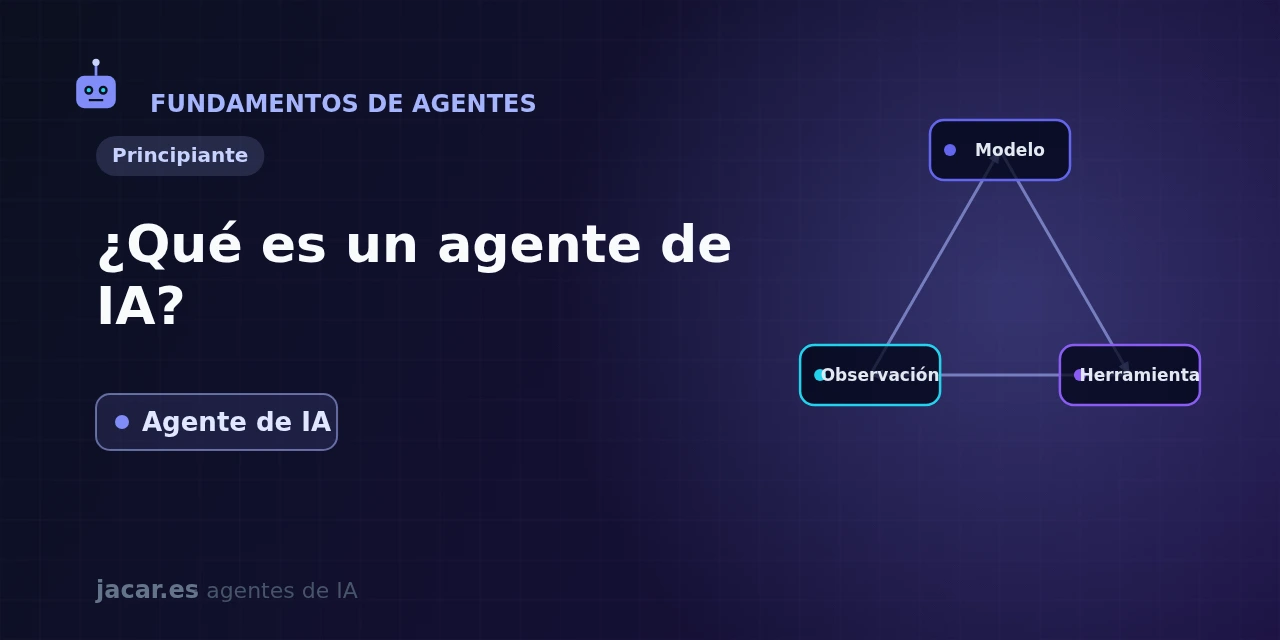
Table of contents
- Key takeaways
- What is an AI agent and how is it different from a chatbot?
- The components: model, tools, memory and loop
- Level of autonomy: from copilot to autonomous agent
- Real use cases in 2026
- Limits and risks
- Frequently asked questions
- Is an AI agent the same as a chatbot?
- Do I need to know how to program to use an AI agent?
- What kind of model do I need to drive an agent?
- Conclusion
- Sources
An AI agent is a program that uses a language model as its brain to pursue a goal on its own. It reasons about what to do, calls external tools, observes what they return and repeats that cycle until the task is done. The difference from a chatbot is that it does not just reply; it decides and executes steps.
In this guide you will see what sets an agent apart from a plain chat assistant. You will also see what its four components are, how its level of autonomy is measured and what limits are worth keeping in mind. The same explanation is available in Spanish.
Key takeaways
- An AI agent uses a language model to choose for itself the sequence of actions that bring it closer to a goal, instead of following a fixed script written by a programmer.
- According to Anthropic, an agent is a system where "the model dynamically directs its own processes and tool usage", as opposed to a workflow, where those steps are fixed in code.
- Its four parts are the model (the brain), the tools (functions and APIs it can call), the memory (the context it carries) and the loop that ties them together.
- The pattern that popularised this cycle is ReAct (reason and act), introduced in a 2022 paper.
- Gartner estimates that by 2028, 33% of enterprise software will include agentic capabilities, up from less than 1% in 2024.
What is an AI agent and how is it different from a chatbot?
An AI agent is a system that receives a goal in natural language and, from there, decides for itself which actions to take to achieve it. At the centre sits a large language model (an LLM) acting as the brain: it interprets the goal, plans a step, executes an action with some tool, reads the result and decides again. That cycle repeats until the task is solved or the agent concludes it cannot make further progress.
The distinction from a chatbot is clear. A chatbot receives a message and returns a text answer: it begins and ends in the conversation. An agent, by contrast, can query a database, run code, search the web or write a file, and it chains those actions one after another without you spelling out each one. The chatbot tells you how to book a flight; the agent goes to the site, fills in the form and confirms the booking.
In its guide Building Effective Agents[1], Anthropic draws a useful line between a workflow and an agent. A workflow orchestrates the model and the tools through predefined code paths: the programmer decides the order of the steps in advance. An agent is a system where the model itself dynamically directs its processes and tool usage, and keeps control over how it reaches the goal. Put another way: in a workflow you own the plumbing in code; in an agent the model owns the plumbing on every iteration.
The components: model, tools, memory and loop
Every agent, however simple, is built from four parts.
The model is the reasoning engine. An LLM like those from Anthropic, OpenAI or Google, or an open model you can run on your own machine with Ollama, decides on each turn what to do next. The better the model reasons, the more reliable the agent.
The tools are the functions and APIs the model can call to act on the world: search the Internet, query a database, run a snippet of code or call an external service. Without tools, the model only generates text; with them, it can do things. The Model Context Protocol (MCP) has become the standard for connecting agents to tools in a uniform way.
The memory is the context the agent carries between steps. In the short term, it holds what it has done in the current task (which tools it used and what they returned). In the long term, it can recall information from earlier sessions, with a vector database as the backing store. Managing that context well is a topic in itself, which we cover in memory in AI agents.
The loop is what ties the previous three parts together. On each iteration the agent reasons about the current state, chooses an action, executes it with a tool, observes the result and decides whether to continue. This reason-and-act cycle is the heart of agentic behaviour, and we detail it in the agentic loop and the ReAct pattern. In pseudocode, a minimal agent fits in a few lines:
def agent(goal, tools, model):
    memory = [goal]
    while True:
        # the model reasons and decides the next action
        decision = model.decide(memory, tools)
        if decision.kind == "finish":
            return decision.answer
        # run the chosen tool and observe the result
        observation = tools[decision.name](decision.args)
        memory.append(observation)
Notice there is no script with the steps written by hand: the order of the actions is decided by the model on each turn of the while, based on what it observes. That is the essence of an agent.
Level of autonomy: from copilot to autonomous agent
Not every system we call "agentic" has the same degree of independence. It helps to think of a scale, similar to the autonomous-driving levels of cars, running from the passive assistant to the agent that acts on its own.
At the lowest level sits the copilot: it suggests, but executes nothing by itself. A code autocomplete that proposes the next line fits here; you decide whether to accept. One step up is the assistant that acts with approval: it proposes a concrete action (delete a file, send an email) and waits for your confirmation before carrying it out. This human checkpoint is a good safety practice.
At the highest level is the autonomous agent: it receives a goal, plans, executes a series of actions and self-corrects when something fails, all without asking permission step by step. A coding agent that receives a bug report, locates the cause, writes the patch and runs the tests is an example. The more autonomy you grant, the more work you delegate, but the more it matters to watch what it does and to limit its permissions. Anthropic’s practical rule is to start with the simplest option and only move up a level when the task truly demands it.
Real use cases in 2026
Agents have stopped being a lab demo. The most mature case is that of coding agents: tools that receive a programming task, edit the affected files, run the tests and repeat until they pass. Their progress is measured in benchmarks like SWE-bench Verified, a set of real GitHub issues. The best agents already solve more than 70% of those cases, when two years ago they barely reached 20%.
Beyond code, agents are used for research (searching dozens of sources and writing a cited summary) and for customer support (resolving an issue by consulting the internal systems involved). They also cover office process automation and data-analysis tasks. In March 2025 OpenAI released its tools for building agents[2], with an API and an open SDK, a sign of how seriously the industry takes this format. If you want to start building one, the Anthropic agent SDK guide is a good starting point, and to coordinate teams of agents there are frameworks like LangGraph or CrewAI.
The market forecast agrees. Gartner estimates that by 2028, 33% of enterprise applications will include agentic AI, up from less than 1% in 2024. It also predicts that by then 15% of everyday work decisions will be made autonomously, when in 2024 that figure was 0%.
Limits and risks
An agent inherits the weaknesses of the model that drives it and adds a few of its own. The first is reliability.
Since the model decides each step, a reasoning error can derail the whole chain. An agent that executes wrong actions does more harm than a chatbot that merely gives an incorrect answer. That is why human oversight of sensitive actions matters so much.
The second is cost and latency. Each turn of the loop is at least one call to the model, so an agent that takes twenty steps consumes far more than a single answer, both in money and in time. The third is security: an agent with access to tools and to the Internet widens the attack surface, and techniques like prompt injection can manipulate it into acting against you.
These risks explain a figure worth remembering. Gartner predicts that more than 40% of agentic AI projects will be cancelled before the end of 2027, due to runaway costs, unclear business value or inadequate risk controls. The lesson is not to avoid agents, but to apply them where autonomy adds real value and to carefully bound what they can do.
Frequently asked questions
Is an AI agent the same as a chatbot?
No. A chatbot receives a message and returns text: its job begins and ends in the conversation. An agent uses a model to decide actions and executes them with tools (search, query data, write files), chaining one step after another toward a goal. There are modern chatbots that embed agentic capabilities, so the boundary blurs, but the key idea is that an agent acts on the world, it does not just talk.
Do I need to know how to program to use an AI agent?
To use ready-made agents, such as a coding assistant inside your editor or a research agent, you do not need to program: giving it instructions in natural language is enough. To build your own agent, some Python or JavaScript does help, because you will have to define the tools it can call and wire up the model. There are also visual platforms that let you assemble agents by dragging blocks, with hardly any code.
What kind of model do I need to drive an agent?
Any language model capable of calling tools (function calling) will do. High-end commercial models are today the most reliable for reasoning step by step, but there are also open models you can run locally with Ollama that support tools. The rule: the better the model reasons, the less the agent derails on long tasks.
Conclusion
An AI agent is, at bottom, a language model you have given a goal, some tools and a loop to use them: it reasons, acts, observes and repeats until it is done. That ability to decide its own steps is what separates it from a chatbot and what opens the door to automating tasks that used to require a person to chain actions by hand. It is also what introduces its risks, so the key is to grant it just enough autonomy and to watch what it does. The natural next step is to understand the cycle that drives it: continue with the agentic loop and the ReAct pattern and try building your first agent with the Anthropic SDK.