Collaborative robotics on the factory floor: 2026 balance sheet
Actualizado: 2026-05-03
Collaborative robotics — cobots, in industry shorthand — has been promising to change the shape of the factory for over a decade: fenceless machines, programmable by operators without robotics training, deployable in weeks rather than months. In 2026, with a global market ABB places at 2.8 billion dollars[1] heading toward 10.9 billion by 2033 (21.4% CAGR) and the IFR reminding us[2] that 70% of recent orders come from outside automotive, it’s worth assessing which parts of the promise have landed and where the blind spots remain.
Key takeaways
- 70% of cobots sold in 2025-2026 go to sectors other than automotive: electronics, pharma, logistics, and industrial SMEs.
- Generative AI in the control loop — natural language for programming trajectories — is the most meaningful leap of the last two years.
- Total cost of a productive cell still sits at €50k–90k, with no structural drop versus five years ago.
- The 2025 revision of ISO 10218 unifies collaboration modes and cuts commissioning to 4-6 weeks.
- Precision, payload, and speed remain the three structural limits not moving at narrative pace.
From automotive to the rest of the world
The most meaningful data point of 2025-2026 isn’t aggregate growth — every sector report has been predicting double-digit CAGRs for years — but distribution. During the first decade, cobots lived mostly in automotive plants: repetitive operations, high volume, machinery investment assumed as cost of business. In 2026, 70% of units shipped go to:
- Consumer electronics.
- Consumer goods.
- Pharma.
- Logistics.
- Industrial SMEs.
The diversification has two practical consequences. First, use cases have expanded beyond assembly: sector reports[3] document deployments in precision dispensing, 3D printing, visual quality control, inspection, palletising, and manipulation. Second, the buyer is no longer the expert engineer at a large auto plant; it’s a production lead at a mid-size factory without a dedicated robotics team. This is the defining shift of 2026: cobots stopped being sold to specialists and started being sold to generalists.
The real leap: generative AI in the control loop
The recurring promise of the last five years was “cobots that program without programming”. For much of that time what existed was mostly marketing: drag-and-drop interfaces still requiring understanding of coordinates, reference frames, and trajectories. What has changed in 2025-2026 is that large language and vision models have reached the control loop.
ABB describes its AVR™[1] as a system combining:
- 3D AI vision.
- Force sensing.
- Natural language interfaces.
- Edge-cloud intelligence for real-time decisions.
Doosan and other vendors have shipped similar layers. In practice this means an operator can say “pick this part, rotate it 90 degrees, and place it on that rail” and the system, with a camera overhead, interprets the scene and executes.
The important nuance is that this does not eliminate traditional programming; it complements it. For well-characterised, repetitive, safety-critical tasks, explicit programming still wins because determinism is an advantage. For low-frequency tasks, rapid reconfigurations, or work where environmental variability is high, natural-language control is a genuine productivity leap.
Costs fell, but less than the narrative claims
Public coverage has hammered that cobots get cheaper every year. The reality, per Standard Bots’ pricing guide[4], is more nuanced:
- A mid-range cobot still costs between $25k and $45k in hardware alone.
- Real integration — mounting, end effectors, safety cells, MES/ERP connection, training — typically adds as much again.
- Total deployment cost of a productive cobot cell sits at $50k-$90k today, not dramatically different from five years ago.
What has dropped sharply is the entry cobot cost: basic models for light tasks can be had under $15k. Typical ROI for well-chosen use cases still sits between 12 and 24 months, with bias toward the shorter end in 2026 thanks to the programming savings AI enables.
Safety: ISO 10218 and TR 15066
The 2025 revision of ISO 10218 consolidated many elements that previously lived in TR 15066. The consequence is that a cobot maker can now more easily certify conformity for several collaboration modes:
- Protective stop.
- Hand guiding.
- Speed and separation monitoring.
- Power and force limiting.
In practice this doesn’t remove on-site risk assessment; it makes it more reproducible. In 2026 it’s not unusual to see a complete cobot cell — assessment included — ready in four to six weeks, against the three-month norm of five years ago.
Limits that haven’t moved
It’s tempting to assume the curve keeps rising without ceiling. Three structural limits aren’t moving at narrative pace:
- Precision: cobots offer repeatability around 0.03–0.05 mm on industrial models. Enough for many applications but not for microelectronic assembly or fine metrology.
- Payload: most cobots operate with 3–25 kg payloads. Beyond that, safety trade-offs increase sharply.
- Speed: power and force limiting imposes a speed ceiling when humans are nearby. The most productive cells operate in “speed and separation monitoring” mode: the cobot slows when it detects a human nearby and accelerates when alone.
Typical 2026 stack
For an industrial SME deploying for the first time, the stack appearing most often combines:
- A cobot from a European or Asian vendor with real local support.
- An interchangeable end effector (gripper, suction, screwdriver tool).
- 3D camera for vision.
- Force sensor if the task requires.
- The vendor’s natural-language programming interface.
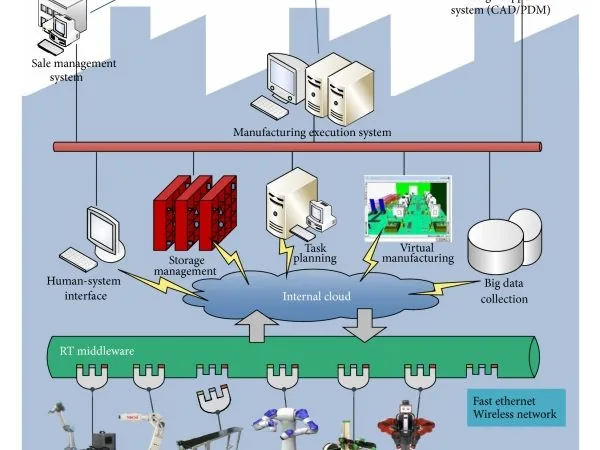
- An ERP/MES connection to receive work orders and report metrics.
The usual integration pattern is commissioning the first cell with a local integrator, using it to validate the use case and learning curve, then internalising subsequent cell deployments. Factories that get this first step right typically have three to four cobot cells operating within two years.
What to have answered before buying
Before signing an order, three questions deserve data-backed answers rather than intuition:
- What exactly is the process being automated? Measured in times, frequencies, and variability.
- What’s the acceptable availability loss? Cobots aren’t immortal — there’s preventive maintenance, spare parts, calibrations.
- What’s the expected transition for the human who does the task today? In successful installations this person usually moves to supervision or QA, and that continuity counts toward acceptance on the shop floor.
Conclusion
Collaborative robotics in 2026 is a mature technology in well-chosen applications and still immature in ambitious ones. The recent leap — generative AI in the control loop, diversification beyond automotive, stabilised integration costs — consolidates cobots as a real option for mid-size factories, not only large ones. The decision is no longer “whether” but “where” and “when”: choose the first use case well, measure the result honestly, and scale from that base.