
Learning path Beginner
AI Agents Fundamentals
What an AI agent is and how it reasons: the agentic loop and ReAct, planning and task decomposition, reflection, memory, human oversight, context engineering and multi-agent patterns.
- 9 resources
- 1 views
- ~83 min
From zero to AI agent fundamentals
An AI agent is a system that uses a language model to decide what to do step by step, not just to answer a single question. This beginner-level path explains, with concrete examples, how these systems reason and what pieces make them up. It is built for anyone who has already used ChatGPT or a similar assistant but has never designed an agent of their own.
What you will be able to do by the end
By the end of the path you will understand the vocabulary and the core mechanisms behind any agent framework, such as LangChain, AutoGPT or CrewAI: why an agent needs a reasoning loop, how it decides which action to take, and when it should ask a human for help. No coding experience or prior use of an AI API is required, just curiosity about how these systems work under the hood.
How the path builds
It starts with the most basic question, what an AI agent is, then moves straight into the agentic loop and the ReAct pattern, the mechanism that alternates reasoning and acting on every turn. From there the path covers how an agent plans and breaks down complex tasks into manageable steps, and how the reflection pattern lets it review its own work before committing to it. The final stretch raises the bar: short and long term memory, when a human should step in, and how several agents coordinate their work together.
Multi-agent systems, where several models split the work between them, are already the dominant pattern in production agents in 2026, which is why they close out this introduction to the fundamentals.
What Is an AI Agent?
An AI agent is a program that uses a language model as its brain to decide for itself which steps to take toward a goal: it reasons, calls external tools, observes the result and repeats that loop until it is done. Unlike a chatbot, it does not just answer; it acts.
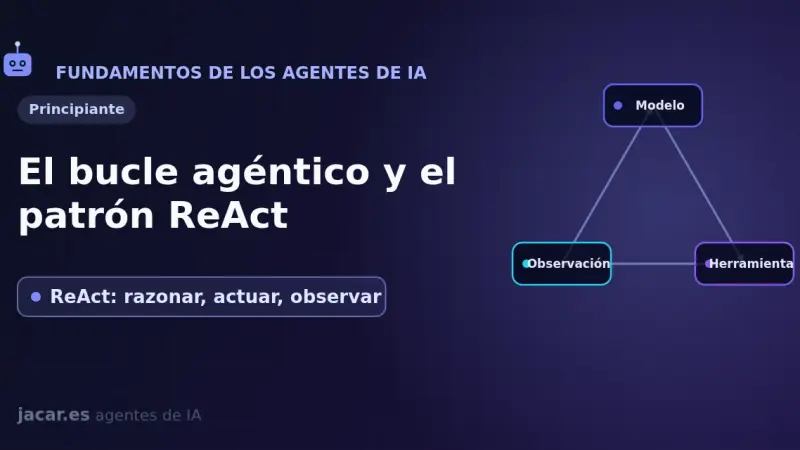
The Agentic Loop and the ReAct Pattern
The ReAct pattern (Reason + Act) organizes an agent as a repeating three-step loop: reason about what to do, take an action with a tool, and observe the result. Introduced by Yao and colleagues in 2022, it interleaves reasoning and acting so the model can plan, consult external sources, and fix its own mistakes as it goes.
Planning and Task Decomposition in Agents
Planning lets an AI agent solve long tasks: instead of improvising step by step, it first breaks the goal into an ordered list of subtasks and then runs them. The planner-executor pattern separates thinking from acting, cuts the number of model calls and lets the agent replan when a step fails midway through the job.
The Reflection Pattern in AI Agents
The reflection pattern makes an agent critique its own output and rewrite it before accepting it. One model generates, a second step evaluates and flags mistakes, and a third revises, in a loop of one or two rounds. It improves quality on tasks with clear criteria, but each cycle adds model calls, tokens and latency.
Memory in AI Agents: Short and Long Term
Memory is what lets an AI agent remember beyond a single conversation. Its working memory is the context window, ephemeral and limited; its long-term memory stores facts, experiences and procedures in an external store, almost always a vector database, and retrieves them when they are needed to keep acting coherently.
Human-in-the-Loop in AI Agents
Human-in-the-loop is the pattern that keeps a person inside an AI agent's decision loop: the agent stops at an approval point before an irreversible action, waits for your confirmation and resumes with its state intact. Frameworks such as LangGraph and OpenAI's Agents SDK implement it with interruptions and tool approval.
Context Engineering for Agents
Context engineering is the craft of deciding what information enters a model's window at each step of an agent. Beyond prompt engineering, it manages the whole set of tokens: instructions, tools, memory and history. Its goal is the smallest possible set of high-signal tokens that still completes the task.
Plan-and-Execute versus ReAct
ReAct and plan-and-execute are the two control patterns for an AI agent. ReAct decides one step at a time, reasoning and acting in a loop; plan-and-execute draws up a full plan first and then executes it step by step. The former adapts better to surprises; the latter uses fewer calls and plans long tasks with more order.
Multi-Agent System Patterns
A multi-agent system splits a task across several specialised agents coordinated by a design pattern. The three most common are orchestrator-workers, where a lead agent delegates to parallel subagents; hierarchical, with teams of teams; and network, where any agent hands control to another through a handoff.