Digital Thread: Industry 4.0 Beyond the Twin
Actualizado: 2026-05-03
Two terms coexist in Industry 4.0: digital twin and digital thread. The first has dominated attention; the second, equally important, is less known. A digital twin is a replica of a specific physical asset. A digital thread is the data continuity connecting all twins and systems across the product lifecycle — from design to retirement.
This article explains what the digital thread is in practice, how it differs from the twin, what it specifically delivers, and how to start without falling into three-year projects that die of their own complexity.
Key Takeaways
- The digital thread is not a product: it is a data architecture that joins PLM, MES, ERP, IIoT, and service under a common identifier.
- The difference from the digital twin is scope: the twin replicates one asset; the thread connects the entire product-life chain.
- Standards (OPC UA, Asset Administration Shell) dramatically reduce integration cost.
- The most common mistake is trying to connect all systems at once; one end-to-end use case is worth more than a 50-system roadmap.
- Without data governance and organisational alignment, technology solves nothing.
Twin vs Thread: The Key Difference
A digital twin groups a 3D model plus real-time data from a specific machine, predicts behaviour, detects anomalies, and is useful locally: “this pump is degrading”.
A digital thread does something different: it provides traceability of an item across multiple systems (PLM, MES, ERP, IIoT, maintenance, support), connects “what we designed” with “what we manufactured”, “what we sold”, “what failed” and “what we improved”, and is useful organisationally: “why does batch X fail after a year?” — with a direct link to design, materials, manufacturing process, and field data.
The two complement each other. A twin without thread is isolated local information. A thread without twins is traceability without detail.
Why It Really Matters
Five value cases only the digital thread delivers completely:
- Quality retrospective. A component fails in the field. The thread goes from repair → serial number → manufacturing batch → process parameters that day → CAD version → raw material supplier. In minutes, not weeks.
- Design optimisation. Engineering accesses aggregated real usage data: which features are used, which fail, what to adjust in the next model.
- Regulatory compliance. Complete traceability for audits in aerospace, pharma, and automotive.
- Recurring services. As manufacturer, you know the real state of every sold unit and can sell predictive maintenance as a service.
- Circular economy. You know what materials each unit contains for end-of-life management.
Typical Architecture
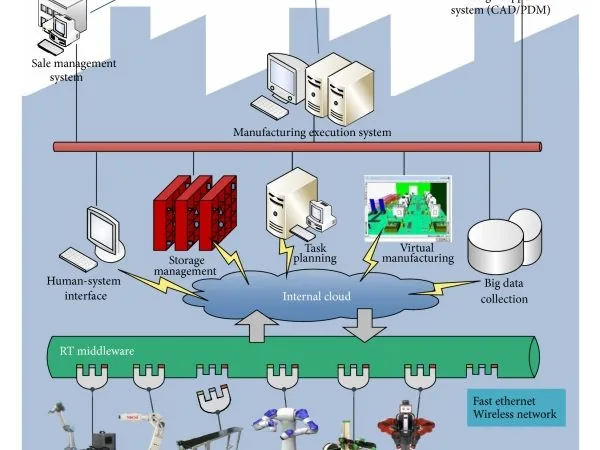
A digital thread is not a product — it is a data architecture. Its common components:
- PLM (Product Lifecycle Management): Siemens Teamcenter, Dassault ENOVIA, PTC Windchill.
- ERP: SAP, Oracle. Commercial and financial information.
- MES (Manufacturing Execution System): Siemens Opcenter, Rockwell FactoryTalk.
- IIoT: plant sensors and machine digital twins.
- Service systems: CRM, support tickets, field maintenance.
- Integration layer: API gateway, event streams (Kafka), ESB.
- Data fabric: analytical storage for cross-system queries.
The modern pattern is event-driven: each system emits events about its scope; an integration layer correlates them by serial_number or batch_id; analytical consumers (data warehouse, ML) read the complete sequence.
Standards That Reduce Cost
Without standards, the digital thread becomes endless custom integration. The most relevant:
- OPC UA[1]: industrial system communication with standardised information models.
- AutomationML[2]: industrial engineering modelling.
- QIF[3] (Quality Information Framework): quality and measurement traceability.
- ISO/IEC 15288 (lifecycle processes) and ISO 10303 (STEP for CAD).
- Asset Administration Shell[4]: model for interoperable industrial twins.
Implemented standards mean cheaper integration every year; without them, maintenance cost grows without ceiling.
Starting Without Drowning
The most common mistake is trying to connect everything at once. A practical start has five steps:
- Choose a critical product or family where thread value is tangible and demonstrable.
- Identify three key systems (for example, PLM, MES, and service), not ten.
- Define a thread identifier — the
serial_numberorbatch_idthat navigates all systems. - Build a first end-to-end use case — for example, “see the complete history of this unit”.
- Iterate adding systems and use cases with proven value.
A year later you have real digital thread in one product line. That result is worth more than a three-year project that never finishes.
Real Obstacles
The problems are not primarily technological:
- Organisational silos. Design, manufacturing, commercial, and service are departments with different systems and cultures. The thread forces them to talk.
- Legacy data quality. Old systems have dirty, inconsistent data. Cleaning represents 30% of the project.
- Shared semantics. “Batch” in production does not mean the same as “batch” in logistics. Aligning meanings is human work, not technical.
- Sustained investment. Not a point project: it is a growing capability.
- Diffuse ROI. Benefits are sometimes indirect (better design, fewer recalls). Justifying the business case demands discipline.
Security and Intellectual Property
A digital thread exposes highly sensitive information: specifications, process parameters, real customer usage. Minimum requirements include:
- Data classification determining which threads cover public, internal, confidential, or restricted information.
- Role-based access — engineering sees design; service sees field; nobody sees everything.
- Audit of access to the thread itself.
- Encryption in transit and at rest mandatory.
Governance is as important as technology.
Conclusion
The digital thread is the next maturity level after the twin. It connects data across the product lifecycle and unlocks value no isolated piece can deliver. Implementing it well requires strategic perspective, pragmatic initial-scope selection, and standards commitment to avoid eternal integration. Companies that do this well gain a real advantage: continuous knowledge of their products that their competitors lack.