Google ADK (Agent Development Kit) is Google's open-source framework for building, evaluating and deploying AI agents. It is code-first, works with Gemini and other models via LiteLLM, and offers workflow agents, tools and memory. Version 2.5.0 landed in July 2026 and deploys straight to Vertex AI.
smolagents is Hugging Face's agent library: in under a thousand lines of code it lets you build an agent that reasons by writing Python instead of filling in JSON. Its CodeAgent runs those actions as code, takes around 30% fewer steps than classic tool calling and works with any model, local or API.
Planning lets an AI agent solve long tasks: instead of improvising step by step, it first breaks the goal into an ordered list of subtasks and then runs them. The planner-executor pattern separates thinking from acting, cuts the number of model calls and lets the agent replan when a step fails midway through the job.
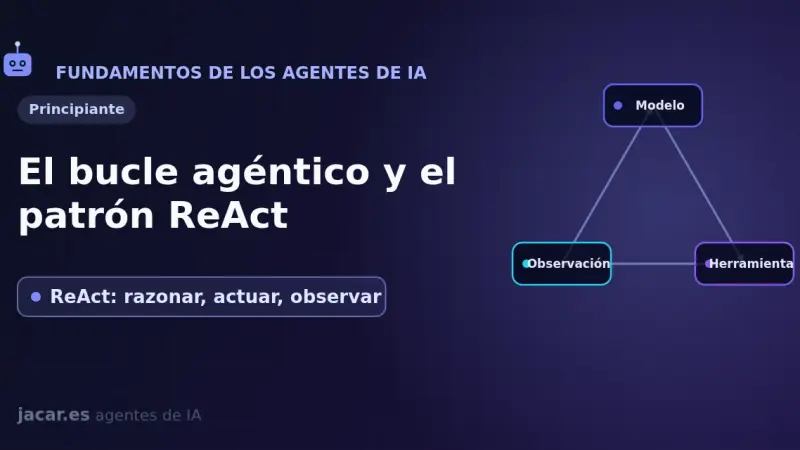
The ReAct pattern (Reason + Act) organizes an agent as a repeating three-step loop: reason about what to do, take an action with a tool, and observe the result. Introduced by Yao and colleagues in 2022, it interleaves reasoning and acting so the model can plan, consult external sources, and fix its own mistakes as it goes.
Computer Use is the Claude API feature, launched by Anthropic on 22 October 2024, that lets the model view screenshots and move the mouse, type, and click inside a loop your own system executes and controls. It works well on apps without an API and fails on CAPTCHAs, highly dynamic interfaces, and long tasks.
CrewAI modela agentes como un equipo con roles y tareas. Cómo se compara con LangGraph y AutoGen, y cuándo merece la pena adoptar un patrón multi-agente.
OpenAI's Assistants API offers persistent threads, sandboxed code execution, and managed document search, but OpenAI is shutting it down completely on August 26, 2026 in favor of the Responses API. We look at when it used to pay off against Chat Completions with your own infrastructure, and what to do if your project still depends on it.
LangGraph modela agentes LLM como grafos de estados explícitos. Cuándo supera al bucle tradicional de LangChain y cómo estructurar flujos que no se desmoronan en producción.
4 min2014.3
We use first- and third-party cookies to analyze site traffic. You can accept them, reject them, or configure your choice.
Learn more about cookies
Cookie preferences
NecessaryEssential for the site to work. Always on.
AnalyticsHelp us understand how the site is used (Google Analytics).