Private 5G networks: enterprise deployments in 2025
Actualizado: 2026-05-03
After several years of corporate pilots, press releases, and technology that was always about to take off, in 2025 private 5G networks start to appear in factories, ports, and warehouses with implementations that actually work and provide measurable value. It’s not the revolution the telco industry promised in 2020, but neither is it the fiasco some predicted. It’s a useful technology for a bounded set of cases, expensive in others, and above all much more mature in deployment than two years ago.
For the broader industrial connectivity context, the analysis of WireGuard mesh networks describes the VPN alternative for connecting distributed nodes. The Industry 4.0 pattern where private 5G fits as a connectivity layer is covered in digital twins of the plant. Network security in industrial environments connects with Zero Trust and SIEM integration.
Key takeaways
- Spectrum concession simplification in Spain and the EU since 2025 reduces timelines to weeks; previously it could take months.
- Small base station price (50–200 m coverage) has dropped 30% versus 2023; half a dozen manufacturers now have public catalogs.
- Private 5G beats WiFi 6E in three scenarios: coverage in metal-heavy environments, deterministic latency under load, and seamless mobility between antennas.
- Minimum initial cost for a comparable private 5G network starts at €100,000; equivalent industrial WiFi is built for €20,000–50,000.
- Best cases: logistics in ports and large warehouses, dense-automation manufacturing, large outdoor mobile environments.
What has changed in 2025
The first thing that has changed is spectrum availability. In Spain, Germany, France, the UK, and Nordic countries there are bands reserved for private industrial use. From 2025 the procedure has simplified and concession times have dropped to weeks in many jurisdictions. For a medium industrial company this changes the calculation: two years ago you had to choose between operating with a carrier (with recurring cost) or fighting the regulator; now the second option is reasonable.
The second is equipment availability. In 2023 the market for small 5G base stations adapted to industrial sites had few players and opaque prices. In 2025 there are half a dozen manufacturers with public catalogs, including very competitive Chinese alternatives and pricier European options with local support. The price of a small base station covering 50–200 meters has dropped 30% versus 2023.
The third is integration. Application-layer gateways translating between industrial protocols — Modbus, OPC UA, Profinet — and modern APIs over 5G are more numerous and better documented. It’s no longer necessary to integrate each thing by hand; there are providers with vertical kits for retail, logistics, and manufacturing.
What it does well that WiFi doesn’t
The honest argument in favor of private 5G versus WiFi 6E has three legs:
Coverage in heavy-metal sites. A warehouse with dense metal structure, large machinery, and many walls is a hostile environment for WiFi. In a plant where the transition from industrial WiFi to a private 5G network was made, access points dropped from 40 to 12, and coverage became more stable.
Deterministic latency. WiFi can have low latency when there’s no congestion, but degrades with many clients competing. Private 5G maintains stable latency under load thanks to how it manages the medium. For applications depending on predictable latency — autonomous forklifts, machine vision with immediate action, remote equipment control — this is a differentiator.
Mobility between antennas. The handover between 5G points is invisible to the client; in WiFi the handover usually involves a short interruption that can break long sessions. For devices that move across the plant, like mobile robots or warehouse staff tablets, this difference accumulates into minor incidents that disappear with 5G.
Where WiFi 6E still wins
WiFi 6E is far from dead. It wins in three contexts:
- Operational familiarity: every systems team knows how to manage a WiFi network. A private 5G network requires knowledge not common outside the telco sector: SIMs, slicing, core, SUCI/SUPI authentication.
- Initial cost: an industrial WiFi network for a medium warehouse is built with €20,000–50,000 of equipment. A comparable private 5G network starts at €100,000 and rises quickly.
- Offices and medium warehouses: where device density is moderate and cost is critical, WiFi 6E is clearly the right option.
Real cases where it pays off
The cases where private 5G pays off cluster in three families:
- Logistics in ports and large warehouses: where crane and autonomous forklift movement is continuous and coverage distance is large. Latency determinism and stable coverage in motion are decisive.
- Manufacturing with dense automation: where dozens of robots cooperate and each has real-time demands. Slicing allows reserving capacity dedicated to critical traffic, separating it from ordinary corporate traffic.
- Large mobile outdoor environments: like large construction sites or mines, where fiber deployment is unfeasible and WiFi can’t reach.
How it’s typically deployed
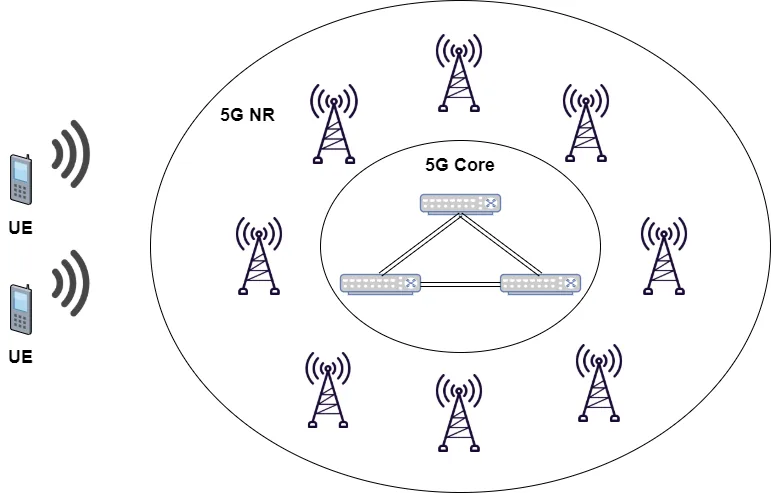
The most common deployment pattern in 2025 has three layers:
- Radio layer: one or several base stations covering the site, fed with fiber and redundant power.
- Core layer: a small 5G standalone core managing authentication, routing, and quality-of-service policy. This core usually runs as software on edge servers on the site itself, keeping the entire control plane within the company.
- Application layer: devices are a mix of terminals with integrated SIM and gateways connecting equipment without native cellular support.
Security is layered: SUCI encryption at radio level, separation by slicing at network level, and firewall and authorization policies at application level. Isolation from the carrier is total.
The points where it hurts
Three points where the implementation hurts:
- Integration with the rest of the corporate network: the private 5G network lives in its own IP domain and you have to think carefully about how it connects with the office LAN, datacenter servers, and internet egress.
- Dependency on specialized providers: commissioning involves a telco-experienced integrator who locks in the vendor, timelines, and often the later operational model.
- Long-term support: an industrial 5G base station rarely exceeds six or seven years before the manufacturer recommends renewal. This cost must be in the initial calculation.
My read
Private 5G in 2025 is a mature technology for a bounded set of cases. If the company has a clear industrial use case, with needs for large coverage, real mobility, or deterministic latency, the investment is justified and the deployment path is reasonable. If the case is connecting offices or providing WiFi for a medium warehouse, WiFi 6E is still the right answer by a wide margin.
The practical criterion I use is asking about the business metric that will improve. If the answer includes words like autonomous crane, mobile robot, real-time machine vision, or mine, private 5G deserves deep study. If the answer is general connectivity, roaming between buildings, open offices, the answer is WiFi 6E.
What will happen is that private 5G consolidates as a vertical option for industry, logistics, and construction, without displacing WiFi on its turf. The dedicated private band changes the economics in a way that wasn’t viable for medium companies two years ago and is now.