Industry 4.0: The Digital Industrial Revolution
Actualizado: 2026-05-03
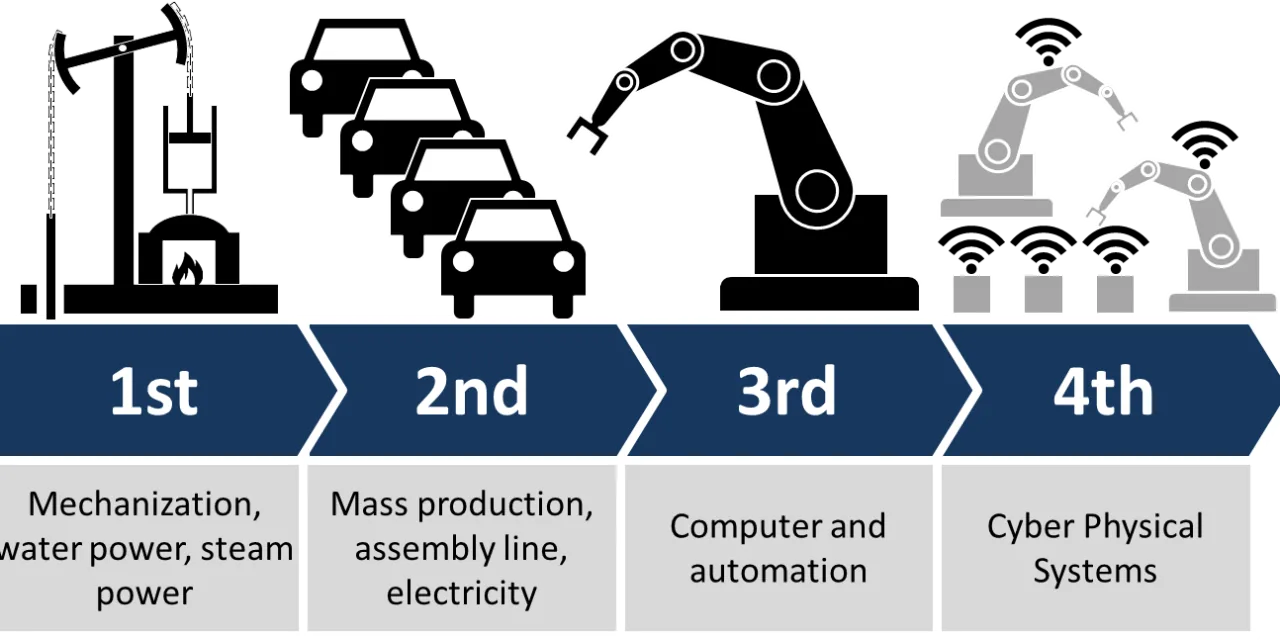
Industry 4.0, also known as the Fourth Industrial Revolution, is a new form of production that combines advanced digital technologies to transform manufacturing processes. From intelligent automation to the Internet of Things, this convergence opens opportunities across sectors as varied as manufacturing, energy, healthcare, and logistics.
Key takeaways
- Industry 4.0 is not a single technology but a convergence: IoT, AI, big data, advanced robotics, and cybersecurity working in an integrated way.
- The central goal is the smart factory: production systems that self-adjust in real time based on the data they collect.
- The benefits are real, but implementation requires investment, cultural change, and team training.
- Cybersecurity is the most underestimated risk: connecting production equipment to digital networks expands the attack surface.
- The Digital Twin is one of the most powerful Industry 4.0 applications — it lets you simulate production changes before implementing them.
What is Industry 4.0?
Industry 4.0 is a productive transformation framework that connects traditional manufacturing systems with advanced digital technologies. The term was coined in Germany as part of a government strategy to modernise the manufacturing industry, and has become a global reference.
The technologies that articulate it are:
- Big data and predictive analytics: collecting and analysing large data volumes to optimise processes and anticipate failures.
- Industrial Internet of Things (IIoT): connected sensors and devices that monitor equipment in real time.
- Artificial intelligence and machine learning: models that detect anomalous patterns, optimise production routes, and improve quality.
- Advanced and collaborative robotics: robots that work alongside human operators, adapting to line changes.
- Additive manufacturing (3D printing): production of unique components or small batches without traditional tooling costs.
- Industrial cybersecurity: specific protection for OT (Operational Technology) environments connected to IT networks.

Uses and benefits
Implementing Industry 4.0 produces measurable benefits across multiple dimensions:
- Productivity: continuous monitoring and automatic parameter adjustment reduce cycle times and eliminate bottlenecks.
- Quality: computer vision systems detect defects in real time before the product advances down the line.
- Predictive maintenance: IIoT sensors detect vibrational or thermal anomalies that predict failures before they happen, reducing unplanned downtime.
- Energy efficiency: real-time consumption analysis identifies savings opportunities in machines, lighting, and climate control.
- Production flexibility: smart lines can be reconfigured for different products without extended downtime.
Implementation challenges
Industry 4.0 doesn’t implement without friction. The main obstacles companies encounter are:
- High initial investment: sensors, analytics software, connectivity, and training represent a significant outlay, especially for SMEs.
- Cultural and skills change: factory operators need digital tool training; IT teams need to learn to work with OT environments.
- Legacy system integration: industrial plants have equipment decades old with no native connectivity — adapting or replacing it is costly.
- Cybersecurity: connecting production equipment to digital networks considerably expands the attack surface. A cyberattack on a connected plant can halt physical production.

The Digital Twin: Industry 4.0 applied to the organisation
One of the most powerful Industry 4.0 applications is the Digital Twin: a virtual replica of the plant, production line, or even the complete organisation. The Digital Twin synchronises real data in real time and allows scenario simulation — configuration changes, new products, different cadences — before physical implementation. This concept is explored in depth in the article on the Digital Twin of the Organisation.
For organisations working with data at scale, federated learning approaches allow training AI models without centralising sensitive production data.
Conclusion
Industry 4.0 is not a passing trend: it is the structural direction of modern manufacturing. Companies that integrate IoT, analytics, and intelligent automation gain in productivity, quality, and market responsiveness. The main risk is not technological but operational: tackling transformation without planning the investment, training, and cybersecurity condemns the project to failure.