Industry 4.0 Concepts: The Digital Twin of the Organization
Actualizado: 2026-05-03
The Digital Twin of the Organization (DTO) is one of the most advanced applications of Industry 4.0: a complete virtual replica of the company that synchronises with real data in real time and lets you simulate any scenario before physically implementing it. From optimising production lines to anticipating supply chain disruptions, the DTO turns the organisation into an object of digital analysis and experimentation.
Key takeaways
- The Digital Twin of the Organization (DTO) goes beyond product or process twins: it models the complete organisation as a dynamic system.
- It requires integrating data from multiple sources: IIoT sensors, ERP, CRM, supply chain data, and production systems.
- The main benefits are scenario simulation, early problem detection, and informed decision-making.
- Successful implementation requires an interdisciplinary team and a well-defined data architecture from the start.
- The DTO does not replace human judgement: it amplifies analytical capacity and reduces uncertainty in decision-making.
The Digital Twin: definition and objectives
The Digital Twin is a technology that creates a virtual replica of a physical system — a machine, a process, a plant, or, in the case of the DTO, the complete organisation — that is updated with real data in real time. Unlike a static simulation model, the digital twin is a living object that reflects the current state of the system.
The main objectives of the DTO are:
- Process optimisation: identify inefficiencies and simulate alternatives without interrupting real operations.
- Early fault detection: predictive models on the digital replica alert to problems before they affect physical production.
- Scenario simulation: evaluate the impact of changes — new products, reorganisations, supplier changes — in a virtual environment before committing real resources.
- Informed decision-making: executives have an integrated, up-to-date view of the organisation for strategic and operational decisions.
- Cost reduction: testing on the digital replica eliminates the cost of failed iterations in the physical world.
Technologies and tools for implementation
Implementing a DTO is not a single technology project: it is the integration of multiple layers. The required technologies include:
- Modelling and simulation software: platforms such as Siemens Teamcenter, Dassault DELMIA, or Azure Digital Twins let you build and manage the digital replica.
- Sensors and IIoT: devices that collect real-time status data from equipment, production lines, logistics environments, and assets.
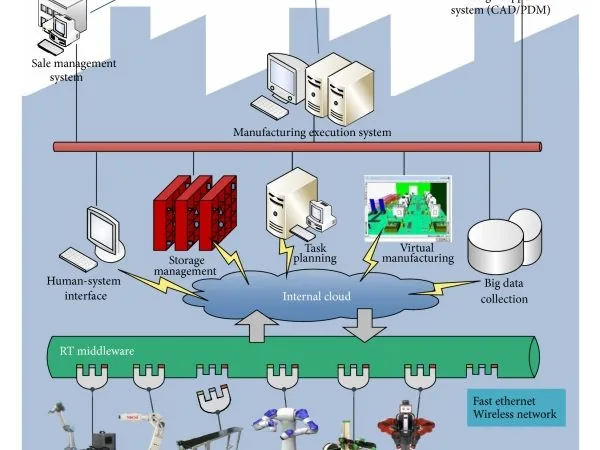
- Data and integration platforms: data lakes, integration pipelines, and APIs that connect existing systems (ERP, MES, CRM) to the digital twin layer.
- Analytics and artificial intelligence: machine learning models that process data in real time to detect patterns, predict failures, and optimise parameters.
- Visualisation interfaces: 3D dashboards or mixed reality environments that let operators interact with the replica intuitively.

The required team combines technical profiles (data engineers, IoT experts, software developers) with deep knowledge of the business and the processes being modelled. Without that domain knowledge, the digital twin models the wrong system.
Concrete benefits of the DTO in the organisation
The Digital Twin of the Organization delivers measurable value across several areas:
- Operational cost reduction: identifying inefficiencies and predictive maintenance reduce unplanned downtime and material waste.
- Improved process efficiency: simulation finds the optimal configuration without costly plant trials.
- Agile market adaptation: the ability to simulate the impact of demand or supply chain changes accelerates decision-making in the face of disruptions.
- Improved collaboration: a common source of truth — the digital replica — makes it easier for different departments (production, logistics, finance) to speak the same language.
- Product and service quality: continuous monitoring and early deviation detection raise quality standards.

Relationship with other Industry 4.0 technologies
The DTO is not an isolated technology but the result of integrating multiple Industry 4.0 capabilities:
- Industrial IoT: sensors are the nerves of the digital twin — without real-time data, the replica goes stale.
- Big data and analytics: the DTO generates and consumes large data volumes; advanced analytics extracts value from that volume.
- Artificial intelligence: computer vision and machine learning models integrated into the DTO detect visual anomalies and optimise parameters autonomously.
- Cybersecurity: the DTO centralises critical organisational data; protecting it from unauthorised access is as important as protecting the physical systems it represents.
For companies handling data distributed across multiple plants or suppliers, federated learning techniques allow training models that feed the DTO without centralising sensitive data.
Conclusion
The Digital Twin of the Organization is the most complete expression of Industry 4.0: it transforms the company into a dynamic system that can be simulated and optimised in real time. Its implementation requires technology investment, data integration, and specialised profiles, but the benefits in efficiency, quality, and responsiveness justify the effort. The key to success lies not in the chosen technology but in the quality of the business modelling and the discipline with which data is kept up to date.