Industry 4.0: IoT Sensors as the Operational Data Foundation
Actualizado: 2026-05-03
“Industry 4.0” has been repeated so much it almost sounds empty. But beneath the marketing, the idea is concrete and useful: instrument physical processes — machines, production lines, warehouses — with connected sensors generating real-time data, and build analytics, predictive maintenance, and optimisation on top. Without that instrumentation foundation, everything else is PowerPoint.
Key takeaways
- Sensor instrumentation is the data foundation of any Industry 4.0 project; without it, no platform is worth anything.
- The protocol ecosystem is fragmented: legacy Modbus, OPC-UA as the modern bet, MQTT as the dominant transport from edge to cloud.
- An edge-broker-cloud topology with local processing reduces cost and improves resilience to network outages.
- Predictive maintenance on rotating electric motors is the “happy path” use case with the most measurable ROI and lowest risk to start.
- Start with 5-10 sensors on a pilot line before buying at scale.
Main Sensor Categories
In typical industrial environments you’ll see these types repeat:
- Temperature: thermocouples, RTDs (Pt100, Pt1000), thermistors. A Pt100 costs ~€30, measures wide range with good accuracy.
- Pressure: gauge, absolute, differential. Typical output 4-20 mA or 0-10 V. Needed in almost any process with liquids or gases.
- Vibration: piezoelectric accelerometers. Foundation of predictive maintenance in motors and bearings. Capture signatures that change before failure.
- Flow: electromagnetic for conductive liquids, non-invasive ultrasonic, vortex for gases. Critical in chemical, food, water industries.
- Position and level: capacitive, inductive, ultrasonic sensors, radar for silos.
- Environmental quality: CO2, VOCs, particulates (PM2.5, PM10). Increasingly relevant in production and offices.
- Energy: three-phase meters, current transducers. Foundation of any energy-efficiency project.
The choice isn’t always obvious: sometimes a less precise but more environment-robust sensor (dirty environment, vibration, extreme temperature) is preferable over a lab-grade one.
Protocols: The Fragmented Ecosystem
Here’s Industry 4.0’s biggest friction. There are dozens of legacy protocols, and coexisting between them consumes project time:
- Modbus RTU/TCP: the historical standard. Simple, reliable, supported everywhere. Still ubiquitous in old PLCs.
- OPC-UA: the modern bet. Cross-platform, rich information model, native security. More vendors support it each year.
- MQTT: lightweight pubsub ideal for sensors transmitting metrics frequently. Dominant in IIoT from edge to cloud.
- HART: superimposed over 4-20 mA — extracts digital data from analog instruments without re-cabling.
- Profibus, Profinet, EtherCAT: high-speed industrial buses for automation. Specific to PLC vendor.
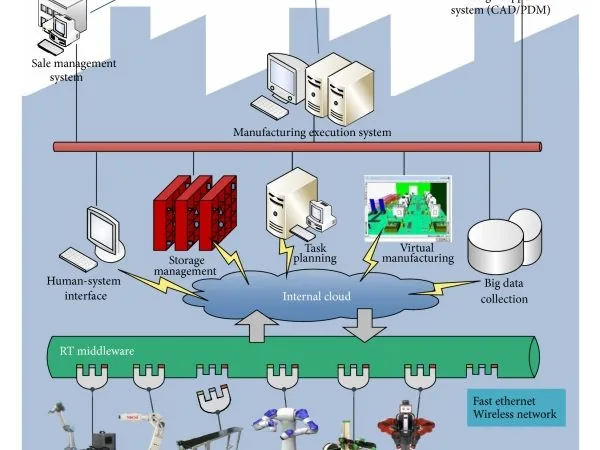
In real projects, you almost always need an IoT gateway translating old protocols to something modern — typically MQTT or OPC-UA → central broker → cloud.
Reference Architecture
A topology that works well in real projects:
Sensors (Modbus/4-20mA/digital)
    │
    └── PLCs / RTUs (read, basic logic)
            │
            └── Edge gateway (Industrial PC with MQTT/OPC-UA)
                    │ (filter, local aggregation)
                    │
                    └── On-site MQTT broker
                            │
                            └── Bridge to cloud (TLS, auth)
                                    │
                                    └── Data platform
                                         (TimescaleDB / InfluxDB)
                                         + dashboards (Grafana)
                                         + alerts
Three key ideas of this architecture:
- Edge processing. Don’t send every raw reading to cloud — aggregate, filter, send only the useful. Cuts cost and improves resilience to network outages.
- Local buffering. If the cloud bridge fails, data accumulates in the local broker and syncs on recovery. Don’t lose data for a temporary outage.
- Security from the start. TLS and authentication between each hop. Industrial networks historically have been flat and open — that model doesn’t scale.

Frequent Errors in Projects
After several instrumentation projects, the problems that repeat:
- Buy before measuring. Teams buying 200 sensors without testing how they integrate with their current system. Start with 5-10 on a pilot line.
- Underestimating wiring. In real environments, taking the sensor signal to the gateway can be more expensive than the sensor itself. Consider radio (LoRaWAN, NB-IoT) when wiring doesn’t pay.
- Ignoring the environment. Office sensors in dust, vapor, vibration, or high-temp areas fail in months. Follow IP certifications (IP65 minimum in industry).
- Not calibrating periodically. Sensors drift. Without a calibration plan, data becomes suspect and trust in the system falls.
- Data without action. Collecting terabytes nobody queries is waste. Define what decision will change before instrumenting.
- OT compatibility. Operational Technology teams (PLCs, SCADA) have their own life cycles and resistance to change. Without aligning with them, the project gets stuck politically.
Typical Case: Predictive Maintenance
A well-defined use case to start Industry 4.0 is predictive maintenance on rotating electric motors:
- Sensor: accelerometer attached to motor bearing.
- Frequency: sample at 10-25 kHz, aggregate per minute to statistics (RMS, kurtosis, FFT bands).
- Indicator: changes in vibration signature precede bearing failures by weeks.
- Measurable ROI: reduction of unplanned stops vs scheduled maintenance on fixed dates.
It’s the “happy path” case because sensor cost is low, the data to collect is clear, and savings are direct. Once demonstrated, the generated data can feed machine learning models for predictive maintenance. The dashboard stack to visualise these metrics is typically built on Grafana and Prometheus.
Conclusion
Industry 4.0 isn’t a technology, it’s the sum of many. The sensor and integration layer is the foundation without which the rest doesn’t work. Start small, measure before buying, scale what proves value. Data platforms come later; without raw data there’s no platform worth having.