How to fix the SSH warning: connection is not using a post-quantum key exchange algorithm
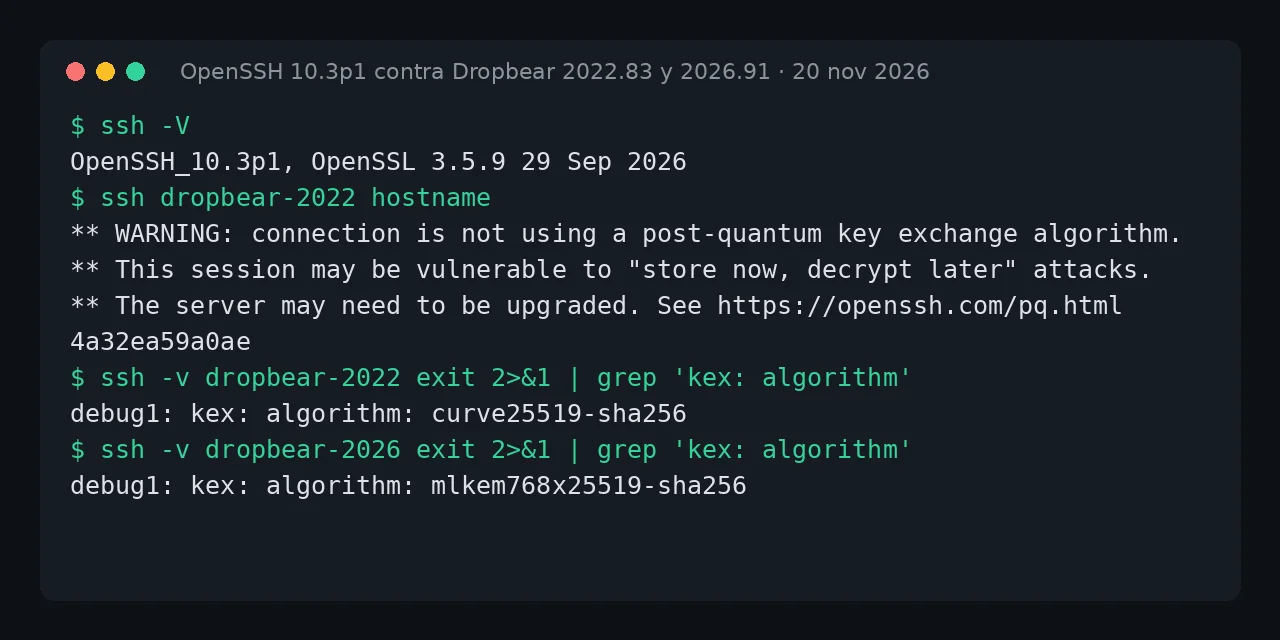
Table of contents
- Key takeaways
- Connection is not using a post-quantum key exchange algorithm: the full warning
- Which servers trigger the warning?
- ISP routers, NAS boxes and Dropbear
- How to check what each server negotiates
- Fix 1: update the SSH server
- SSH server in Docker
- Fix 2: enable mlkem768x25519-sha256 and sntrup761x25519-sha512
- On OpenSSH 9.x use sntrup761x25519-sha512
- Fix 3: silence the warning per host with WarnWeakCrypto
- Do not break your configuration on older clients
- What changes on the server with OpenSSH 10.6
- FAQ
- Is it dangerous to connect to a server that shows this warning?
- Does the warning mean my SSH key is weak?
- Why don't I see the warning with OpenSSH 10.0?
- Conclusion
- Sources
OpenSSH clients from version 10.1 print connection is not using a post-quantum key exchange algorithm when the server accepts neither of the two post-quantum key exchanges, mlkem768x25519-sha256 and sntrup761x25519-sha512. The connection works, but its encryption could be broken in the future with a quantum computer. The right fix is to update the server or add those algorithms to its KexAlgorithms, and only on a router or network-attached storage (NAS) box you cannot update does it make sense to silence it per host with WarnWeakCrypto no-pq-kex. I reproduced it on 20 November 2026 in Docker on arm64 Linux with the OpenSSH 10.3p1 client from alpine:latest against seven different servers. There is also a Spanish version of this guide.
Key takeaways
- The warning comes from OpenSSH 10.1 or later clients: I saw it with 10.3p1 and 10.6p2, and not with 10.0p2.
- Of seven servers tested, three trigger it: Dropbear 2022.83, OpenSSH 8.6 and an OpenSSH 10.3 restricted to
curve25519-sha256insshd_config. - OpenSSH 9.2p1 (Debian 12) and 8.9p1 (Ubuntu 22.04) do not: they negotiate
sntrup761x25519-sha512even though they have no ML-KEM. ssh -v server exittells you in one line which algorithm was negotiated, even without an account on the server.WarnWeakCrypto no-pq-kexinside aHostblock silences it for that device only, but it breaks your~/.ssh/configon clients older than 10.1 unless you addIgnoreUnknown WarnWeakCrypto.
Connection is not using a post-quantum key exchange algorithm: the full warning
The warning has three lines and appears before the server asks for your password or key, right after the key exchange. This is the literal output of the OpenSSH 10.3p1 client against a Dropbear 2022.83 server:
$ ssh dropbear-2022 hostname
** WARNING: connection is not using a post-quantum key exchange algorithm.
** This session may be vulnerable to "store now, decrypt later" attacks.
** The server may need to be upgraded. See https://openssh.com/pq.html
4a32ea59a0ae
The last line is the output of hostname on the server: the session opens and the command runs. It is a warning, not an error, and it does not change the exit code of ssh.
The risk it describes is the "store now, decrypt later" attack: someone records your encrypted SSH traffic today and decrypts it once a quantum computer can break the classical key exchange. The OpenSSH post-quantum cryptography page[1] puts it this way: "Traffic sent today is at risk of decryption unless post-quantum key agreement is used." The same page places the arrival of such a computer somewhere between 5 and 20 years away.
OpenSSH has offered a post-quantum key exchange by default since version 9.0 (April 2022), with sntrup761x25519-sha512. Version 9.9 added mlkem768x25519-sha256, based on the ML-KEM standard I cover in the article on FIPS 203, 204 and 205, and 10.0 made it the preferred one. The OpenSSH 10.1 release notes[2], from 6 October 2025, list the warning among the potentially incompatible changes. For the full migration plan there is the practical guide to migrating SSH to post-quantum cryptography.
Which servers trigger the warning?
Any server that offers neither mlkem768x25519-sha256 nor any variant of sntrup761x25519-sha512 triggers it. I checked on 20 November 2026 with the same client against seven servers in containers, reading the kex: algorithm line from ssh -vv:
| Server (image) | Negotiated algorithm | Warning? |
|---|---|---|
OpenSSH 10.3p1 (alpine:latest), default configuration |
mlkem768x25519-sha256 |
No |
OpenSSH 10.3p1 with KexAlgorithms curve25519-sha256 |
curve25519-sha256 |
Yes |
| Dropbear 2026.91 (Alpine 3.24 package) | mlkem768x25519-sha256 |
No |
| Dropbear 2022.83 (Alpine 3.17.10) | curve25519-sha256 |
Yes |
| OpenSSH 9.2p1 (Debian 12) | sntrup761x25519-sha512 |
No |
| OpenSSH 8.9p1 (Ubuntu 22.04) | sntrup761x25519-sha512@openssh.com |
No |
OpenSSH 8.6p1 (panubo/sshd, Alpine 3.14.10) |
curve25519-sha256 |
Yes |
Two results need an explanation. OpenSSH 8.6 knows sntrup761x25519-sha512@openssh.com (it shows up in ssh -Q kex inside the container), but it is not in its default list, so it never offers it. And the OpenSSH 10.3 restricted to curve25519-sha256 is the most surprising case: the server is modern, but one line from an old hardening guide strips its post-quantum algorithms.
ISP routers, NAS boxes and Dropbear
At home, the warning tends to appear on the router your ISP gave you or on your NAS, because the vendor picks the SSH server and you do not update it. Dropbear, the SSH server of embedded systems and OpenWrt, added sntrup761 and ML-KEM in version 2025.87, released on 5 March 2025, according to its changelog[3]. Anything older triggers the warning.
On OpenWrt, according to the Dropbear package in the repository[4] as read on 20 November, the 24.10 branch ships Dropbear 2024.86 and 25.12 ships 2025.89. On 25.12, sntrup761 is enabled except on devices with little flash memory, and ML-KEM is disabled. A router on OpenWrt 24.10 will show the warning, and one on 25.12 will not, unless it is one of those small models.
How to check what each server negotiates
The most direct way is to ask ssh for the negotiation details and filter the line with the chosen algorithm. It works even without an account on the server, because the key exchange happens before authentication:
ssh -v dropbear-2022 exit 2>&1 | grep 'kex: algorithm'
ssh -v dropbear-2026 exit 2>&1 | grep 'kex: algorithm'
Against the two Dropbear servers in the lab it printed this:
debug1: kex: algorithm: curve25519-sha256
debug1: kex: algorithm: mlkem768x25519-sha256
With -vv you also see the full list the server offers, on the KEX algorithms line after peer server KEXINIT proposal. To see what your own client supports, ssh -Q kex lists the 15 key exchange algorithms OpenSSH 10.3p1 knows. On the server, if you have access, sshd -T | grep kexalgorithms shows the effective list after applying sshd_config and its included files.
Fix 1: update the SSH server
Updating is the fix OpenSSH recommends on its page about the warning. Any OpenSSH 9.0 or later with the default configuration avoids the warning, and from 9.9 it also negotiates ML-KEM. Dropbear avoids it from 2025.87.
SSH server in Docker
If your SSH server lives in a container, updating it means pulling the new image and recreating the container. With the lscr.io/linuxserver/openssh-server image, which on 20 November ships Alpine 3.24.4 and OpenSSH 10.3p1, these are the steps:
docker compose pull
docker compose up -d
docker exec openssh-server ssh -V
Against that image, the client negotiated mlkem768x25519-sha256 without any change. If you build your own image on an old base, as panubo/sshd does with Alpine 3.14, change the FROM line to a supported version and rebuild. Alpine 3.24 ships OpenSSH 10.3p1 and Dropbear 2026.91.
Fix 2: enable mlkem768x25519-sha256 and sntrup761x25519-sha512
When the server is modern but has KexAlgorithms pinned, add the post-quantum algorithms at the start of the list. On the OpenSSH 10.3p1 restricted to curve25519-sha256, this file in /etc/ssh/sshd_config.d/ fixed it:
KexAlgorithms mlkem768x25519-sha256,sntrup761x25519-sha512,curve25519-sha256
Check the syntax with sshd -t before restarting the service, or you will lock yourself out of SSH. After the restart, the client negotiated mlkem768x25519-sha256 and the warning was gone. curve25519-sha256 stays at the end as a fallback for old clients.
The order of the list barely matters for the warning: the client picks the first algorithm in its own list that the server accepts, and OpenSSH 10 puts ML-KEM first. Dropbear 2026.91 offers sntrup761 before ML-KEM, and the client still negotiated mlkem768x25519-sha256.
On OpenSSH 9.x use sntrup761x25519-sha512
ML-KEM arrived in OpenSSH 9.9, so on Debian 12's 9.2p1 the name does not exist. If you put it in KexAlgorithms, sshd -t fails with Unsupported KEX algorithm "mlkem768x25519-sha256" and exits with code 255. On that server, previously restricted to curve25519-sha256, this line worked:
KexAlgorithms sntrup761x25519-sha512,curve25519-sha256
On OpenSSH 8.6, which only knows the algorithm's old name, I added KexAlgorithms +sntrup761x25519-sha512@openssh.com at the end of sshd_config. The + sign appends it to the default list, and the 10.3p1 client negotiated it without the warning. It is a patch: OpenSSH 8.6 no longer gets updates, and a server like that deserves fix 1.
Fix 3: silence the warning per host with WarnWeakCrypto
Silencing only makes sense for a device you can neither update nor configure, such as your ISP's router or a NAS with no vendor updates, and always per host. The ssh_config man page of OpenSSH 10.3p1 describes the WarnWeakCrypto option like this: "Warnings about connections that don't use a post-quantum key exchange may be disabled using the no-pq-kex flag." The default is yes, and no disables every weak crypto warning, present and future.
Add a block like this one to ~/.ssh/config, with the device's name or IP address:
Host home-router 192.168.1.1
    WarnWeakCrypto no-pq-kex
I tested it with OpenSSH 10.3p1. With no-pq-kex inside a Host or Match host block for the server, the warning disappears. For any other host it still shows. With an invalid value, ssh refuses to connect with unsupported option and exit code 255.
Do not break your configuration on older clients
WarnWeakCrypto does not exist before OpenSSH 10.1, and an older client treats an unknown option as a fatal error. With the same ~/.ssh/config, Debian 12's OpenSSH 9.2p1 client refused to connect to any server:
/root/.ssh/config: line 2: Bad configuration option: warnweakcrypto
/root/.ssh/config: terminating, 1 bad configuration options
If you share that file across machines with different versions, put IgnoreUnknown WarnWeakCrypto on the first line, outside any Host block. With that line, the 9.2p1 client connected normally and 10.3p1 still honoured the option.
Two shortcuts also hide the warning, and you should avoid both. LogLevel ERROR or ssh -q hide it, but they also hide other messages you do want to see. Pinning a client KexAlgorithms without post-quantum algorithms makes it disappear too, because the client only warns when it offered one itself: that way you give up the protection on every server.
What changes on the server with OpenSSH 10.6
OpenSSH 10.6, released on 6 October 2026, adds WarnWeakCrypto to sshd_config as well, enabled by default, so the server logs clients that do not negotiate a post-quantum key exchange. With the 10.6p2 sshd from alpine:edge and a client forced to curve25519-sha256, the container log showed this line:
WARNING: connection from 172.22.0.11 port 35220 is not using a
post-quantum key exchange algorithm: "curve25519-sha256" [preauth]
On the server it blocks nothing, it only leaves a record in the log. It helps you find which old clients you still have before you remove curve25519-sha256 from the list. OpenSSH 10.6p2, from 5 November 2026, is the latest release as of 20 November. If your server runs on Alpine, also check the OpenSSH sshole flaw on Alpine, which asks you to update the same package.
FAQ
Is it dangerous to connect to a server that shows this warning?
Not right away: the session is still encrypted with curve25519-sha256, which no classical computer breaks today. The risk is that someone stores the traffic and decrypts it with a future quantum computer. That is why it matters more for sessions that carry long-lived secrets, such as passwords or private keys, than for a quick check on your router.
Does the warning mean my SSH key is weak?
No. The warning is about the session's key exchange, not your user key or the server's host key. Your ed25519 key is still fine, and OpenSSH notes on its page that the risk to signatures has no equivalent of "store now, decrypt later".
Why don't I see the warning with OpenSSH 10.0?
Because the warning arrived in OpenSSH 10.1. With the 10.0p2 client from Alpine 3.22, the same server restricted to curve25519-sha256 showed nothing. Not seeing the warning on an older client does not mean the connection is post-quantum: check it with ssh -v.
Conclusion
The OpenSSH 10.1 warning tells you the server offers neither ML-KEM nor sntrup761. In my tests that happened with old servers, with Dropbear older than 2025.87 and with a hand-pinned KexAlgorithms. Check the algorithm with ssh -v, update the server or add mlkem768x25519-sha256 and sntrup761x25519-sha512 to its list, and keep WarnWeakCrypto no-pq-kex for the devices you do not control, always inside a Host block.
Sources: [1] OpenSSH, post-quantum cryptography[1], [2] OpenSSH, release notes for 10.1[2], [3] OpenSSH, release notes[5], [4] OpenBSD, ssh_config man page[6], [5] Dropbear, changelog[3], [6] OpenWrt, Dropbear package[4].