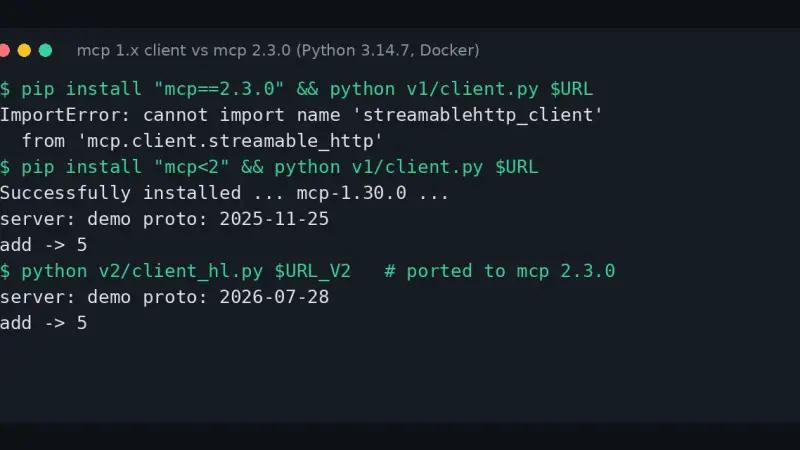
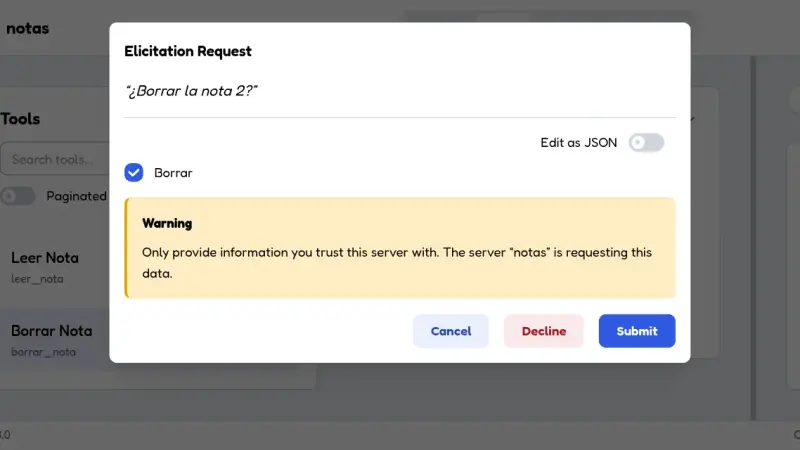
The cannot import name streamablehttp_client error appears because the Python mcp package 2.x deleted that function, and McpError was renamed MCPError. To get unblocked, pin mcp
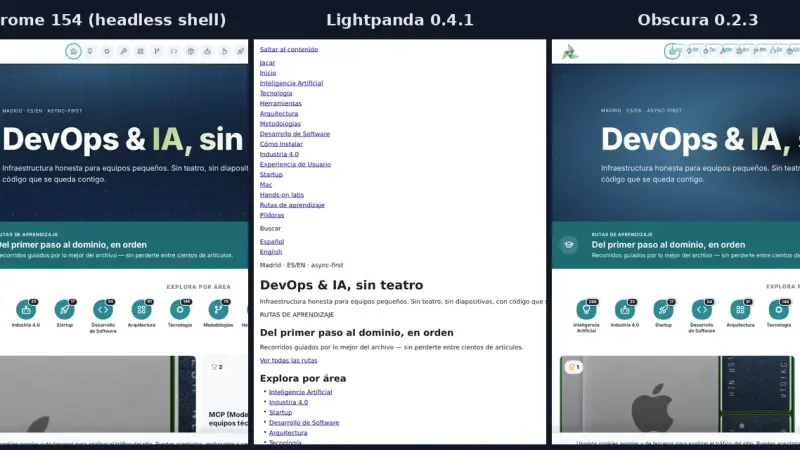
Lightpanda 0.4.1 and Obscura 0.2.3 speak CDP and open the same sites as headless Chrome, but they do not pass the same tests. On arm64, driven by Playwright, Chrome passed 17 of 17 and Lightpanda and Obscura 10 each. With 8 sessions, Lightpanda loaded 5.6 times as many pages per second as Chrome, and Obscura 4 times as many.
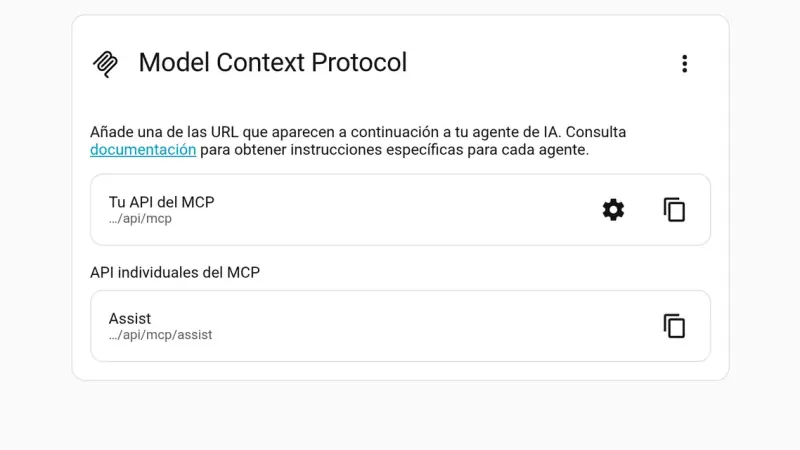
Home Assistant 2026.10 turns its MCP server on in one click from Settings > System > AI and gives you the URL for your agent. I tested it with the Python SDK and Claude Code: 28 tools, 45 of 122 entities exposed, locks left out by default and admin accounts only.
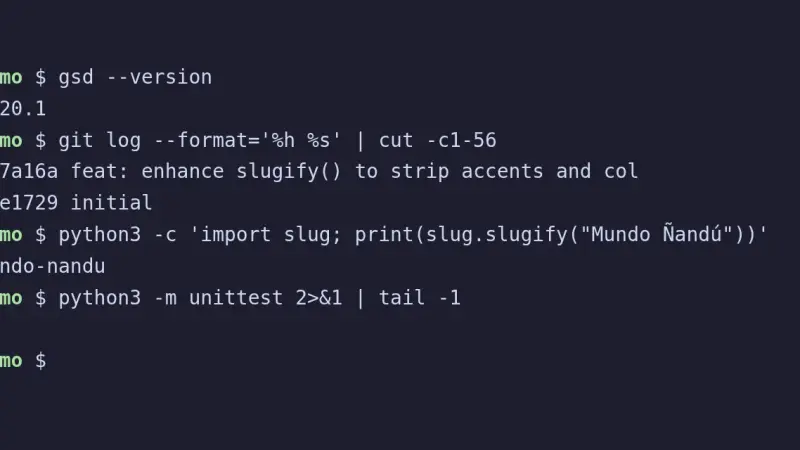
To install gsd-pi, the Open GSD terminal agent, run npx @opengsd/gsd-pi@latest with Node.js 22.18 or later. It works without an API key: with a models.json pointing at llama.cpp and a 64k context, a 4B Qwen3.5 finished a task with 12 passing tests and a commit. gsd-core, by contrast, installs inside Claude Code or OpenCode.
If your server imports mcp.server.fastmcp, upgrading the mcp package to version 2 breaks it: FastMCP was renamed MCPServer. You have two destinations, MCPServer or FastMCP 4, and both require moving host and port to run(), building MCPError from a code and a message, and replacing ctx.elicit, which fails on 2026-07-28 connections.
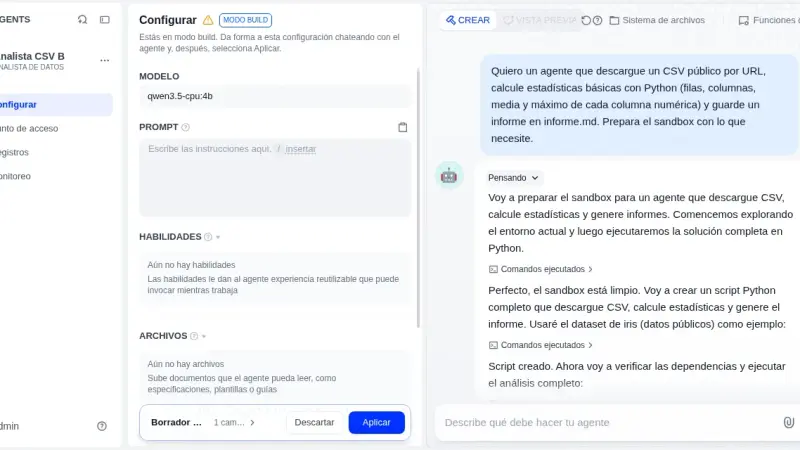
Dify Agent, the Linux-sandbox agent Dify introduced in 1.16, works with a local model once you install the Ollama plugin and switch on tool calling. With Dify 1.17.1 and Qwen3.5-4B on a CPU, the published agent returned correct figures in three out of three runs; Build mode finished none of its three sessions.
OpenClaw 2026.9.4 installs with Docker Compose from the official GHCR image, which ships for amd64 and arm64. To run it without a cloud API, connect it to a llama-server on the compose file's internal network. Publish port 18789 on 127.0.0.1 only, because the repository's compose file opens it on every interface.
ThinkingBox is an MIT-licensed Microsoft sandbox that runs an agent against stateful MCP tools and judges it by the side effects it leaves in the system, not by what it claims to have done. Its companion benchmark covers 507 business tasks, each repeated twenty times.
Agentic search means the model plans its own queries against the repository using grep, file listings and a language server, instead of querying an embedding index built beforehand. Claude Code and Cline work this way by design, yet Cursor and Devin Desktop still index, and their own documentation says so.
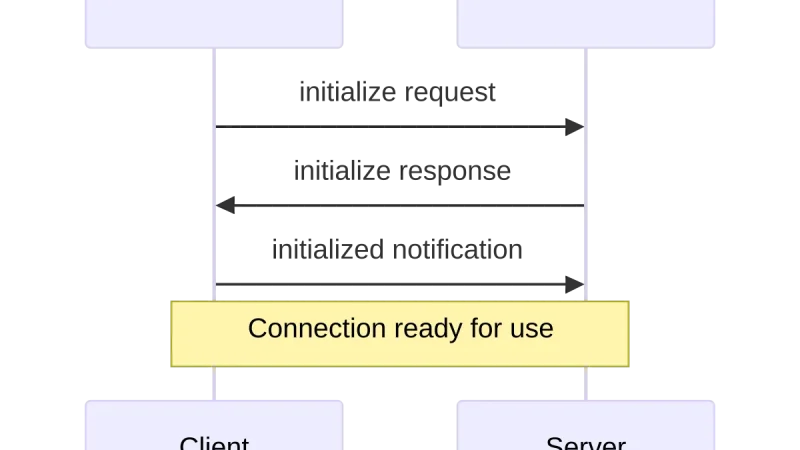
The 2026-07-28 revision turns MCP into a stateless protocol. The initialize exchange and the Mcp-Session-Id header are gone, and the protocol version plus client capabilities now travel inside the _meta field of every request. In exchange, Roots, Sampling and Logging are deprecated with a twelve-month window.
Obscura is a headless browser engine written in Rust and released under Apache-2.0. It runs JavaScript on V8, speaks the Chrome DevTools Protocol and replaces headless Chrome inside Playwright or Puppeteer without touching your code. Its measured advantage is memory: around 38 MB per session against 532 MB for Chromium.
Docker Agent is a Docker CLI plugin for building and running AI agents from a declarative YAML file, no code required: you define one or more agents, give them MCP tools, run them with docker agent run, and share them through any OCI registry, on OpenAI, Anthropic, Gemini or other providers.
Open GSD (Git. Ship. Done.) is an open-source, MIT-licensed toolkit for steering coding agents without losing context: it splits work into five phases (discuss, plan, execute, verify and ship) and delegates the heavy lifting to subagents that each start with a clean context. Its core is the gsd-core engine and the gsd-pi terminal agent.
Opus 4.7 launched as Anthropic's most capable model, with emphasis on long-horizon agentic work. After two months of intensive use, these are the practical changes versus Opus 4.6.
The first invoice for a production agent usually runs double or triple the estimate. This article walks through five real levers, in priority order, caching, routing, context control, batching, and telemetry, to cut cost without touching perceived quality.
Skills package reusable capabilities; subagents isolate bounded-task execution. Together they form the most effective pattern for composing complex agents in 2026.
Using an LLM to judge another LLM became widespread in 2024 and remains, in 2026, the only scalable way to evaluate qualitative quality in LLM systems. It is reliable when judge-human correlation exceeds 0.7 on 30 cases and gets recalibrated quarterly; below that threshold, do not trust the number.
AI agents fail in production, and what matters is how you respond in the first twenty minutes. This runbook covers severity classification, isolating before investigating, purging contaminated memory, communicating without inventing facts, and turning every incident into a regression test before closing it as done.
LLM red teaming has gone from an esoteric activity to a mandatory practice. With the OWASP Agentic Top 10 and the CSA Agentic AI Red Teaming Guide converging on shared vocabulary, this is the operational playbook any team deploying agents needs to have.
Reliable agents come from measurement, not from better models or prompts. A production agent evaluation setup starts with a golden dataset of 30 to 200 cases, split roughly 60 percent normal usage, 30 percent edge cases and 10 percent adversarial, and it never uses the same model as both worker and judge.
An Agent OS is a runtime layer built to run AI agents rather than ordinary applications, and after six months of production deployments the trade-off is clear. A dedicated agent stack starts slower but stays stable; Kubernetes with orchestration bolted on top moves faster early, then hits observability and policy limits. It pays off from five active agents.
After two years of pilots and a year of agents in production, governance has moved from an aspirational committee to an operational control. What audits ask for, what broke in 2025, and which guardrails absorb most incidents.
By late 2025, 57.3 percent of organizations had agents in production, up from 51 percent a year earlier, according to LangChain's survey of more than 1,300 professionals. Three failure modes dominate the postmortems: degenerative reasoning loops, hallucinated data in RAG systems, and silent misalignment between the request and the interpretation.
Twenty months after the initial announcement, Model Context Protocol went from curiosity to de-facto standard among agent clients and servers. What is available, which servers are worth it, which problems remain open, and how it compares to earlier protocol maps.
Claude Haiku 4.5, released by Anthropic on October 15, 2025, performs close to Sonnet 4 on structured tasks for roughly a third of the price. It carries a 200K-token context window and tool use on par with Sonnet 4.5. Pairing it as a filter ahead of Sonnet cuts total cost several times over.
After two years watching every product invent its own interface for talking to an agent, by January 2026 a stable design consensus is emerging about which patterns work, which do not, and what the average user already expects. Time to write down what has settled.
Six months after A2A landed at the Linux Foundation, and after several implementation cycles from Google, Microsoft, and open projects, what version 1 of the protocol means and whether it is safe to build on yet.
With MCP solving the agent-to-tool layer, a parallel problem surfaces: how do two agents from different vendors communicate with each other. Google's Agent2Agent protocol, donated to the Linux Foundation in June 2025, tries to fill that gap with an open standard.
Agents that chain calls to models, tools and memory are hard to debug without instrumentation designed for them. After a long year running agents in production, I cover what to measure first, which standards are consolidating, and which costly mistakes are avoided by getting the traces right from the start.
Computer Use in production works today for narrow, repetitive interface tasks where a human still checks the result. Anthropic shipped it in October 2024 calling it experimental and error-prone, and nine months on that framing still holds: teams run it on real work by constraining scope, not by trusting it end to end.
MCP clients are now built into the editor itself: VS Code, Zed, Cursor, and several Neovim forks ship native support. The agent picks up project context in place, with no copying of files into a separate chat window. The practical questions become which servers to keep enabled and how to scope their permissions.
AI agents are starting to earn a real place in continuous integration pipelines: reviewing diffs, proposing fixes, generating missing tests. Six months of real-world use to separate the patterns that work from the ones that end up costing more time than they save.
A year after chat stopped being the only acceptable way to talk to an agent, UI patterns built specifically for agent tasks are emerging. I go through the ones starting to stick and the ones that are just cycle fashion.
September 2026 review of the MCP servers I use daily: filesystem, git, fetch, and memory are still reference servers, and DBHub replaces the archived Postgres server. The official registry verifies who publishes, not the code's security, so I apply five criteria and list tools with the MCP Inspector before connecting anything.
Y Combinator's W25 and S25 cohorts show a historic tilt toward vertical agents and developer tools, with outcome-based pricing emerging as a new model. I break down the visible patterns, the business models on display, and what founders operating outside Silicon Valley should copy from this reading of the batch.
8 min8764.3
We use first- and third-party cookies to analyze site traffic. You can accept them, reject them, or configure your choice.
Learn more about cookies
Cookie preferences
NecessaryEssential for the site to work. Always on.
AnalyticsHelp us understand how the site is used (Google Analytics).