Artificial Intelligence
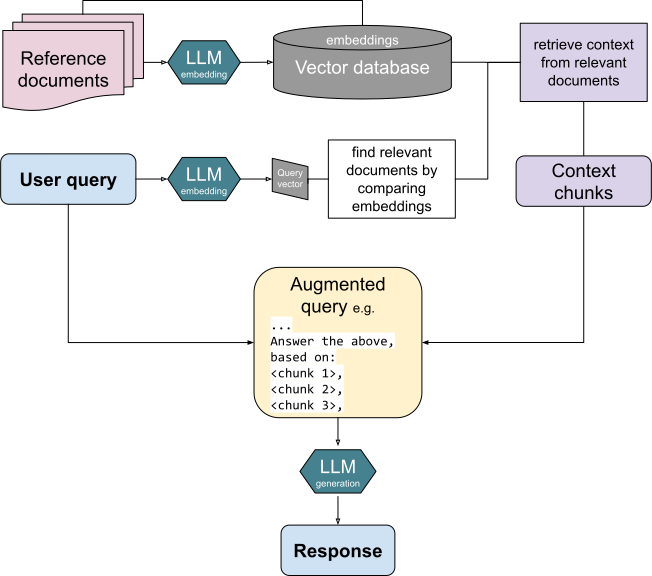
RAG with Postgres and pgvector in production: from PoC to SLO
Embeddings, HNSW indexing, reranking, evaluation, context window, latency under load. Full stack with code and measurable SLOs.
Category
Methodologies that respect your time: lightweight processes for small teams.
Embeddings, HNSW indexing, reranking, evaluation, context window, latency under load. Full stack with code and measurable SLOs.
This guide shows how to build a production-ready agent with the Anthropic SDK in Python: the tool-use loop with the Messages API, streaming with backpressure via a bounded queue, prompt caching with cache_control, your own MCP server registered with the Claude Agent SDK, OTel GenAI traces, and a non-root Docker container ready for production.
Using an LLM to judge another LLM became widespread in 2024 and remains, in 2026, the only scalable way to evaluate qualitative quality in LLM systems. It is reliable when judge-human correlation exceeds 0.7 on 30 cases and gets recalibrated quarterly; below that threshold, do not trust the number.
Opus 4.7 launched as Anthropic's most capable model, with emphasis on long-horizon agentic work. After two months of intensive use, these are the practical changes versus Opus 4.6.
The first invoice for a production agent usually runs double or triple the estimate. This article walks through five real levers, in priority order, caching, routing, context control, batching, and telemetry, to cut cost without touching perceived quality.
After fourteen months testing AI-integrated DevOps tools across several teams, the stack that stays is small: Claude Code, Cursor, and Aider for code; PagerDuty AIOps, Datadog Bits AI, and Grafana Assistant for alert triage; and OpenTofu with OPA for infrastructure generation bounded by policy rules.
AI agents fail in production, and what matters is how you respond in the first twenty minutes. This runbook covers severity classification, isolating before investigating, purging contaminated memory, communicating without inventing facts, and turning every incident into a regression test before closing it as done.
LLM red teaming has gone from an esoteric activity to a mandatory practice. With the OWASP Agentic Top 10 and the CSA Agentic AI Red Teaming Guide converging on shared vocabulary, this is the operational playbook any team deploying agents needs to have.
Después de año y medio llenando tableros con agentes en producción, la pregunta que separa equipos que envían fiable de los que van a ciegas sigue siendo la misma: ¿cómo mides que el agente está funcionando?
The RICE framework is a prioritization methodology created by Intercom that produces a score by combining four factors: Reach, Impact, Confidence, and Effort. It divides the product of the first three by the estimated effort in person-months, so it can compare unrelated initiatives using one objective number.
Prompt engineering has moved from viral tricks to a discipline with reproducible patterns: few-shot, chain-of-thought, and structured output with function calling. Teams treating prompts like code (versioned, tested, and monitored) get consistently better results than those who improvise.
Two years after the final NIST standards, post-quantum migration is no longer hypothetical. What has actually been migrated, what remains stuck, where the real operational problems lie, and how the timelines look from April 2026.
After two years of pilots and a year of agents in production, governance has moved from an aspirational committee to an operational control. What audits ask for, what broke in 2025, and which guardrails absorb most incidents.
Durante 2025 cientos de equipos pusieron agentes IA en producción real. A principios de 2026, con datos suficientes, emergen lecciones consistentes sobre qué falla, qué funciona, cuánto cuesta y qué tareas no encajan. Repaso ordenado para equipos que empiezan ahora.
Tres años después de que platform engineering se convirtiera en palabra de moda, el polvo ha caído. Unas pocas empresas tienen plataformas internas que de verdad aceleran al desarrollo, muchas montaron un portal Backstage vacío y algunas volvieron a DevOps clásico. Análisis de qué distingue a las que ganaron.
La factura de IA en las empresas ha dejado de ser anecdótica. Entre tokens de modelos frontera, GPUs reservadas que nadie usa y pipelines RAG con cachés mal configuradas, muchos equipos pagan diez veces lo que deberían. Guía de FinOps específico para IA sin relatos promocionales.
Sixteen months after Anthropic first shipped computer use, with browser-use, OpenAI Operator and Gemini Computer Use all pushing in parallel, agents that drive the browser and desktop have moved from demo to real workflows. Time to review which patterns survive when you run them daily in production.
A selection of postmortems published between 2025 and 2026 by teams running AI systems in production reveals repeated patterns: guardrail failures, silent model drift, hidden vendor dependency, and a collection of near-misses worth distilling.
Dos años de experimentación con modelos generativos aplicados a descubrimiento de producto han dejado prácticas concretas útiles y otras tantas que se descartan. Un repaso honesto de qué ha funcionado, qué ha fracasado y cómo incorporar IA al ciclo de discovery sin corromper sus fundamentos.
A principios de 2026, varias plataformas de orquestación incluyen carbon-aware scheduling como opción por defecto o muy visible. Con meses de datos reales, toca evaluar si la promesa de reducir emisiones sin dañar rendimiento se cumple y en qué escenarios.
Los cuadros de mando con IA llevan un par de años prometiendo detección de anomalías mágica y causa raíz automática. La realidad es más modesta pero también más útil, si se sabe separar el ruido del valor real. Repaso honesto de qué funciona y qué no.