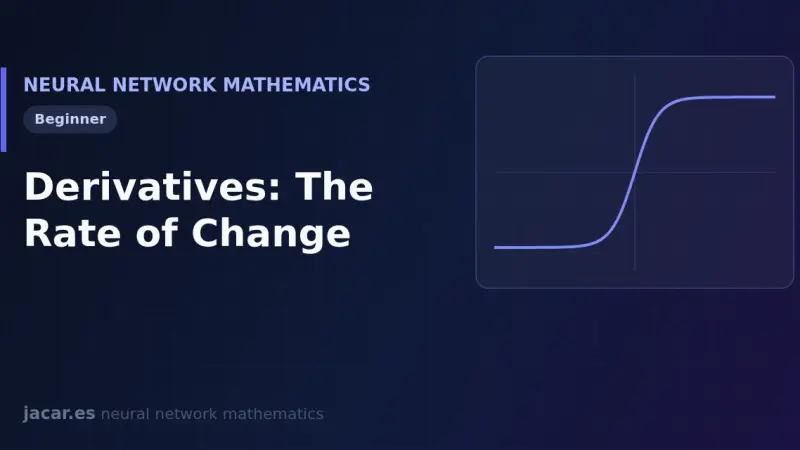
A derivative measures the rate of change of a function: how much its output varies when the input changes a little. In a neural network, that slope tells us in which direction and how strongly to adjust each weight to reduce the error, and it is the foundation of gradient descent and backpropagation.
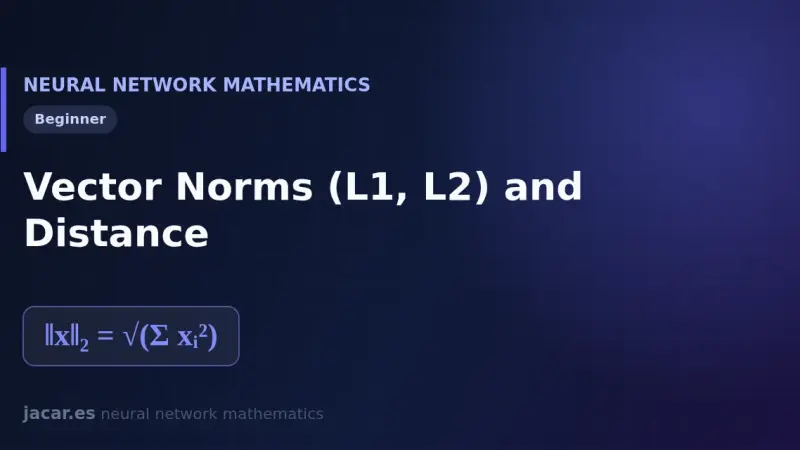
A vector norm measures its length or magnitude. The L1 norm adds the absolute values of the components, while the L2 norm applies the Pythagorean theorem: the square root of the sum of squares. Both define different distances between points and underpin the regularisation that prevents overfitting in neural networks.
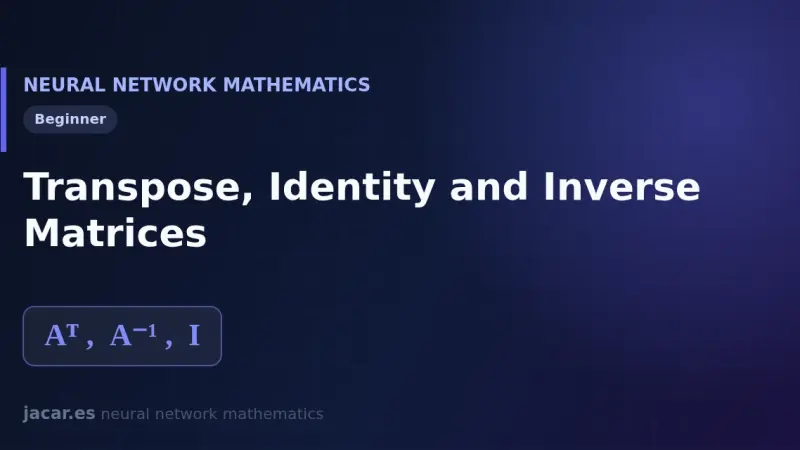
The transpose swaps rows for columns and shows up at every step of backpropagation; the identity matrix acts as the 1 of matrix algebra and leaves any vector unchanged, and the inverse matrix undoes a transformation, though it only exists when the matrix is square and its determinant is not zero. Three operations that hold up the maths of a network.
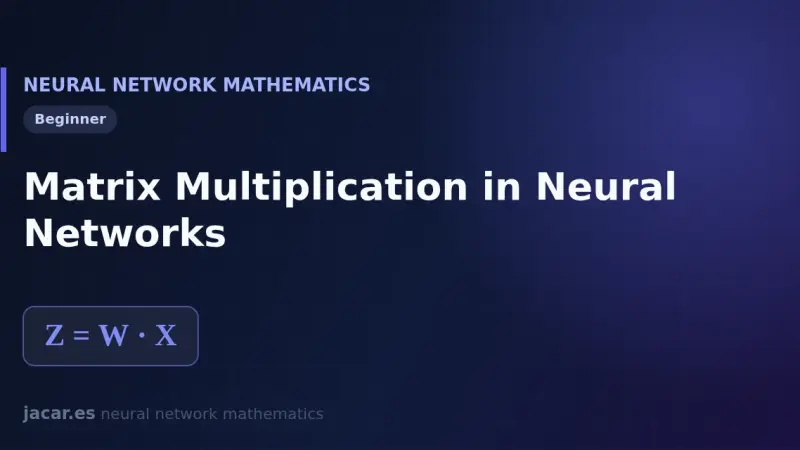
Matrix multiplication is the core operation of a neural network: each layer gathers its weights into a matrix W and computes its output as the product W times X. That single operation, repeated layer after layer, turns the inputs into predictions and explains why graphics cards dominate modern deep learning.
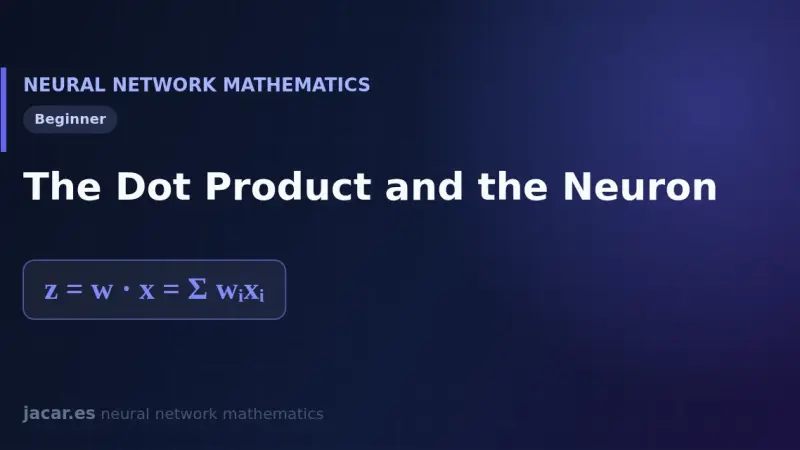
The dot product multiplies each input by its weight and adds the results into a single number. A neuron uses that operation to compute its weighted sum z equals w times x plus the bias b, and that value decides, after the activation, how strongly the neuron fires in response to the data it receives.
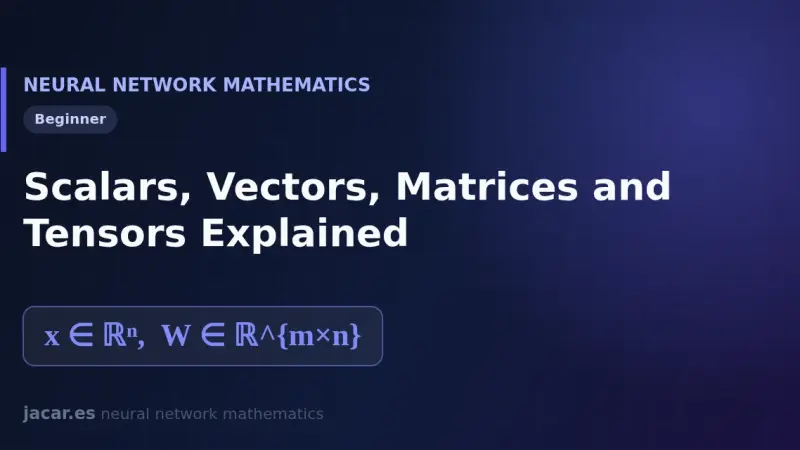
A scalar is a single number, a vector an ordered list of numbers, a matrix a two-dimensional table and a tensor the generalisation to any number of dimensions. In a neural network the data enters as vectors and the weights form matrices, so every layer computes z = Wx + b by combining the two.
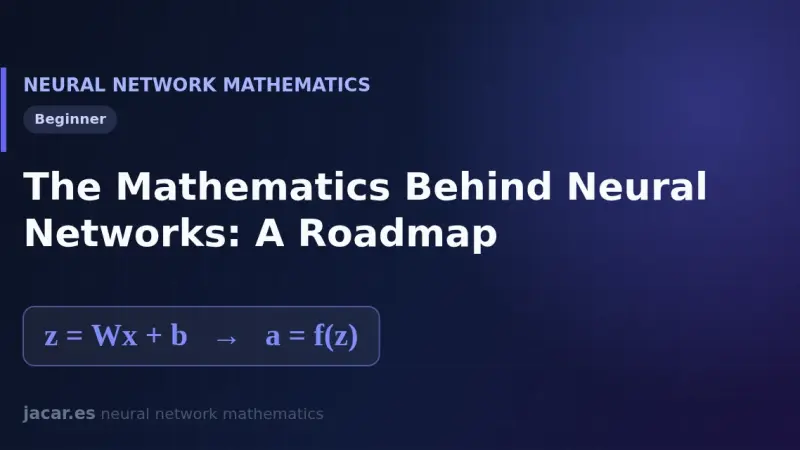
The mathematics of neural networks rests on three blocks: linear algebra represents data and weights as vectors and matrices, calculus with derivatives and the chain rule lets the network learn through gradient descent, and probability shapes the loss functions. This roadmap walks that path from beginning to end so you know what to study and in what order.
The Spanish draft law transposing NIS2 is still in parliament in 2026, but the directive's technical obligations have applied since October 2024. Practical map: the ten minimum security measures, the 24-hour, 72-hour and one-month incident notification window, and the new supply-chain security obligations.
Recipe for oMLX 0.6.4 on a Mac M5 Max with 128 GB: install, Claude Code and advanced settings with screenshots (Lightning MTP, VLM MTP and DFlash). Includes our own September 2026 benchmarks, with up to 1.88x more tokens per second.
100 must-have apps for your M5 Mac organised into 20 categories: browser, notes, terminal, IDE, containers, AI and more. Each pick with purpose, key features, plugins, pricing in EUR and the official link.
Kubernetes 1.35 GA consolidates three releases of work: native sidecars with full lifecycle management, generalised DRA for FPGAs and NPUs, and a scheduler that cuts resource waste by 15-25% in heterogeneous clusters. An operations-side balance sheet: what to enable now, what to watch before migrating, and what path to follow from 1.30.
NVIDIA still dominates frontier-model training in 2026, but inference tells a different story. AMD MI300X/MI325X with mature ROCm, Intel Gaudi 3, Google TPU v6, and AWS Trainium/Inferentia deliver 20 to 50% lower cost per token without sacrificing quality. Here is when to choose each option.
Cobots have been promising the fenceless factory for almost fifteen years. In 2026, with the market heading toward eleven billion dollars and 70% of orders coming from outside automotive, it is time to review what has delivered and what remains open.
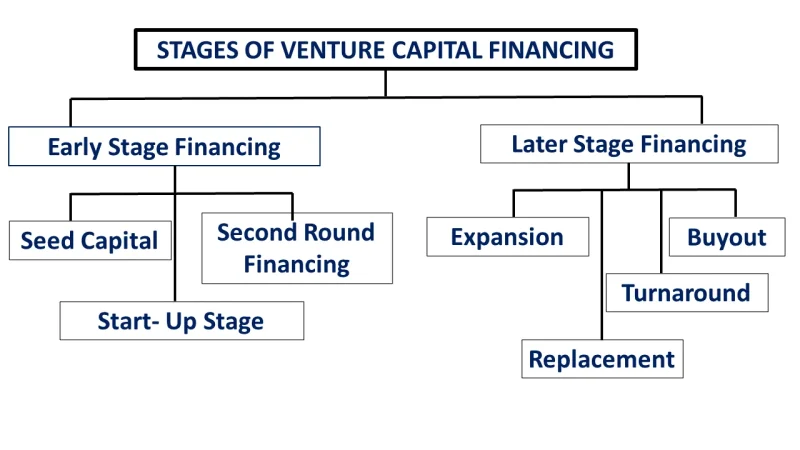
After the 2021 historic peak and the 2022 correction, startup funding in 2023 has been redefined: Series A rounds dropping from $15M to $8-10M, due diligence extending to 14 weeks, and metrics like the real Rule of 40 and NRR above 110% as the new minimum.
Kubernetes won the orchestration battle, but Docker Swarm stays maintained inside Docker Engine and makes real sense for small teams without dedicated SRE, self-hosted stacks on 1-5 VPS, and edge mini-clusters. In those contexts, Swarm's minimal learning curve and low operational cost outweigh Kubernetes's advanced features.
Ollama 0.5 or newer runs Llama 3.3 70B and Mistral Large 2 locally on Ubuntu 24.04: Q4_K_M quantization lets a single NVIDIA GPU with 24 GB of VRAM, an RTX 4090 for example, handle the full model. This guide installs the drivers, sets up Open WebUI, and exposes the service behind Traefik with TLS.
Two years after the final NIST standards, post-quantum migration is no longer hypothetical. What has actually been migrated, what remains stuck, where the real operational problems lie, and how the timelines look from April 2026.
Humanoid robotics left the trade-show floor for factory floors and warehouses during 2025 and 2026. Which companies have really deployed units, which tasks fit, what real costs look like, and where humans remain unbeatable.
NPUs stopped being an accessory and became the component that defines real performance in laptops, phones, and small servers. A practical look at the hardware that rules 2026, which workloads pay off, and where the traditional GPU still wins.
Four and a half years after Rust officially entered Linux 6.1, with real Apple GPU and NVMe drivers in production and several public conflicts between maintainers, it is time for a sober technical balance. What works, what still costs, and where the next phase is heading.
Carbon aware scheduling delivers savings in proportion to how much of your workload can move in time or geography. If under 20 percent of it is elastic, cluster-wide gains stay modest. Deferrable jobs do best, cutting carbon intensity 15 to 30 percent: nightly batch, model training, CI builds and tests, report generation, video rendering.
After the 2023-2024 hype cycle led by Apple Vision Pro, the 2025 valley of disillusionment, and the quiet but real consolidation of Meta Quest 3S and the WebXR stack, it is time to assess honestly where extended reality stands. What works, what has died, what is still alive.
WASI preview 3 was stabilized in late 2025 and adds what preview 2 lacked: native async, bidirectional streams, and inter-component concurrency with specified semantics. Portability and async are no longer a trade-off, since one async component runs unchanged on wasmtime, WasmEdge, JCO and the main commercial runtimes. API gateways and SaaS extension plugins are the strongest production cases.
After the 2021-2022 cycle, most blockchain projects have vanished from the radar, leaving only the ones that deliver real value. An honest inventory of which use cases work, which failed, and where blockchain is still a sensible idea.
Kubernetes 1.35 has reached feature freeze, and three items matter. CEL-based admission policies go stable, replacing admission webhooks with expressions evaluated inside the control plane and removing an external failure point. Dynamic Resource Allocation goes stable for GPUs, NPUs and other accelerators. The new KubeletConfigSource API pushes kubelet configuration without restarting the node.
After a decade of Prometheus, three years of consolidation around OpenTelemetry, and the open stack now mature with Grafana, Loki, and Tempo, concrete recommendations for teams starting or reviewing their observability layer: what fits, what is excess, and what to avoid.
containerd Wasm support is production ready: the runwasi shim ships in containerd 2.0 and is backported to 1.7.7 and 1.6.25, so WasmEdge or wasmtime workloads run beside ordinary Linux containers on one Kubernetes cluster, selected per pod through RuntimeClass. Wasm wins on cold start, image size and kernel-free sandboxing, but not every workload fits.
After a decade of grandiose headlines, quantum computing enters this cycle with more honest metrics, thousand-physical-qubit machines, and the first serious signs of error correction at scale. It pays to separate what already works from what remains research.
Neural processing units have stopped being a marketing label on Snapdragon, Apple Silicon and AMD Ryzen AI laptops. Here is what you can actually do from code today, which tools are mature, and when it pays off to target the NPU instead of the CPU or GPU.
gVisor isolates containers by inserting Sentry, a kernel written in Go, between the container process and the real host kernel, shrinking the system-call surface a hostile tenant can reach. Its OCI-compatible runsc runtime drops in where runc used to sit. Use systrap mode, the default since 2023: portable, no special hardware required.
Fly.io has spent years selling the idea that deploying an application across several regions should be almost as simple as pushing an image and writing one config line. After several real projects on the platform, here is an honest read on what it delivers, what is missing, and who it is worth choosing over more classic options.
Garnet is the open-source cache server Microsoft Research published in March 2024. Written from scratch in .NET 8, it speaks the Redis wire protocol, so existing clients connect unchanged, and it stores data through a hybrid memory-and-disk backend called Tsavorite. Core-affinity threading is what lets the Garnet cache outrun Redis on many-core hardware.
Citus is a Postgres extension that spreads tables across worker nodes while the cluster still looks like a single Postgres server to your application. The coordinator intercepts query planning and distributes the work. Picking the distribution key is the decision that matters most, since every later query inherits its consequences.
OSV-Scanner is Google's dependency scanner, announced in 2022, that queries the open OSV.dev database rather than raw CVE advisories. Because OSV pins each vulnerability to precise commit or semantic version ranges, matching against your actual dependencies becomes deterministic and produces far less noise. It reads npm, Python, Go, Ruby, PHP, Rust and Maven manifests.
An Authentik Docker Compose install now needs only three containers: PostgreSQL, the server and the worker, since Redis stopped being mandatory in version 2025.10. Once running, it acts as your identity provider for single sign-on over OAuth2, OIDC, SAML and LDAP, and a reverse proxy such as Traefik can delegate authentication to it through forward auth.
CVE-based attack surface management has moved from an abstract list to an engineering practice with real prioritization. We look at how it works once EPSS, KEV and exposure context enter the same equation.
Unikernels were promised as the future of cloud deployment back in 2015, then faded into obscurity soon after. Ten years later, Unikraft has reached a stable release and reads like a more mature, more useful take on that same idea. A review of what has changed.
Wolfi, the kernelless distribution Chainguard announced in 2022, is now the base of Chainguard OS. Guide re-tested on 16 September 2026 on arm64: glibc 2.44, how to search its 15,119 packages with apk, SBOMs and signatures, an apko-built image, the 6-month retention policy and a comparison with Alpine and Debian slim.
Post-quantum cryptography stopped being an academic topic once Cloudflare, Google, and Apple put ML-KEM hybrids into production. By 2025 it already covers the majority of real web traffic. A look at where adoption stands, where friction still shows up, and what to review in your own infrastructure.
Dragonfly is a Redis-protocol-compatible cache built on a multithreaded shared-nothing design with one thread per data shard, so an eight-core node uses all eight cores where Redis uses one. Its fork-free snapshot algorithm keeps latency flat while persisting. Ordinary clients work fine; modules like RedisSearch and RedisJSON are where compatibility frays.
Four years ago it was an academic curiosity. Today, scheduling workloads by grid carbon intensity is a built-in option in Kubernetes, in several cloud provider services, and in CI tooling. We look at what genuinely changed and what is still more promise than practice.
NVIDIA Blackwell GPUs change large-model training mainly at rack scale. The GB200 NVL72 packs 72 Blackwell GPUs and 36 Grace CPUs into around 120 kW and presents itself to software as one machine holding 13.4 TB of HBM3e. Official MLPerf Training v5.0 numbers show 2.2x on Llama 3.1 405B pretraining against H100.
OpenSSH added hybrid post-quantum key exchange with ML-KEM in version 9.9 and made it the default algorithm in 10.0. The question is no longer whether to migrate SSH to post-quantum, but how to do it without breaking old clients: enable the hybrid mode, keep a classical fallback, and verify with ssh -v that the active algorithm is the right one.
The combination of Parca for continuous profiling, Beyla for eBPF auto-instrumentation, and Grafana as the visualisation layer delivers deep observability without touching code. A look at how the three pieces fit together and where the limits still show.
Kubernetes 1.34 ships with Dynamic Resource Allocation (DRA) graduating to stable, scheduler improvements, and CEL-based mutating admission policies that replace webhooks. A practical rundown of what is safe to upgrade now, what can wait, and what actually changes for teams running production clusters.
WireGuard is simple over a single link, but hand-building a multi-node mesh quickly turns into a tangle of keys and routes. Patterns that work, when pure WireGuard earns its keep, and when it is worth leaning on Tailscale or Headscale instead.
After years of pilots, private 5G is starting to show up in plants, ports, and warehouses with cases that actually work. What changed in 2025, which deployments make sense, and where WiFi 6E or a wired network still win the comparison.
8 min3354.5
We use first- and third-party cookies to analyze site traffic. You can accept them, reject them, or configure your choice.
Learn more about cookies
Cookie preferences
NecessaryEssential for the site to work. Always on.
AnalyticsHelp us understand how the site is used (Google Analytics).