IoT: The Intelligent Connection of the World
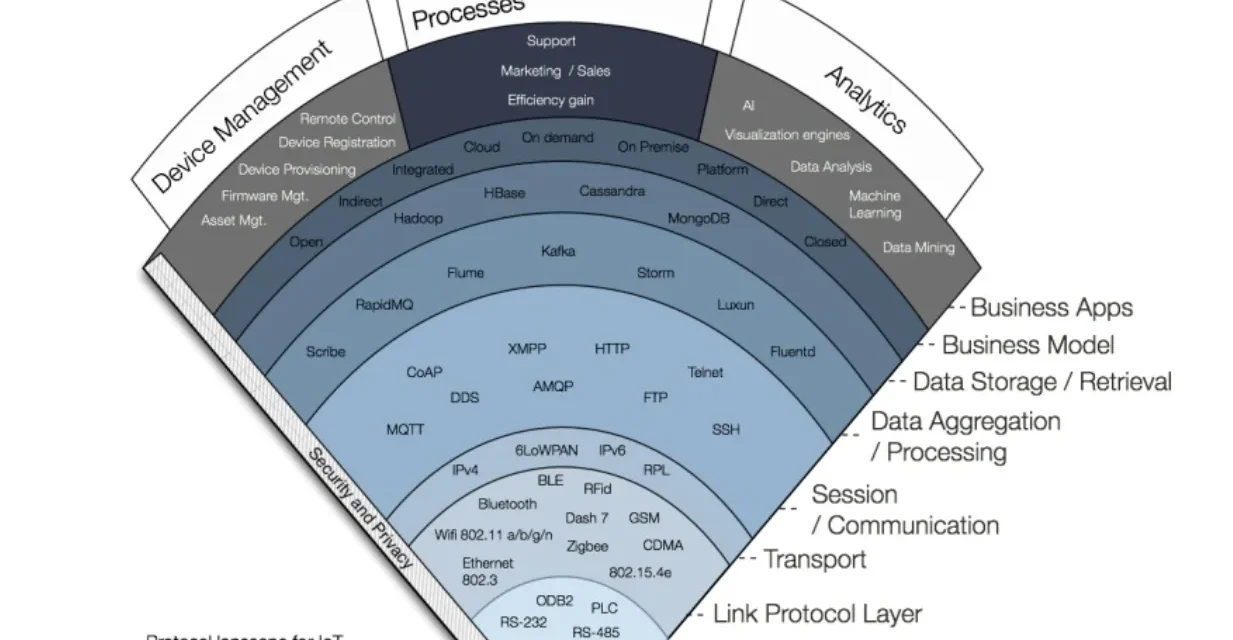
Table of contents
- Key takeaways
- What IoT is and how it works
- Industrial applications
- Applications in agriculture and daily life
- Challenges: security and data scale
- Conclusion
- Frequently asked questions
- How much does predictive maintenance with IoT sensors actually save?
- What security measures should an IoT project include?
- Do all sensor data have to be sent to the cloud?
- Sources
The Internet of Things (IoT) turns everyday objects into network nodes capable of collecting, sharing, and acting on data in real time. Temperature sensors in a factory, heart rate monitors on a wristband, or thermostats that learn household routines all share the same logic. They all connect the physical world to digital systems to generate value from information that was previously lost.
Spanish version of this article
Key takeaways
-
IoT is a network of physical devices with internet connectivity that exchange data without direct human intervention.
-
The architecture is structured in three layers: perception (sensors), network (communication protocols), and application (analysis and action).
-
Machine learning processes the collected data to detect anomalies, predict failures, and automate responses.
-
Its most mature applications are in manufacturing industry, precision agriculture, and the smart home.
-
Security and data volume management remain the two main challenges for the sector.
What IoT is and how it works
IoT is a network of electronic devices (sensors, actuators, microcontrollers) connected to the internet, with the ability to collect and transmit data to other nodes on the same network. Communication can occur between devices (M2M, machine-to-machine) or between devices and cloud platforms.
The typical architecture is organised in three layers:
-
Perception layer: sensors collect data from the physical environment (temperature, humidity, vibration, GPS position, etc.).
-
Network layer: data travels through protocols such as MQTT, CoAP, Zigbee, LoRaWAN, or LTE-M to servers or the edge.
-
Application layer: analysis algorithms (machine learning, for example) process the data and trigger actions: alerts, inventory updates, automatic machinery adjustments.
What makes IoT distinct from simple telemetry is scale and bidirectionality: the platform does not just read data, it also sends instructions back to devices in real time.
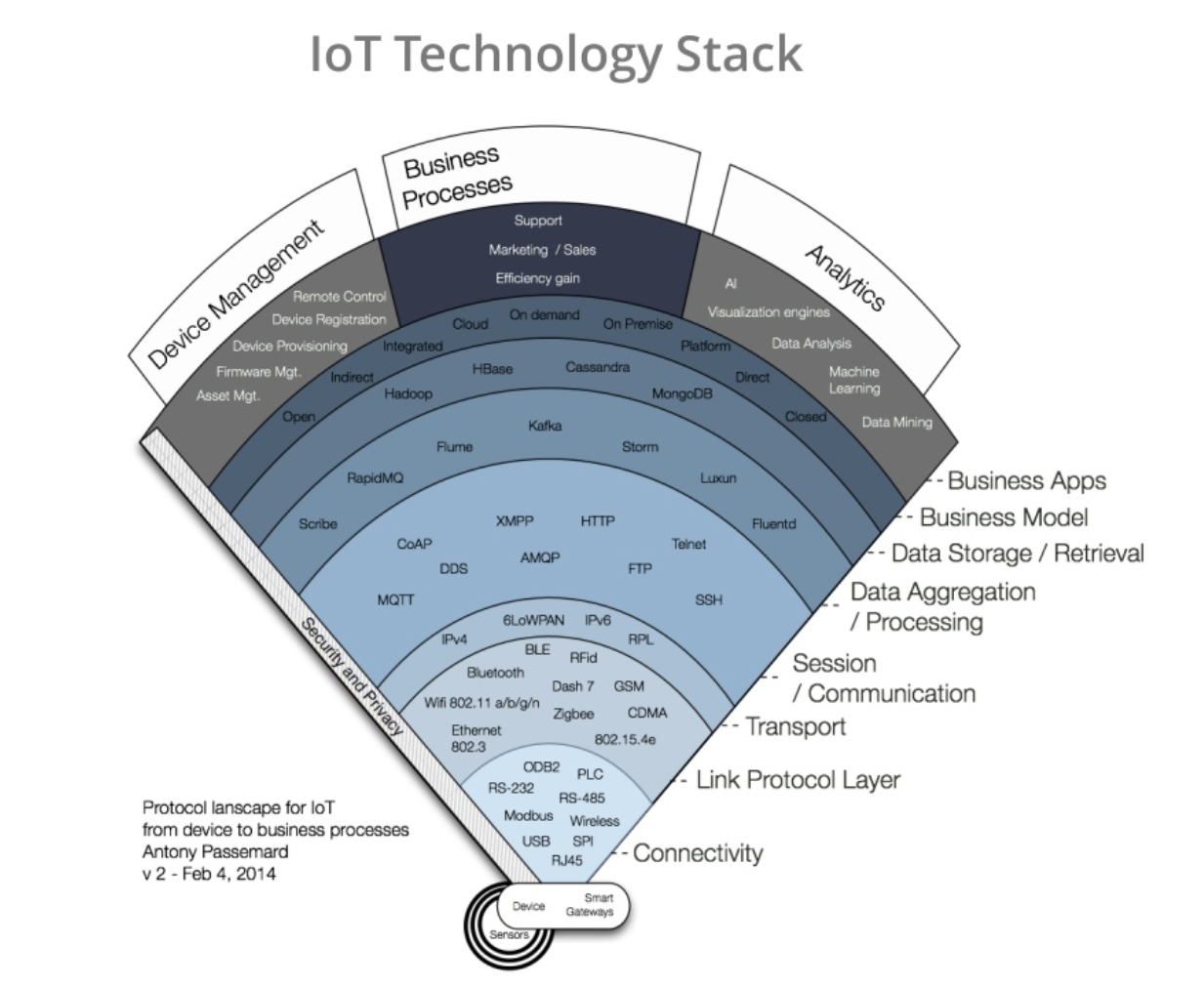 IoT protocol stack diagram showing perception, network, and application layers (Image: Abdullah Ozturk, CC BY-SA 4.0, via Wikimedia Commons)
Industrial applications
In industrial environments, known as IIoT (Industrial IoT) or Industry 4.0, IoT has matured in three concrete areas:
-
Predictive maintenance: vibration and temperature sensors monitor the condition of motors and bearings. ML models detect degradation before failure occurs; Deloitte documents real cases[1] with 10-20% higher uptime in typical predictive-maintenance programs, and unplanned-downtime reductions of up to 50% on specific manufacturing lines.
-
Supply chain tracking: RFID and GPS tags on pallets and containers provide real-time visibility of in-transit inventory, reducing losses and improving planning.
-
Energy management: smart meters and consumption sensors identify peaks and efficiency opportunities in industrial plants.
Integration with observability platforms, like those described in Pixie and Kubernetes observability, follows the same logic: instrument the system to make data-driven decisions rather than react after the fact.
Applications in agriculture and daily life
Precision agriculture is one of the most impactful IoT use cases:
-
Soil moisture sensors and weather stations automatically adjust irrigation. A field trial of IoT-based precision irrigation, published in Frontiers in Water[2], applied 30% less water than the farmer’s traditional schedule while keeping equivalent crop quality.
-
Drones with multispectral cameras identify areas of water stress or pest infestation before they are visible to the naked eye.
-
GPS collars on livestock track movements and detect abnormal behaviours associated with illness.
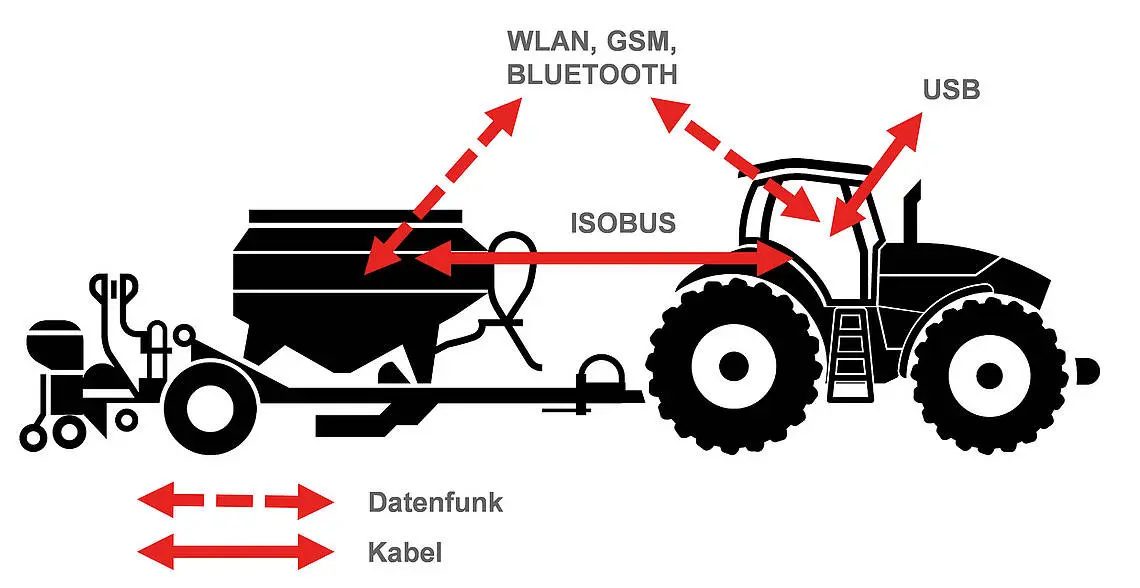 IoT sensor deployment in an agricultural field for crop monitoring (Image: DLG e.V., CC BY-SA 4.0, via Wikimedia Commons)
In the smart home, IoT devices automate climate control, lighting, and security from a mobile app. Thermostats like Nest or Ecobee learn usage patterns and optimise heating and air conditioning consumption. Connected security systems send real-time alerts and allow remote video verification.
Challenges: security and data scale
IoT’s growth is not without problems. The two most significant challenges are:
-
Security: many low-end IoT devices are deployed with default credentials or without firmware updates. The Mirai[3] botnet, built from compromised IP cameras and home routers, launched a 1 Tbit/s attack against hosting provider OVH in 2016. It also knocked out much of the internet across the United States by saturating DNS provider Dyn. Any serious IoT project must include credential rotation, signed OTA updates, and network segmentation.
-
Data volume and latency: a fleet of thousands of sensors generates data volumes that saturate connections if everything is sent to a central cloud. Edge computing (local processing on the device or an intermediate gateway) reduces latency and bandwidth consumption: only relevant data or statistical summaries reach the cloud.
Well-designed IoT instrumentation shares principles with AI-assisted technical support: the value is not in collecting more data, but in identifying which data triggers actions.
Conclusion
IoT transforms the relationship between the physical world and digital systems by making inanimate objects produce actionable data. Its most mature applications (predictive maintenance in industry, precision irrigation in agriculture, home automation) already demonstrate economic returns. The key to extracting that value is a well-designed architecture: appropriate sensors, efficient protocols, edge computing where latency matters, and security from day one.
Frequently asked questions
How much does predictive maintenance with IoT sensors actually save?
Deloitte documents real cases with 10-20% higher uptime in typical predictive-maintenance programs and unplanned-downtime reductions of up to 50% on specific manufacturing lines. The mechanism is vibration and temperature sensors monitoring motors and bearings, with machine learning models detecting degradation before failure occurs.
What security measures should an IoT project include?
At a minimum credential rotation, signed OTA updates, and network segmentation. The risk is real: many low-end devices ship with default credentials or without firmware updates. The Mirai botnet, built from compromised IP cameras and home routers, launched a 1 Tbit/s attack against OVH in 2016. It also knocked out much of the internet across the United States by saturating DNS provider Dyn.
Do all sensor data have to be sent to the cloud?
No. A fleet of thousands of sensors generates data volumes that saturate connections if everything goes to a central cloud. Edge computing, meaning local processing on the device or an intermediate gateway, reduces latency and bandwidth consumption: only relevant data or statistical summaries reach the cloud. The value is not in collecting more data but in identifying which data triggers actions.
Sources: Wikipedia: Mirai (malware)[3] · Deloitte Insights: Using predictive technologies for asset maintenance[1] · Frontiers in Water: Implementation of an in-field IoT system for precision irrigation management[2]