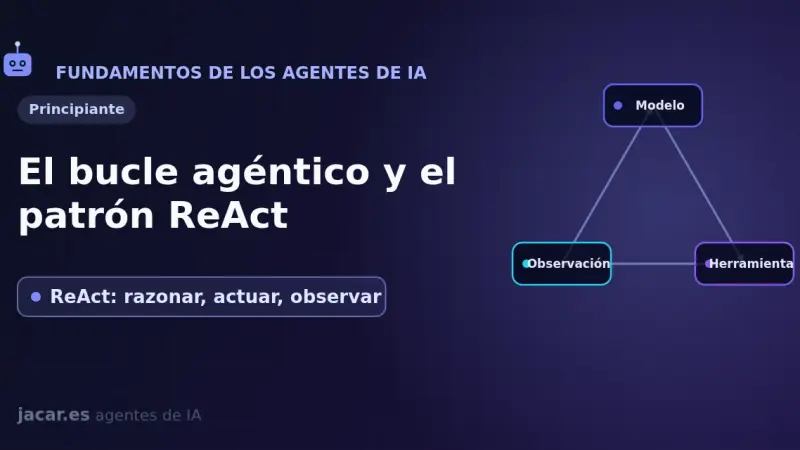
The ReAct pattern (Reason + Act) organizes an agent as a repeating three-step loop: reason about what to do, take an action with a tool, and observe the result. Introduced by Yao and colleagues in 2022, it interleaves reasoning and acting so the model can plan, consult external sources, and fix its own mistakes as it goes.
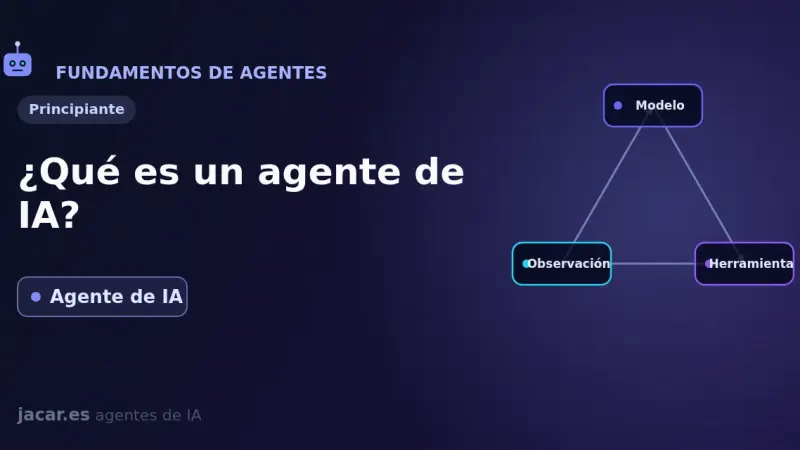
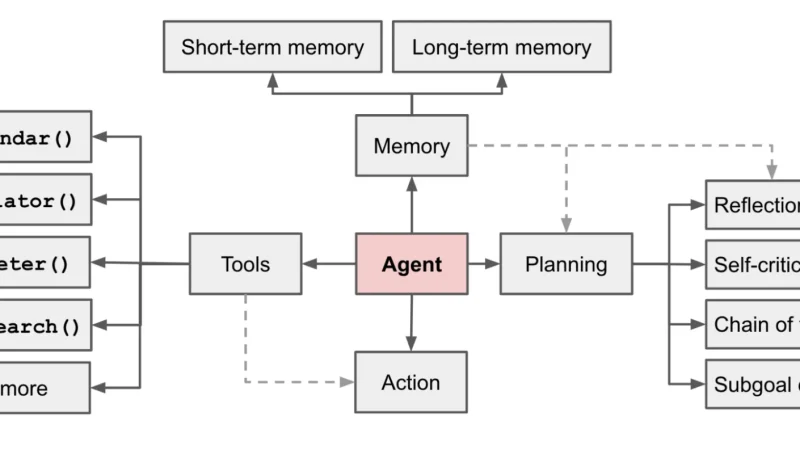
An AI agent is a program that uses a language model as its brain to decide for itself which steps to take toward a goal: it reasons, calls external tools, observes the result and repeats that loop until it is done. Unlike a chatbot, it does not just answer; it acts.
This guide shows how to build a production-ready agent with the Anthropic SDK in Python: the tool-use loop with the Messages API, streaming with backpressure via a bounded queue, prompt caching with cache_control, your own MCP server registered with the Claude Agent SDK, OTel GenAI traces, and a non-root Docker container ready for production.
After eighteen months of multi-vendor adoption, MCP is the de facto standard for connecting models to tools. The complete guide: architecture, servers, policies, authentication, composition, and the antipatterns we’ve already seen in production.
The Model Context Protocol, proposed by Anthropic in late 2024 and adopted through 2025-2026 by Anthropic, OpenAI, Google, and the open-source community, already has proven operational patterns: separating generic servers from custom ones, explicit per-tool policies, credentials kept outside the model, prefixed composition, and contract tests. This is the state of the art in 2026.
The Model Context Protocol has gone from proposal to de facto standard for connecting editors with external tools. This practical guide walks through standing up a local MCP server, wiring it into VS Code or your client of choice, and understanding exactly what you are exposing.
The AI tool stack a developer uses in 2026 looks nothing like it did eighteen months ago. Agentic editors, review tools, terminal agents, and test assistants have settled into recognizable roles. A practical guide by category.
Sixteen months after Anthropic first shipped computer use, with browser-use, OpenAI Operator and Gemini Computer Use all pushing in parallel, agents that drive the browser and desktop have moved from demo to real workflows. Time to review which patterns survive when you run them daily in production.
Model Context Protocol turns ten months old since Anthropic's announcement, and it is no longer just a proposal: hundreds of servers, cross-vendor implementations and a public registry now back it. A look at what has worked, what is still weak, and why 2025 marks the shift from curiosity to basic infrastructure.
After months of rumors, OpenAI released GPT-5 in early August. The first weeks of real-world use show a picture less spectacular than the marketing suggested and more useful than many expected. It is worth separating what is genuinely new from what is merely incremental.
Anthropic released Claude Opus 4 and Claude Sonnet 4 on 22 May 2025, the first major naming jump since the 3.5 series. Claude 4 reasons noticeably better over long programming tasks: multi-hour refactors that previously stalled without a human nudge now run further alone, and the family targets agentic, multi-step flows.
Prompt injection is the most common vulnerability in LLM applications, and many teams defend against it with filters that do not work. We review defense layers backed by evidence, what actually works, and what is security theater.
AI agents have moved from a lab curiosity to serious SDKs from three major providers. A reflection on moving from the flashy demo to an internal use case that shifts a real, measurable metric.
Gemini 2.0, announced by Google in December, puts tool use and agent behavior at the center of the product: it is designed to execute actions, not only generate text. Its clearest advantages are Flash's one-million-token context window, cheap input tokens, and first-class access to Search, Maps, Cloud, and Workspace. Claude 3.5 Sonnet still leads on complex reasoning.
Computer Use is the Claude API feature, launched by Anthropic on 22 October 2024, that lets the model view screenshots and move the mouse, type, and click inside a loop your own system executes and controls. It works well on apps without an API and fails on CAPTCHAs, highly dynamic interfaces, and long tasks.
OpenAI published Swarm as an experimental, educational framework for multi-agent systems. It reduces coordination to two concepts — agents and handoffs — and fits in under 500 lines of Python. A comparison with CrewAI and LangGraph.
CrewAI models agents as a team, each with an explicit role and a set of tasks to carry out. How it compares with LangGraph and AutoGen, what the multi-agent pattern really costs to run, and when the extra coordination is worth paying for.
OpenAI's Assistants API offers persistent threads, sandboxed code execution, and managed document search, but OpenAI is shutting it down completely on August 26, 2026 in favor of the Responses API. We look at when it used to pay off against Chat Completions with your own infrastructure, and what to do if your project still depends on it.
LangGraph models LLM agents as explicit state graphs instead of an opaque loop. When it beats the traditional LangChain agent loop, how checkpointing and failure recovery work, and how to structure flows that do not fall apart the moment they reach production.
LangChain is a Python framework that unifies building LLM applications: prompt templates, retrievers over vector databases, function-calling agents, and conversational memory. It earns its keep in fast prototypes and multi-model systems, but for a single well-defined production use case, direct code usually stays more maintainable.
ChatGPT plugins let the model invoke external services through an OpenAPI specification. Three months after launch, the ecosystem has around 500 plugins with a clear pattern: they work well for live data lookup and internal API exposure, but show friction in multi-plugin orchestration and real-money transactions.
6 min2424.7
We use first- and third-party cookies to analyze site traffic. You can accept them, reject them, or configure your choice.
Learn more about cookies
Cookie preferences
NecessaryEssential for the site to work. Always on.
AnalyticsHelp us understand how the site is used (Google Analytics).