Agentic search means the model plans its own queries against the repository using grep, file listings and a language server, instead of querying an embedding index built beforehand. Claude Code and Cline work this way by design, yet Cursor and Devin Desktop still index, and their own documentation says so.
A vector embedding is a list of real numbers that represents the semantic meaning of a piece of text, an image, or any other data. Two sentences with the same meaning produce vectors that are close together; two unrelated ones produce vectors that are far apart. Semantic search, RAG, and recommendation systems are all built on this principle.
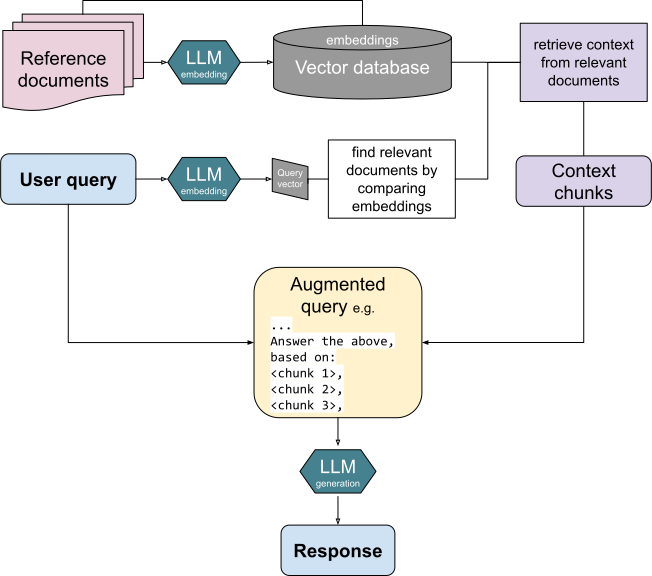
Hybrid RAG in 2026 combines dense and lexical search fused with RRF, cross-encoder reranking over the top-50 candidates, structure-aware chunking, and continuous evaluation with Ragas or TruLens. It is the pattern that survives in serious production systems three years after the initial embeddings boom.
Redis 8.2 ships vector search as a native data type. The real question is whether it replaces a dedicated engine like Qdrant, Weaviate, or pgvector on workloads with millions of vectors and tight latency budgets, or only works as a bonus on top of the cache you already run.
RAG 2.0 means retrieval built from several sources at once rather than a single vector search: dense embeddings, lexical matching, and knowledge graphs that capture relationships between entities, with a reranking layer ordering the final candidates. The 2023 pattern of one vector database plus an LLM no longer describes what production systems actually do.
nomic-embed-text-v1.5 from Nomic AI is an embedding model with weights, code and training data released under Apache 2.0: 137 million parameters, up to 8192 tokens of context, and an MTEB score of 62.4, almost matching the 62.3 of OpenAI's text-embedding-3-small, at 768 dimensions instead of 1536.
OpenAI released text-embedding-3 on 25 January 2024 in two variants: small and large. It improves MTEB quality over ada-002, adds variable dimensions you can truncate without retraining, and lowers the price for small. Migration pays off for most serious RAG setups, but measure real recall on your own corpus before reindexing everything.
pgvector matured in 2023-2024 with the HNSW index type and parallel construction that arrived in version 0.6. For projects already running PostgreSQL, a dedicated vector database is not needed in most cases: this guide explains when PostgreSQL is enough, how to configure the index, and where it starts to fall short.
Cohere Embed v3 is an embedding model that distinguishes queries from documents via the input_type parameter and scores intrinsic text quality, with multilingual support for over 100 languages at 1024 dimensions. It costs $0.10 per million tokens versus OpenAI's $0.02, and delivers better recall in multilingual RAG.
Vector databases have gone from an experimental curiosity to the central component of most LLM-based products. This comparison covers Qdrant, Pinecone, and Weaviate: architecture, strengths, limitations, and a decision tree for choosing the right option based on your operational priorities and budget.
pgvector turns PostgreSQL into a vector database without adding another service to the stack. With version 0.8.6 and PostgreSQL 18, HNSW reached 95.1% recall@10 at 1.15 ms on 99,000 real embeddings. SQL filters share the query with vector ranking, and iterative index scans stop a filter from returning fewer rows than requested.
A text embedding is a numeric vector that encodes the meaning of a word or phrase, so that semantically similar pieces of text produce nearby vectors measured by cosine distance. The models most used in production are OpenAI ada-002, Sentence Transformers, and BGE, and they mainly serve semantic search, RAG systems, and text classification without training a classic classifier.
Chroma is the easiest vector database to get started with embeddings and semantic search: install it with pip install chromadb, no extra infrastructure required, and it exposes a minimal API (add, query, delete). It suits prototypes and mid-sized RAG systems well; past a few million vectors, Qdrant or Milvus scale better.
Qdrant is the pick when full control and performance in self-hosted setups matter most; Pinecone wins for fully managed SaaS with zero operations; Weaviate stands out when native embeddings and hybrid search built into one pipeline add real value. This comparison covers architecture, quantisation, filtering, and RAG use cases to help you decide based on budget and control needs.
7 min3524.4
We use first- and third-party cookies to analyze site traffic. You can accept them, reject them, or configure your choice.
Learn more about cookies
Cookie preferences
NecessaryEssential for the site to work. Always on.
AnalyticsHelp us understand how the site is used (Google Analytics).