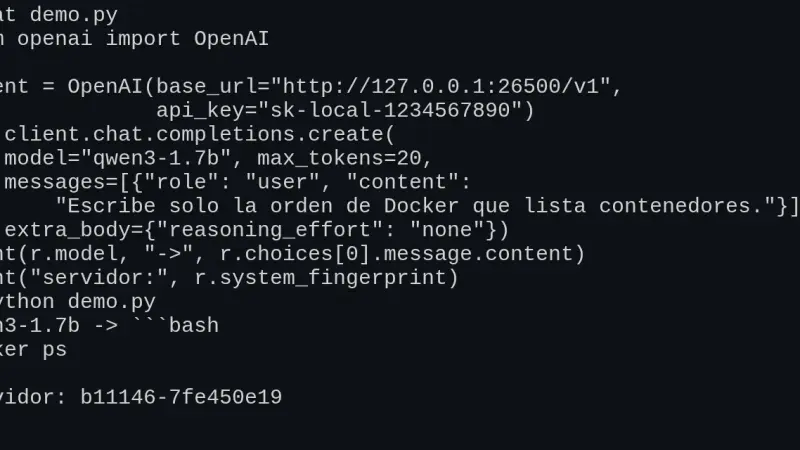
llama-server, the llama.cpp server, exposes /v1/chat/completions, /v1/completions, /v1/embeddings and /v1/models in OpenAI's format, so the official SDK works by changing base_url. I tested v0.5.0 in Docker: tools, schema-constrained JSON and Open WebUI work, but the context is split across slots and a named tool_choice is ignored.
The Model Context Protocol, proposed by Anthropic in late 2024 and adopted through 2025-2026 by Anthropic, OpenAI, Google, and the open-source community, already has proven operational patterns: separating generic servers from custom ones, explicit per-tool policies, credentials kept outside the model, prefixed composition, and contract tests. This is the state of the art in 2026.
After months of rumors, OpenAI released GPT-5 in early August. The first weeks of real-world use show a picture less spectacular than the marketing suggested and more useful than many expected. It is worth separating what is genuinely new from what is merely incremental.
o3-mini, the first public release of OpenAI's o3 reasoning series, clearly improves logic, math, and complex code over GPT-4o, though it answers slower and still hallucinates facts. This analysis, based on weeks of real use, explains where it pays off and where it does not.
OpenAI published Swarm as an experimental, educational framework for multi-agent systems. It reduces coordination to two concepts — agents and handoffs — and fits in under 500 lines of Python. A comparison with CrewAI and LangGraph.
OpenAI's Assistants API offers persistent threads, sandboxed code execution, and managed document search, but OpenAI is shutting it down completely on August 26, 2026 in favor of the Responses API. We look at when it used to pay off against Chat Completions with your own infrastructure, and what to do if your project still depends on it.
GPT-4 Turbo, released in November 2023, expanded GPT-4's context to 128,000 tokens and cut the input price threefold, down to 10 dollars per million tokens. GPT-4o now beats it on price, speed and answer quality, but Turbo still holds up in stable production apps, contracts pinned to a specific version, and deterministic tests that depend on its exact behaviour.
GPT-4o is the OpenAI model presented on May 13, 2024, that fuses text, image, and audio into a single native model, without separate pipelines. It delivers roughly 320-millisecond conversational latency, better multimodal understanding, and a price 50% lower than GPT-4 Turbo.
nomic-embed-text-v1.5 from Nomic AI is an embedding model with weights, code and training data released under Apache 2.0: 137 million parameters, up to 8192 tokens of context, and an MTEB score of 62.4, almost matching the 62.3 of OpenAI's text-embedding-3-small, at 768 dimensions instead of 1536.
The LiteLLM proxy sits between your applications and your model providers, exposing a single endpoint in the OpenAI format that routes each call to OpenAI, Anthropic, Cohere, or a self-hosted model. It earns its place at the second provider, where clean code breaks down: every SDK brings its own client, message format, streaming semantics, errors, and function calling.
OpenAI released text-embedding-3 on 25 January 2024 in two variants: small and large. It improves MTEB quality over ada-002, adds variable dimensions you can truncate without retraining, and lowers the price for small. Migration pays off for most serious RAG setups, but measure real recall on your own corpus before reindexing everything.
LangChain is a Python framework that unifies building LLM applications: prompt templates, retrievers over vector databases, function-calling agents, and conversational memory. It earns its keep in fast prototypes and multi-model systems, but for a single well-defined production use case, direct code usually stays more maintainable.
A text embedding is a numeric vector that encodes the meaning of a word or phrase, so that semantically similar pieces of text produce nearby vectors measured by cosine distance. The models most used in production are OpenAI ada-002, Sentence Transformers, and BGE, and they mainly serve semantic search, RAG systems, and text classification without training a classic classifier.
Five months after launch, GPT-4 excels at chained reasoning, technical writing, and medium-complexity code, but still fails at arithmetic, post-cutoff information, and cross-conversation consistency. Claude 2 wins on long context; LLaMA 2 wins on cost and privacy.
ChatGPT plugins let the model invoke external services through an OpenAPI specification. Three months after launch, the ecosystem has around 500 plugins with a clear pattern: they work well for live data lookup and internal API exposure, but show friction in multi-plugin orchestration and real-money transactions.
OpenAI Code Interpreter extends ChatGPT Plus with an isolated Python sandbox: it runs code on demand, reads files you upload (CSV, Excel, PDF, images, ZIPs) and returns results plus charts within the same chat. Sessions are ephemeral and offline, but remarkably effective for exploratory ad-hoc analysis without spinning up a notebook.
ChatGPT 4 combines advanced natural language processing with deep learning to deliver conversations that are more natural, coherent, and personalised than earlier chatbots. It understands intent and accumulated context, handles multiple intents in a single turn, and reduces escalations to human agents, though it still requires careful design and human oversight.
GitHub Copilot is an AI-powered coding assistant that suggests code as you type, built into VS Code, JetBrains, and Neovim. It speeds up repetitive tasks and API exploration, but it also generates plausible code with real errors: studies document security vulnerabilities in a meaningful share of its suggestions, so every suggestion still needs human review.
6 min206
We use first- and third-party cookies to analyze site traffic. You can accept them, reject them, or configure your choice.
Learn more about cookies
Cookie preferences
NecessaryEssential for the site to work. Always on.
AnalyticsHelp us understand how the site is used (Google Analytics).