Cryptocurrencies: Technical and Professional Analysis

Table of contents
- Key takeaways
- Technical analysis tools and strategies
- Professionalism in cryptocurrency trading
- Legal and tax considerations
- Conclusion
- Frequently asked questions
- Does an RSI above 70 mean I should sell?
- Do I have to declare taxes in Spain if I only swap one cryptocurrency for another?
- How do I protect my cryptocurrencies from theft or mistakes?
- Sources
In the cryptocurrency market, technical analysis is the discipline that allows you to read price history to make better-informed buy and sell decisions. It does not eliminate risk (no tool does), but it separates impulsive decisions from informed ones. In a market as volatile as crypto, that difference can be decisive.
Key takeaways
-
Technical analysis uses charts, indicators, and oscillators to study the historical behaviour of prices.
-
The fundamental tools are Japanese candlestick charts, RSI, and moving averages (EMA/SMA).
-
Support and resistance levels and chart patterns are the foundations of trend analysis.
-
Cryptocurrency trading requires a clear plan, pre-defined loss limits, and rigorous risk management.
-
Asset security (2FA, hardware wallets, regulated exchanges) is as important as analysis.
Technical analysis tools and strategies
Technical analysis starts from a premise: price reflects all available information and historical patterns tend to repeat. The main tools are:
Japanese candlestick charts
Each candle shows four data points: opening price, closing price, high, and low for a time period. Candlestick patterns (hammer, morning star, bullish engulfing) are visual signals of possible trend changes.
Momentum indicators:
-
RSI, Relative Strength Index[1]: measures whether an asset is overbought (RSI > 70) or oversold (RSI < 30). Not an automatic buy or sell signal, just contextual data.
-
MACD, Moving Average Convergence-Divergence[2]: detects changes in a trend’s strength, direction, and duration.
-
EMA (Exponential Moving Average): gives more weight to recent prices; a short EMA crossing above a long EMA reads as a bullish signal.
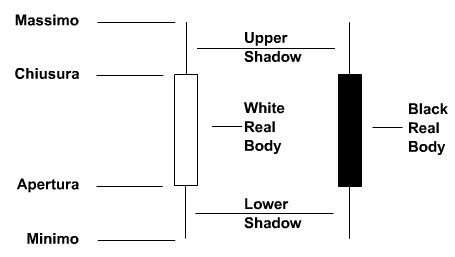 Japanese candlestick chart used in technical analysis of financial markets (Image: Pascarella Giuseppe from Italy., CC BY-SA 3.0, via Wikimedia Commons)
Support, resistance, and chart patterns
Support levels are price zones where historical demand has stopped declines; resistance zones are where supply has contained rises. The most recognised chart patterns are:
-
Head and shoulders (bearish reversal signal).
-
Ascending and descending triangles (trend continuation or reversal).
-
Pennants and flags (trend continuation after brief consolidation).
-
Double top / double bottom (trend reversal).
Volume analysis complements patterns: a resistance breakout on high volume is more valid than one on low volume. The same data analysis principles that Big Data applies to business decision-making function here at market scale.
Professionalism in cryptocurrency trading
The cryptocurrency market is one of the most volatile in the world. Spain’s CNMV and Banco de España have warned about this in joint statements[3]. No cryptocurrency issuance is authorised by a Spanish supervisor, so investors do not have the protections that apply to a regulated financial product. Professionalism does not guarantee profits, but it does limit avoidable losses:
Before trading:
-
Thoroughly research any asset before investing: technology, team, use cases, liquidity, and applicable regulation in your jurisdiction.
-
Define your risk profile: how much can you lose without affecting your financial situation?
During trading:
-
Set stop-loss limits on every trade before opening it, not after.
-
Diversify: do not concentrate all capital in a single asset.
-
Avoid trading on margin until you have consolidated experience; it amplifies both gains and losses.
Asset security:
-
Enable two-factor authentication (2FA) on all exchanges and wallets.
-
For significant amounts, use a hardware wallet (Ledger, Trezor) that keeps private keys offline.
-
Use only regulated exchanges with a verifiable track record.

Cryptocurrency security is a specific case of the practices described in cybersecurity and protection against digital threats. The attack vectors (phishing, malware, social engineering) are the same. The irreversibility of blockchain transactions means the impact of an error is permanent.
Legal and tax considerations
Each country treats cryptocurrencies differently. In Spain, according to the Tax Agency (Agencia Tributaria)[4]:
-
Gains from disposing of cryptocurrency are taxed as a capital gain within the savings tax base (personal income tax).
-
There is an obligation to declare assets held abroad above €50,000 via Form 721[5].
-
Exchanging one cryptocurrency for another is a barter transaction and counts as a taxable event, not just converting to fiat currency.
The key takeaway is universal: do not trade in any market without understanding the tax obligations it entails. Ignorance does not exempt you from responsibility before the tax authority.
Conclusion
Technical analysis is a valuable tool in the cryptocurrency market, but it is not an oracle. Its real value lies in structuring decision-making, reducing impulsive trades, and managing risk with judgement. Combined with fundamental research, robust asset security, and tax discipline, it can be part of a sustainable long-term investment strategy; without them, it only adds noise.
Frequently asked questions
Does an RSI above 70 mean I should sell?
Not automatically. RSI indicates an asset is overbought above 70 and oversold below 30, but it is contextual data, not a buy or sell signal on its own. It is best combined with other indicators such as MACD or EMA crossovers, with support and resistance levels, and with volume: a breakout on high volume is more valid than one on low volume.
Do I have to declare taxes in Spain if I only swap one cryptocurrency for another?
Yes. According to the Agencia Tributaria, exchanging one cryptocurrency for another is a barter transaction and counts as a taxable event, not just converting to fiat. Gains from disposing of cryptocurrency are taxed as a capital gain within the savings base of personal income tax, and assets held abroad above €50,000 must be declared via Form 721. Ignorance does not exempt you from responsibility before the tax authority.
How do I protect my cryptocurrencies from theft or mistakes?
Enable two-factor authentication (2FA) on all exchanges and wallets. Use only regulated exchanges with a verifiable track record. For significant amounts, keep private keys offline in a hardware wallet such as Ledger or Trezor. The attack vectors are the same as anywhere else online (phishing, malware, social engineering), but the irreversibility of blockchain transactions means the impact of an error is permanent.