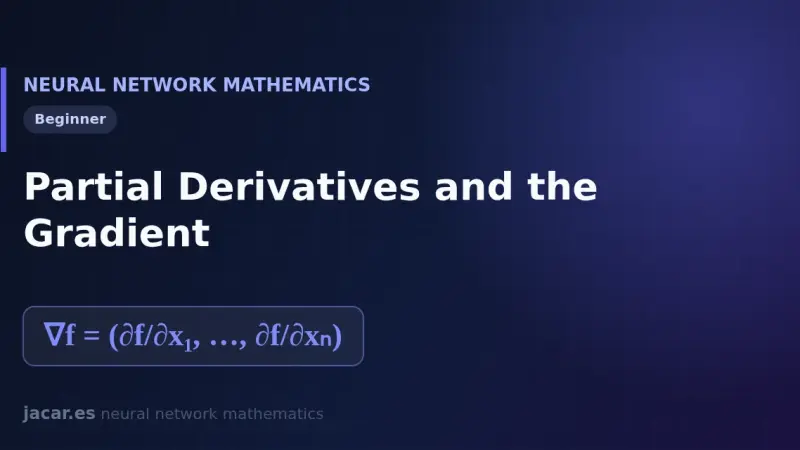
A partial derivative measures how a function changes when you move just one of its variables and hold the rest fixed. The gradient gathers all those partial derivatives into a vector that points toward the steepest ascent; in a neural network, moving the opposite way lowers the error and drives the training.
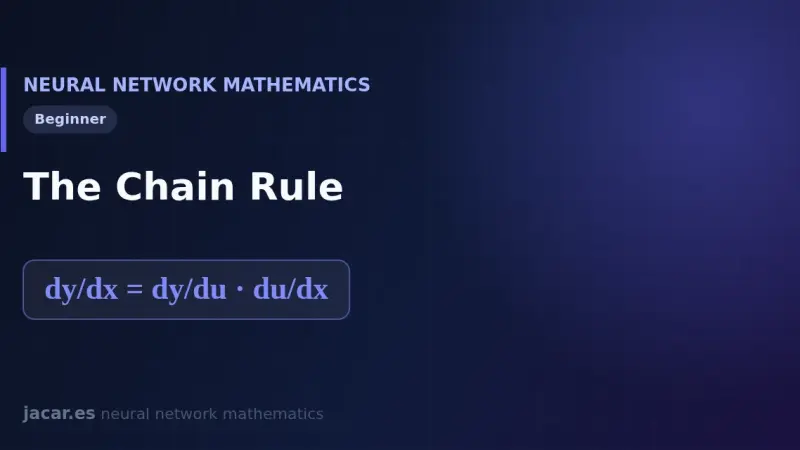
The chain rule computes the derivative of a composite function by multiplying the derivatives of its links: if y depends on u and u depends on x, then dy/dx equals dy/du times du/dx. That layer-by-layer multiplication of derivatives is exactly what backpropagation does to train a neural network.
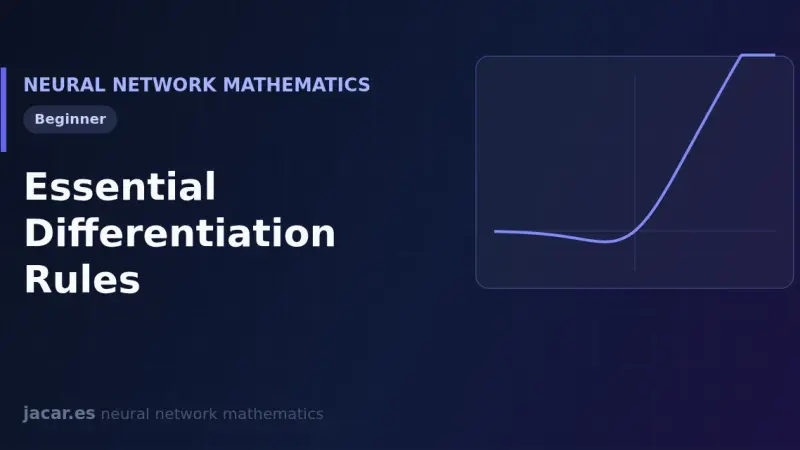
The essential differentiation rules are a handful of formulas that turn any function into its derivative: the power rule, the product and quotient rules, and the rules for the exponential and the logarithm. With them, plus the chain rule, a neural network computes gradients and learns by adjusting its weights.
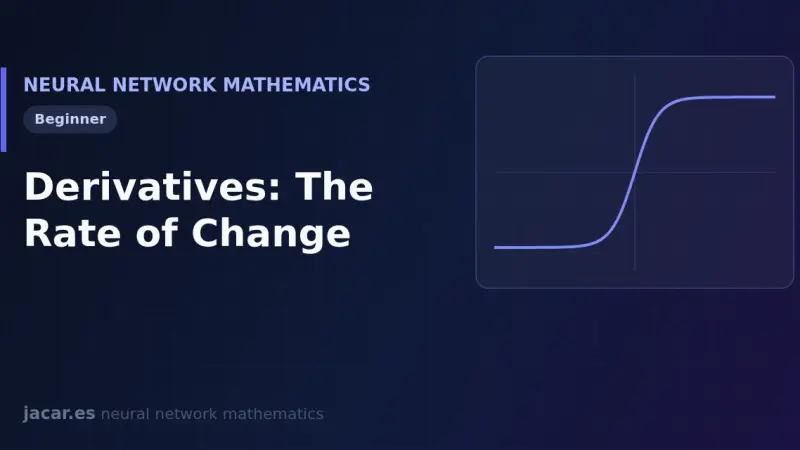
A derivative measures the rate of change of a function: how much its output varies when the input changes a little. In a neural network, that slope tells us in which direction and how strongly to adjust each weight to reduce the error, and it is the foundation of gradient descent and backpropagation.
7 min
We use first- and third-party cookies to analyze site traffic. You can accept them, reject them, or configure your choice.
Learn more about cookies
Cookie preferences
NecessaryEssential for the site to work. Always on.
AnalyticsHelp us understand how the site is used (Google Analytics).