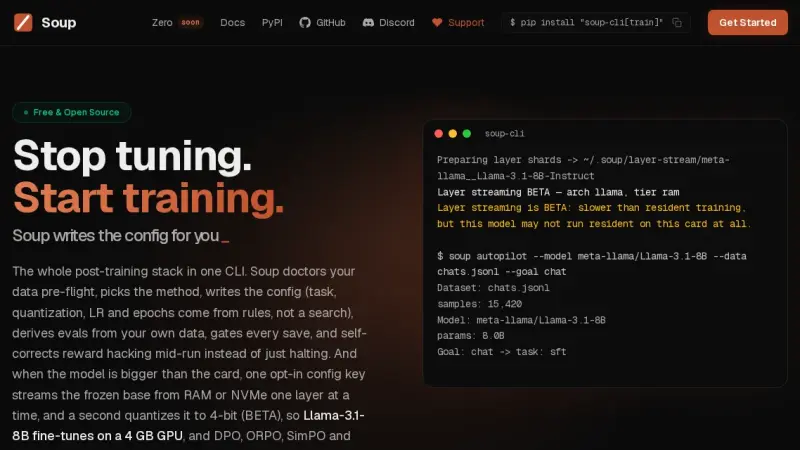
Soup is an open-source CLI (Apache 2.0) that covers LLM post-training end to end: it decides whether training is worth it, writes the config, trains with LoRA, DPO or GRPO and returns a SHIP or DON'T SHIP verdict. I tested version 0.76.1 on 15 October 2026 on Linux arm64 with no GPU.
Synthetic data has moved from a precarious substitute for real data to a central component of modern model training: the most reliable pattern expands a real core of 500 examples with thousands of synthetic paraphrases, provided you validate diversity, correctness, and distribution, and keep at least 30% real data to avoid model collapse.
Direct Preference Optimization (DPO) and its variants, IPO, KTO, and SimPO, have displaced RLHF as the preferred alignment method for language models: they drop the separate reward model, cut training cost, and are easier to reproduce. RLHF still has an edge only for frontier models with very large budgets.
Three years after RLHF became popular, the model-alignment field is far richer. A review of RLHF, DPO, and newer methods such as KTO and ORPO, with criteria for choosing between them.
LoRA cuts fine-tuning cost for large language models by training only small low-rank adaptation matrices instead of every parameter in the base model. QLoRA adds 4-bit quantization on top, cutting required GPU memory by 65-75%, with quality loss of just 1-3% versus full fine-tuning.
Fine-tuning your own LLM pays off in three cases: you need a very specific style or voice, a rigid structured output format, or you want lower cost and latency from a small specialised model. LoRA and QLoRA have cut the GPU cost, but preparing data and running the model in production are still expensive. For everything else, RAG and prompt engineering are usually enough.
Transfer learning lets you reuse a model already trained on a massive dataset, such as ImageNet or a large text corpus, to solve a new task with far less proprietary data and compute time. It works through fine-tuning, feature extraction, or prompting, and it performs best when the source and target domains are similar to each other.
7 min3734.1
We use first- and third-party cookies to analyze site traffic. You can accept them, reject them, or configure your choice.
Learn more about cookies
Cookie preferences
NecessaryEssential for the site to work. Always on.
AnalyticsHelp us understand how the site is used (Google Analytics).