A learning rate schedule changes the value of η over the course of training instead of keeping it fixed. It starts with a warmup that raises η from near zero, holds a peak and then lowers it with step, exponential or cosine decay so the network converges faster and with far less oscillation.
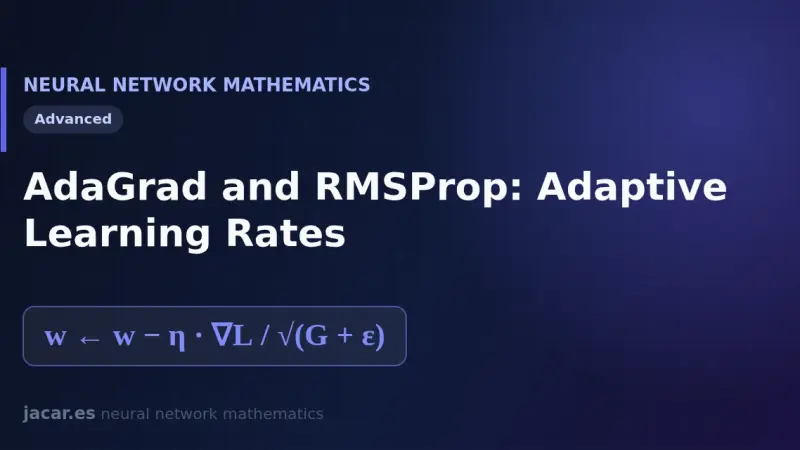
AdaGrad and RMSProp are optimisers that give every weight its own learning rate. AdaGrad accumulates the square of all past gradients and divides the step by its root, which slowly fades it out. RMSProp fixes this with a moving average that forgets the past using a decay factor of about 0.9.
The learning rate is the hyperparameter that sets the size of each step when adjusting the weights during training. Too high a value makes the loss diverge; too low a value makes learning painfully slow. Typical values range from 0.001 with Adam to 0.1 with classic gradient descent.
4 min32
We use first- and third-party cookies to analyze site traffic. You can accept them, reject them, or configure your choice.
Learn more about cookies
Cookie preferences
NecessaryEssential for the site to work. Always on.
AnalyticsHelp us understand how the site is used (Google Analytics).