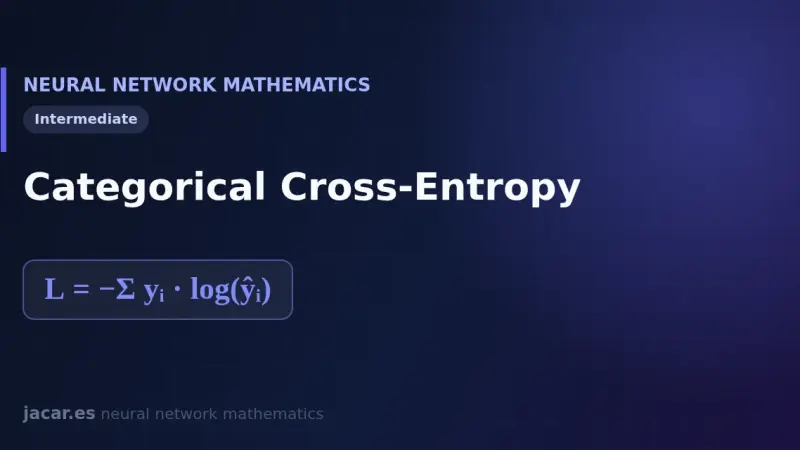
Categorical cross-entropy is the standard loss function for classifying into several mutually exclusive classes. It compares the distribution the network predicts, usually after a softmax, with the true label written in one-hot format, and it penalises heavily any low probability assigned to the correct class.
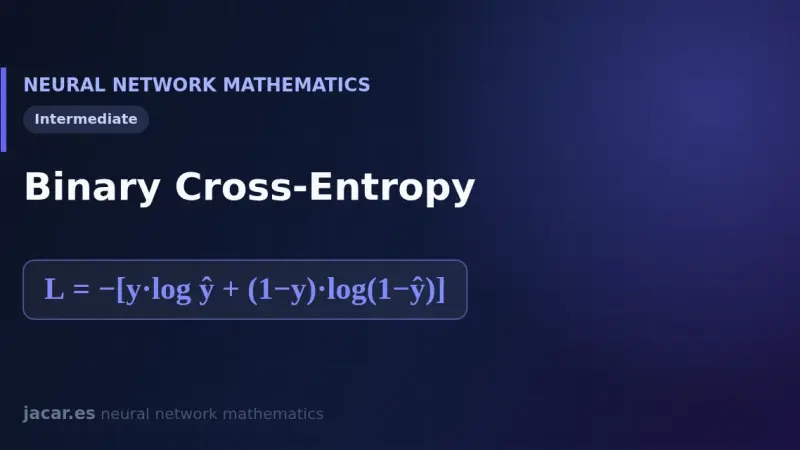
Binary cross-entropy is the standard loss function for two-class classification. It compares the probability returned by the sigmoid with the true label, 0 or 1, and punishes confident mistakes hard. Its formula comes from maximum likelihood, and its derivative combines with the sigmoid into a very simple gradient.
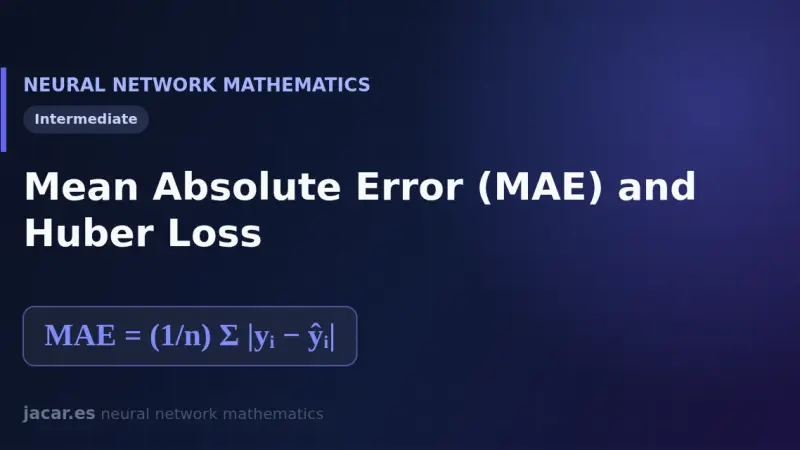
Mean absolute error (MAE) averages the absolute difference between prediction and reality, so a single outlier weighs only its fair share and never blows up the loss. Huber loss combines that robustness with the smoothness of mean squared error through a delta parameter that decides where the behaviour switches over.
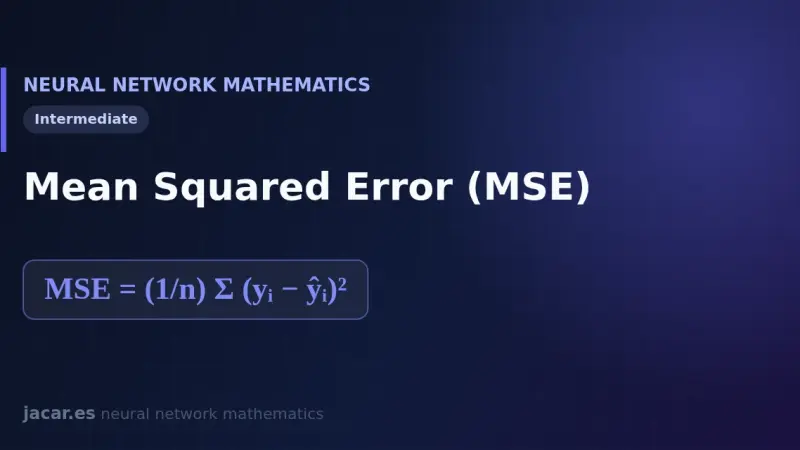
Mean squared error (MSE) is the most common loss function in regression: it averages the square of the gap between each true value and its prediction. Squaring punishes big mistakes hard, keeps the function differentiable and gives gradient descent a clear, smooth target to minimise while training a model.
A loss function measures how wrong a neural network is on a single example, comparing its prediction with the correct value. The cost function averages that loss across the whole dataset. That single number is exactly what training tries to reduce, step by step, using gradient descent to adjust every weight.
Probability in neural networks rests on three ideas: a distribution assigns weights to possible outcomes, the expected value averages those outcomes, and likelihood measures how well the model fits the data. From those three pieces come the softmax function and the cross-entropy loss that we optimise.
7 min
We use first- and third-party cookies to analyze site traffic. You can accept them, reject them, or configure your choice.
Learn more about cookies
Cookie preferences
NecessaryEssential for the site to work. Always on.
AnalyticsHelp us understand how the site is used (Google Analytics).