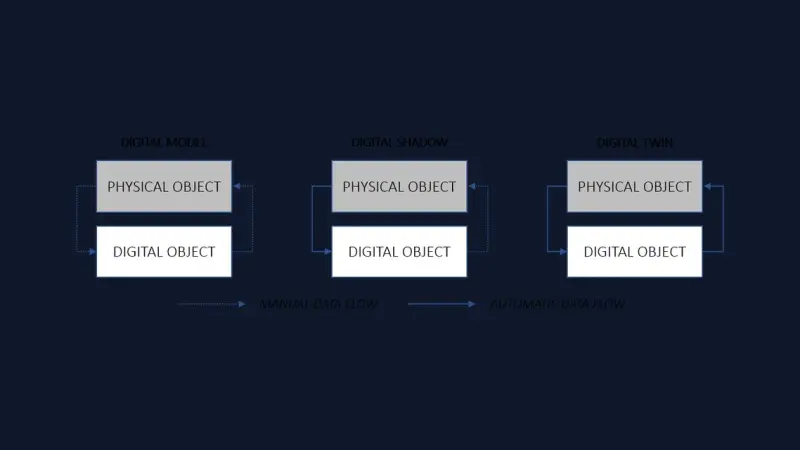
We've spent a decade talking about digital twins on the factory floor, and today real plants in Spain have twins that actually work. Of the four typologies (asset, process, plant, and product), three have proven return; the product twin remains more promise than reality. A look at which platforms are winning, where the twin pays for itself, and what is still hype.
A digital twin is a software replica of a physical asset (machine, production line, or whole plant) synchronised in real time with IoT sensors. It enables failure prediction, energy optimisation, and operator training without risk. It returns real value when the asset is critical, the data is reliable, and the team can maintain the model long-term.
Industrial predictive maintenance rarely needs deep learning: classic models such as random forests, SVMs, or survival models solve 80% of cases. The key lies in feature engineering over vibration, temperature, and power-consumption signals, with pipelines that run on as little as 50 MB of RAM without a GPU.
6 min2334.4
We use first- and third-party cookies to analyze site traffic. You can accept them, reject them, or configure your choice.
Learn more about cookies
Cookie preferences
NecessaryEssential for the site to work. Always on.
AnalyticsHelp us understand how the site is used (Google Analytics).