The hyperbolic tangent (tanh) is an activation function that squashes any real value into the interval (-1, 1) with zero-centred output, which removes the systematic gradient bias seen with sigmoid. It is the standard activation inside the LSTM and GRU memory cells used in recurrent networks.
The sigmoid function maps any real number to a value between 0 and 1, which makes it the natural activation function for expressing probabilities in a neural network. It is differentiable across its whole domain, though it suffers from saturation and vanishing gradients in deep networks, so today it is mostly reserved for the output layer.
The Softmax function transforms a neural network's output logits into a probability distribution that sums to 1. It is the standard activation for multi-class classification, from image classifiers to the vocabulary layer of language models like GPT.
Leaky ReLU is an activation function derived from ReLU that replaces the zero output for negative inputs with a small slope, typically 0.01. This keeps the gradient from ever reaching zero, which prevents the dying neuron problem and stabilizes training in very deep convolutional, recurrent, and GAN networks.
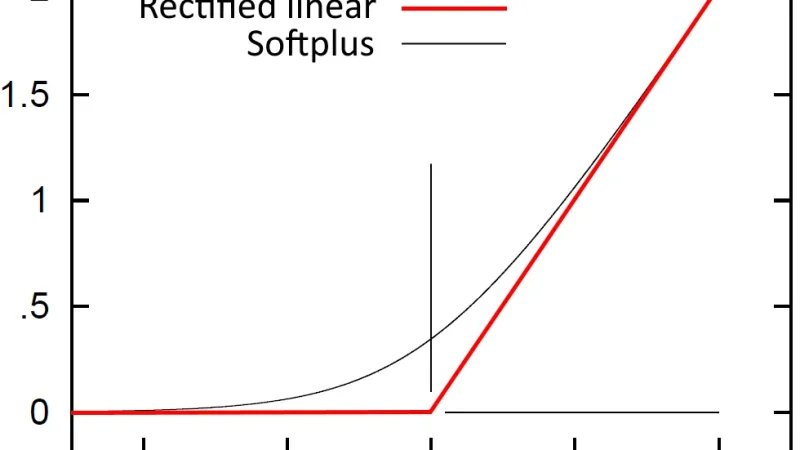
ReLU (Rectified Linear Unit, f(x) = max(0, x)) has been the dominant activation function in deep learning since AlexNet popularised it in 2012: cheap to compute, resistant to vanishing gradients, and with one well-known weakness, dying ReLU.
The step function, or Heaviside function, is the simplest activation function in a neural network: it maps any input to a binary output, 0 or 1, depending on whether it crosses a fixed threshold. It was the core decision mechanism of Rosenblatt's perceptron in 1958, but its derivative is zero almost everywhere, so modern networks use sigmoid or ReLU instead.
The linear function f(x) = ax + b is the simplest activation a neural network can use: in its identity form, f(x) = x, it is the standard choice for the output layer in regression, because it does not bound the range of possible values. In hidden layers it fails, because composing several linear functions collapses the whole network into one equivalent linear layer.
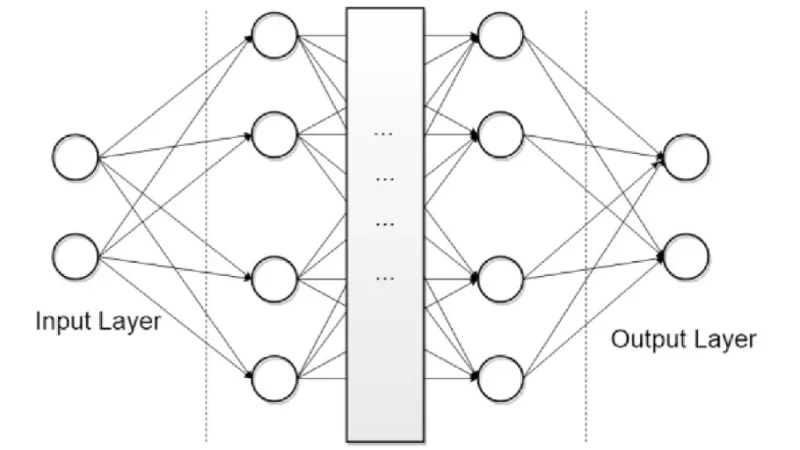
A fully connected neural network, also called a dense network, is the fundamental architecture of deep learning: every neuron in a layer connects to all neurons in the previous and next layer. This total connectivity lets it approximate any continuous function, though its computational cost grows quadratically with the number of neurons.
In a neural network, the input is represented as a column vector x in R^n that the hidden layer transforms through a weight matrix W, a bias vector b, and a non-linear activation function such as ReLU, sigmoid, or tanh. Training adjusts W and b by minimising the loss function via gradient descent and backpropagation.
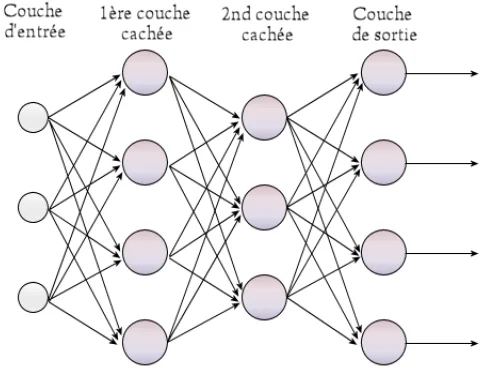
A multilayer neural network consists of an input layer, one or more hidden layers, and an output layer, where each neuron weights its inputs and applies a non-linear activation function before passing the result to the next layer. Through forward propagation and backpropagation, the network adjusts millions of weights to learn hierarchical representations capable of classifying images, translating text, or generating language.
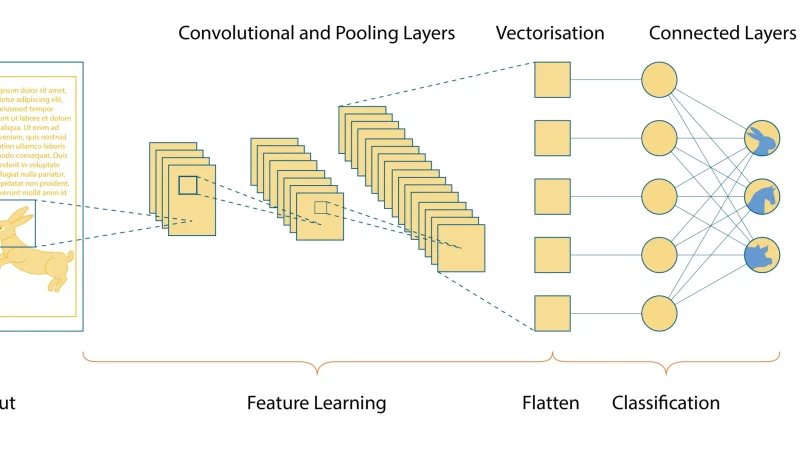
Computer vision is the branch of artificial intelligence that lets machines interpret digital images: detecting objects, segmenting regions and recognising patterns through convolutional neural networks. Since 2012, when AlexNet cut ImageNet classification error to 15.3%, it has spread into manufacturing, medicine, transport and precision agriculture.
Deep neural networks are today the foundation of almost every artificial intelligence application: from facial recognition to machine translation. Built on architectures like CNNs, RNNs, and Transformers, deep learning has transformed computer vision, speech recognition, and natural language processing over the last decade.
Modern artificial intelligence rests on three pillars: machine learning, deep neural networks, and natural language processing. These techniques have pushed image recognition and machine translation past human-level precision on specific tasks, though the overall system still depends on quality data and constant human oversight.
5 min2054.3
We use first- and third-party cookies to analyze site traffic. You can accept them, reject them, or configure your choice.
Learn more about cookies
Cookie preferences
NecessaryEssential for the site to work. Always on.
AnalyticsHelp us understand how the site is used (Google Analytics).