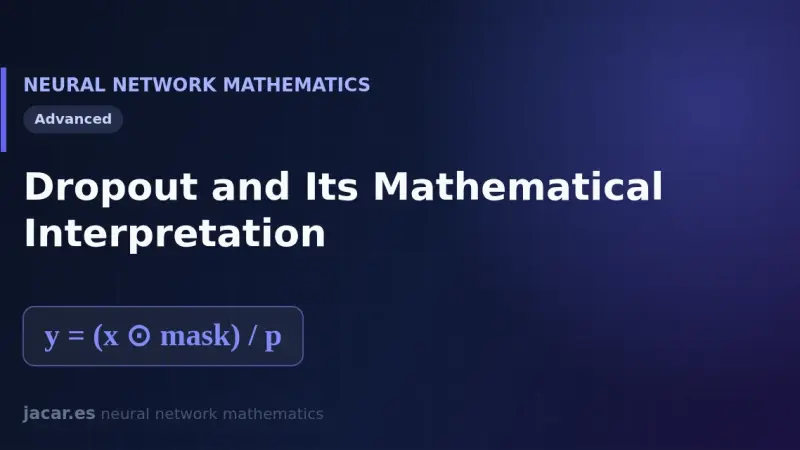
Dropout is a regularization technique that switches neurons off at random during training, with retention probability p, and divides the surviving activations by p to preserve their scale. At inference the full network runs without dropping anything. Mathematically it amounts to averaging a huge ensemble of subnetworks that share weights.
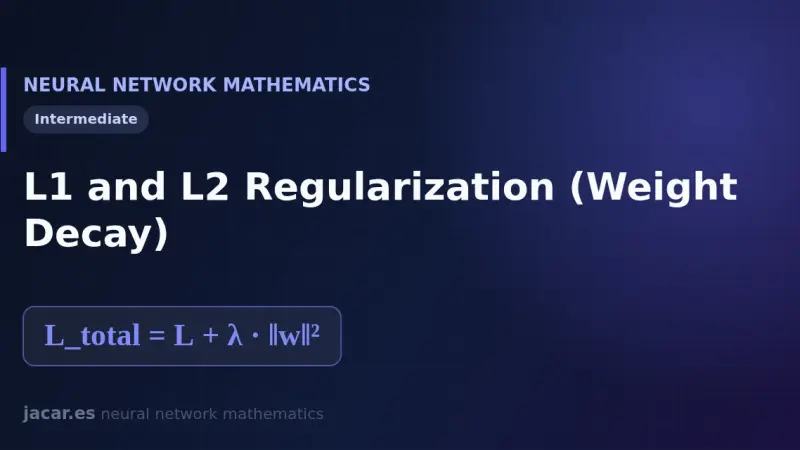
L1 and L2 regularization adds a term to the loss function that penalises large weights. L2, or weight decay, shrinks the weights smoothly towards zero; L1 drives them exactly to zero and yields sparse models. Both curb overfitting and improve the generalisation ability of a neural network on unseen data.
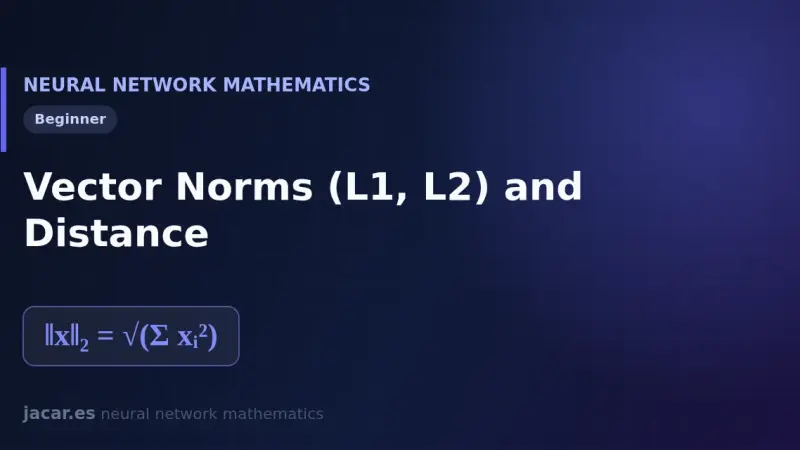
A vector norm measures its length or magnitude. The L1 norm adds the absolute values of the components, while the L2 norm applies the Pythagorean theorem: the square root of the sum of squares. Both define different distances between points and underpin the regularisation that prevents overfitting in neural networks.
6 min
We use first- and third-party cookies to analyze site traffic. You can accept them, reject them, or configure your choice.
Learn more about cookies
Cookie preferences
NecessaryEssential for the site to work. Always on.
AnalyticsHelp us understand how the site is used (Google Analytics).