The 3D Printing Revolution: Transformative Technology

Table of contents
- Key takeaways
- How additive manufacturing works
- Industry impact
- 3D printing in construction and sustainability
- Current limits and expected evolution
- Conclusion
- Frequently asked questions
- When does 3D printing pay off compared with injection moulding?
- Which 3D printing technology should I choose for the part I need?
- Are 3D-printed parts reliable for structural or certified applications?
- Sources
3D printing (technically, additive manufacturing) has travelled from laboratory curiosity to production tool in just over two decades. Today, customised medical prostheses, rocket components, aircraft parts, entire houses, and spare parts that would otherwise have weeks of lead time are being printed. The key to this revolution lies not just in the technology, but in the paradigm shift it introduces: from subtractive to additive manufacturing, from economies of scale to personalisation at no additional cost.
Also available in Spanish: La Revolución de la Impresión 3D: Tecnología Transformadora.
Key takeaways
-
Additive manufacturing builds objects layer by layer from a digital file, eliminating the need for moulds or specific tooling.
-
Different technologies exist, each with its own trade-offs between cost, resolution, and materials: FDM (fused deposition modelling), SLA (stereolithography), SLS (selective laser sintering), among others.
-
The most documented benefits are reduced prototyping lead times, part customisation, and on-demand manufacturing.
-
The sectors with the highest adoption are medicine, aeronautics, automotive, and construction.
-
Current limits include production speed for high volumes and the range of certifiable materials.
How additive manufacturing works
The principle is common to all 3D printing technologies: a CAD or scanned file is converted into a sequence of thin layers that the system materialises one by one. What varies between technologies is the method of fusion or curing:
-
FDM (Fused Deposition Modelling): the most widespread method in desktop printers. A thermoplastic filament is melted and deposited by an extrusion head onto the build surface. Materials: PLA, ABS, PETG, nylon, carbon-fibre-filled materials.
-
SLA (Stereolithography): a UV laser or LCD screen cures a liquid photosensitive resin layer by layer. Higher resolution than FDM; used in dentistry and jewellery.
-
SLS (Selective Laser Sintering): a laser sinters nylon, TPU, or metal powders. No support structures required; ideal for complex geometries and small-series production.
-
DMLS/EBM (metal fusion): SLS variants for metals (titanium, aluminium, stainless steel). Used in aeronautics and medicine for high-strength parts.
 Complex plastic part produced by FDM additive manufacturing, showing the characteristic layers of the process (Image: Jgarant, CC BY-SA 3.0, via Wikimedia Commons)
Industry impact
The most immediate transformation has been in prototyping. Where an injection mould previously took weeks and cost tens of thousands of euros, a 3D printer produces the same functional prototype in hours at marginal cost. This has dramatically accelerated design-test-iterate cycles.
The market itself reflects this maturity: according to the Wohlers Report 2026[1], global additive manufacturing revenues reached $24.2 billion in 2025, up 10.9% year over year. As Mahdi Jamshid, director of market intelligence at Wohlers Associates, put it: "additive manufacturing is no longer advancing on a single, uniform growth curve"; the industry is growing more unevenly, more regionally, and more closely tied to real production outcomes.
The most documented production impacts include:
-
Inventory reduction: instead of stocking thousands of spare parts, aeronautical and naval manufacturers print certified parts on demand when needed, reducing tied-up capital.
-
Component consolidation: a complex part that previously required joining 20 sub-components can be printed as a single piece, reducing failure points and weight.
-
Mass customisation: orthopaedic prostheses, orthopaedic insoles, and dental implants are now manufactured to measure for each patient using 3D scanning + 3D printing, at a cost that does not scale with personalisation.
In aerospace, GE Aerospace manufactures LEAP engine fuel nozzles via DMLS: the process consolidates roughly 20 previously welded and brazed pieces into one, cutting the nozzle’s weight by about 25% (GE Aerospace News[2]). For a closer look at this kind of application, see metal additive manufacturing: where it stands in 2025. In medicine, companies like Materialise produce customised surgical guides for orthopaedic procedures.
3D printing in construction and sustainability
One of the most striking developments is the application of additive manufacturing to construction:
-
Companies like ICON (USA) and COBOD (Europe) print entire homes in concrete in a matter of days. ICON now prices its printed wall systems from $25 per square foot ($80 including foundation and roof), below typical conventional-construction pricing. That would mean savings of up to $25,000 on an average American home (ICON[3]).
-
In civil engineering, MX3D[4] in Amsterdam printed a 12-metre stainless-steel pedestrian bridge, installed over one of the canals in the historic city centre since 2021.
The sustainability angle is relevant: additive manufacturing generates less material waste than subtractive machining (milling, turning), where surplus material is discarded. FDM printers using recycled or biodegradable filaments (PLA based on corn starch) reduce the environmental footprint.
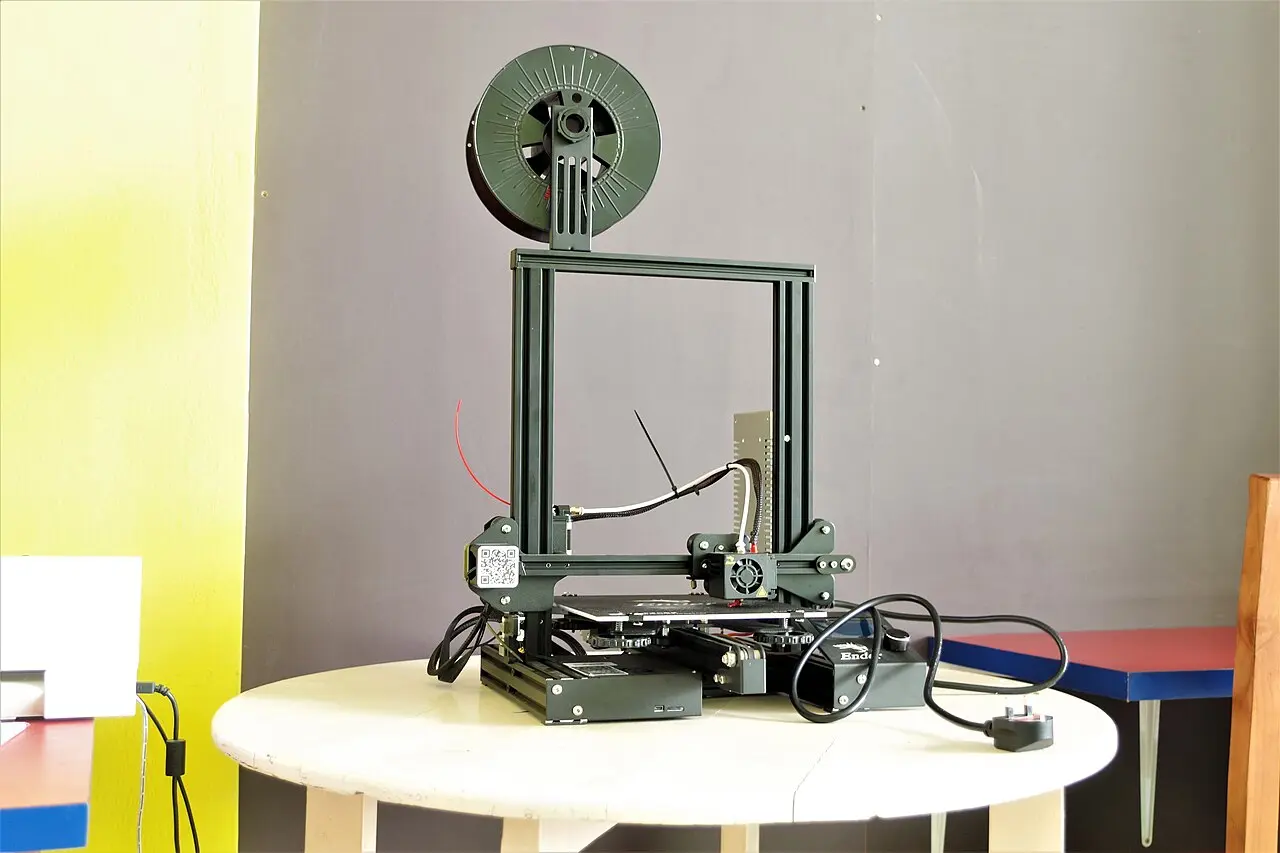 FDM 3D printer depositing thermoplastic material layer by layer to build a three-dimensional part (Image: Adoscam, CC BY-SA 4.0, via Wikimedia Commons)
Current limits and expected evolution
Additive manufacturing is not the solution for everything. Its most relevant limitations today are:
-
Speed: for high volumes, injection moulding remains faster. 3D printing competes in small series and unique parts.
-
Mechanical properties: FDM parts have anisotropic properties (weaker between layers). For critical structural applications, SLS and DMLS are more reliable, but much more expensive.
-
Material certification: in aeronautics and medicine, validating printed materials is costly. The database of certified materials is growing but is still smaller than for conventional processes.
-
Post-processing: surface finishing, support removal, or subsequent heat treatment add time and cost.
The most promising near-term evolution lies in continuous carbon fibre printing (companies like Markforged or Continuous Composites) and multi-material systems that allow printing rigidity gradients or embedded electronic components. We track the aggregate state of these trends in additive manufacturing: industrial state at the start of 2026.
This type of incremental innovation shares the logic of the development tools described in GitHub Codespaces: each iteration of the environment removes a specific friction, without trying to solve everything at once.
Conclusion
3D printing has moved from laboratory technology to a real production tool in key sectors. Its value proposition is clear: customisation without cost penalty, on-demand manufacturing without inventory, and geometries that conventional processes cannot produce. Teams that integrate additive manufacturing into their value chain don’t just reduce time and cost. They also gain the ability to iterate designs at a speed that fundamentally changes the relationship between prototype and product.
Sources:
- GE Aerospace News: Manufacturing Milestone: 30,000 Additive Fuel Nozzles[2]
- MX3D: MX3D Bridge[4]
- ICON: ICON Unveils New Construction Technologies for Lowest Cost, Fastest, and Most Sustainable Way to Build at Scale[3]
- Wohlers Associates: New Wohlers Report 2026 Values Additive Manufacturing Market at $24.2B[1]
Frequently asked questions
When does 3D printing pay off compared with injection moulding?
For small series, unique parts, and prototypes: an injection mould takes weeks and costs tens of thousands of euros, while a 3D printer produces the same functional prototype in hours at marginal cost. For high volumes, injection moulding remains faster. Additive manufacturing also wins when the geometry is complex or when it makes sense to produce on demand without stocking inventory.
Which 3D printing technology should I choose for the part I need?
FDM is the most widespread in desktop printers and melts filaments such as PLA, ABS, PETG, or nylon, but its parts are anisotropic, weaker between layers. SLA cures resin with a UV laser or LCD screen and offers higher resolution, useful in dentistry and jewellery. SLS sinters nylon, TPU, or metal powders with no support structures, ideal for complex geometries; DMLS/EBM are its variants for titanium, aluminium, or stainless steel.
Are 3D-printed parts reliable for structural or certified applications?
It depends on the process. FDM parts have anisotropic properties and are not the best choice for critical structural applications; SLS and DMLS are more reliable, though much more expensive. In aeronautics and medicine, certifying printed materials remains costly and the database of validated materials is still smaller than for conventional processes. Surface finishing, support removal, or subsequent heat treatment also add work after printing.