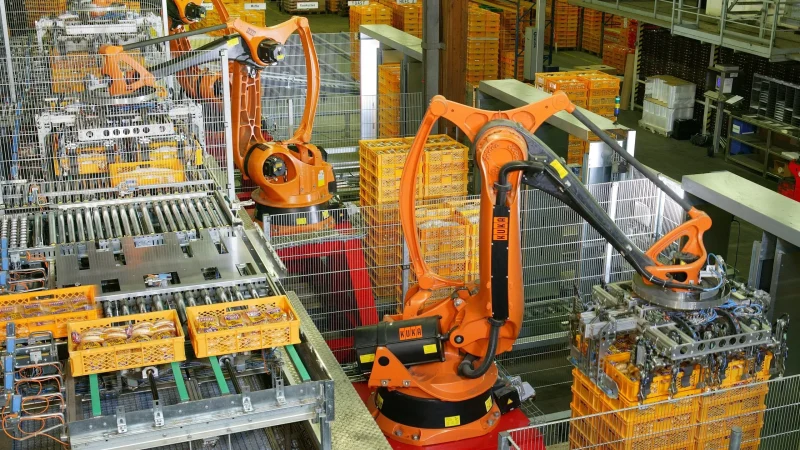
Cobots have been promising the fenceless factory for almost fifteen years. In 2026, with the market heading toward eleven billion dollars and 70% of orders coming from outside automotive, it is time to review what has delivered and what remains open.
Humanoid robotics left the trade-show floor for factory floors and warehouses during 2025 and 2026. Which companies have really deployed units, which tasks fit, what real costs look like, and where humans remain unbeatable.
Fully connecting the plant to global clouds now collides with European regulators and CFOs who no longer tolerate dependence on foreign providers; 2026 is the year we rethink where industrial data actually lives.
The dark factory, with no human workers on shift, has been promised for years but is only now starting to multiply in earnest. The Chinese and Japanese cases show a mature model; in Europe and Spain the reality is different. An honest look at what works and what is still hype.
Small language models have become genuinely useful. Phi-3.5, Gemma 2, and Llama 3.2 fit on modest hardware and solve bounded tasks without reaching the cloud. A look at where they fit on the factory floor and when skipping the large model pays off.
We've spent a decade talking about digital twins on the factory floor, and today real plants in Spain have twins that actually work. Of the four typologies (asset, process, plant, and product), three have proven return; the product twin remains more promise than reality. A look at which platforms are winning, where the twin pays for itself, and what is still hype.
Printing steel, titanium, or aluminum parts is no longer a lab experiment. Metal additive manufacturing has spent a decade maturing, with stable aerospace certifications and service providers across Europe. The question is no longer whether it works, but for which parts it pays off against machining, casting, or forging.
The best digital twin tools fall into three categories: simulation (ANSYS, Siemens NX, COMSOL, Dassault SIMULIA), virtual-reality visualisation (Unity, Autodesk VRED, Blender), and lifecycle management or PLM (Siemens Teamcenter, PTC Windchill, Aras). The right choice depends on your sector, asset type, and the integration budget with your existing operational systems.
Intelligent automation combines AI, machine learning, and physical robots that perceive, decide, and adapt in real time instead of following a fixed script. It is transforming manufacturing, logistics, healthcare, and food processing, and by 2024 there were already more than 4.6 million industrial robots active worldwide, per the IFR.
3D printing, or additive manufacturing, has moved beyond the lab to become a real production technology: it builds medical prostheses, aircraft parts and entire houses layer by layer from a digital file. This guide explains FDM, SLA and SLS technologies, which industries already use them, and today's limits on speed and material certification.
Industry 4.0 is the Fourth Industrial Revolution: the convergence of IoT, artificial intelligence, big data, advanced robotics, and cybersecurity that connects factories to digital networks. The goal is the smart factory, able to adjust its production in real time from the data it collects, gaining productivity, quality, and energy efficiency.
5 min1924.5
We use first- and third-party cookies to analyze site traffic. You can accept them, reject them, or configure your choice.
Learn more about cookies
Cookie preferences
NecessaryEssential for the site to work. Always on.
AnalyticsHelp us understand how the site is used (Google Analytics).