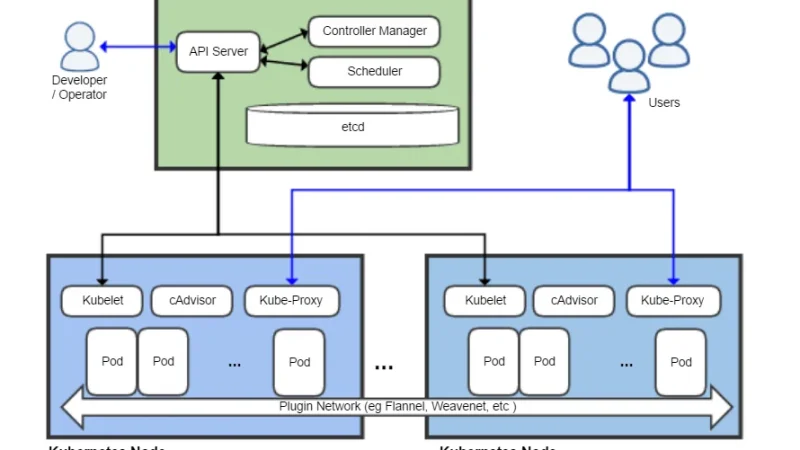
Kubernetes 1.35 GA consolidates three releases of work: native sidecars with full lifecycle management, generalised DRA for FPGAs and NPUs, and a scheduler that cuts resource waste by 15-25% in heterogeneous clusters. An operations-side balance sheet: what to enable now, what to watch before migrating, and what path to follow from 1.30.
Skills package reusable capabilities; subagents isolate bounded-task execution. Together they form the most effective pattern for composing complex agents in 2026.
The Model Context Protocol, proposed by Anthropic in late 2024 and adopted through 2025-2026 by Anthropic, OpenAI, Google, and the open-source community, already has proven operational patterns: separating generic servers from custom ones, explicit per-tool policies, credentials kept outside the model, prefixed composition, and contract tests. This is the state of the art in 2026.
Hybrid RAG in 2026 combines dense and lexical search fused with RRF, cross-encoder reranking over the top-50 candidates, structure-aware chunking, and continuous evaluation with Ragas or TruLens. It is the pattern that survives in serious production systems three years after the initial embeddings boom.
Kubernetes won the orchestration battle, but Docker Swarm stays maintained inside Docker Engine and makes real sense for small teams without dedicated SRE, self-hosted stacks on 1-5 VPS, and edge mini-clusters. In those contexts, Swarm's minimal learning curve and low operational cost outweigh Kubernetes's advanced features.
El concepto de Agent OS pasó del slide al despliegue en 2025. Seis meses en producción dejan patrones visibles: qué arquitecturas funcionan, dónde se rompe el modelo y qué aporta frente a correr agentes sobre pila existente.
A year after GraphRAG left the lab, one statistic holds: it works where corporate information has dense relational structure, fails where there are only loose documents. Patterns, ingestion costs, and architectural decisions that have survived a year of real deployment.
Twenty months after the initial announcement, Model Context Protocol went from curiosity to de-facto standard among agent clients and servers. What is available, which servers are worth it, which problems remain open, and how it compares to earlier protocol maps.
Tres años después de que platform engineering se convirtiera en palabra de moda, el polvo ha caído. Unas pocas empresas tienen plataformas internas que de verdad aceleran al desarrollo, muchas montaron un portal Backstage vacío y algunas volvieron a DevOps clásico. Análisis de qué distingue a las que ganaron.
Six months after A2A landed at the Linux Foundation, and after several implementation cycles from Google, Microsoft, and open projects, what version 1 of the protocol means and whether it is safe to build on yet.
Con 1.34 liberado en agosto de 2025 y el ciclo de 1.35 en su última fase de congelación de funciones, qué llegará estable, qué quedará en beta, qué nos interesa a quienes mantenemos clústeres pequeños o medianos y qué podemos ignorar sin culpa hasta el siguiente ciclo.
La integración de WebAssembly dentro de containerd como tiempo de ejecución alternativo ha madurado. Ya es posible desplegar cargas mixtas Linux y Wasm en el mismo clúster de Kubernetes con argumentos operativos sólidos. Cuándo compensa y cuándo no.
With MCP solving the agent-to-tool layer, a parallel problem surfaces: how do two agents from different vendors communicate with each other. Google's Agent2Agent protocol, donated to the Linux Foundation in June 2025, tries to fill that gap with an open standard.
gVisor interpone un kernel en espacio de usuario entre el contenedor y el anfitrión. Después de años en producción en Google y adopción creciente en plataformas serverless, merece una lectura honesta sobre cuándo compensa frente a microVMs y runtimes clásicos.
A caching proxy in front of a language model can cut the token bill significantly, but it introduces subtle risks if the design is not careful. Which cache types work in production, where the usual traps sit, and how to add them without degrading the experience.
Un enrutador de inferencia decide qué modelo atiende cada petición en función de coste, latencia y complejidad. Bien diseñados reducen la factura de tokens sin que el usuario perciba degradación; mal diseñados introducen fallos sutiles difíciles de depurar.
TigerBeetle is a distributed database written in Zig, specialized in one specific kind of workload: high-volume double-entry accounting with strong consistency guarantees. It does not aim to replace Postgres; it aims to be the right tool when the problem is counting financial transactions at millions per second without subtle failures.
After three years of expansion and an overheated ecosystem around the term, platform engineering enters 2025 in a consolidation phase. The internal platforms that survive are the ones that understood their real function; those that mistook the label for the solution are dismantling their teams or cutting them drastically.
Tras la adquisición por Microsoft en 2019, Citus vivió un limbo comercial que terminó con Microsoft abriendo el código completo en 2022. Tres años después, la extensión de particionado para Postgres ha madurado y ofrece una ruta práctica para escalar sin abandonar el motor que ya conoces. Un repaso honesto.
SQLite lleva años ganando terreno en servidores reales gracias a WAL, a proyectos como Litestream y libSQL, y a hardware con discos rápidos. Repaso los patrones que siguen funcionando después de varios años de uso, los que no, y por qué el tamaño medio de una aplicación web se come ya sin despeinarse.
After years of promising an open lakehouse, Apache Iceberg with REST catalogs plus dbt on top has jelled in 2025 into the reference stack. I break down what it solves, where it still hurts, and why the clean split between table, engine and transformation matters more than it looks.
DuckDB has spent two or three years quietly working its way into data architectures. It is no longer just the embedded database for local analytics: in 2025 it keeps turning up in concrete enterprise cases where it replaces far pricier pieces. A tour of the real patterns.
The term Agent OS has spent a year gaining traction across research and product circles. It describes a layer that goes well beyond an agent library: request scheduling, context management, persistent memory, and isolation. A look at the real state of that concept.
Wolfi turned three as a public project and has become the base for Chainguard container images and much of the industry chasing clean software supply chains. A field-tested review of what it offers against Alpine and Debian slim.
Kata Containers has spent years promising VM-grade container isolation without giving up Docker ergonomics. With the 3.x series now mature under the OpenInfra Foundation, the technical story finally holds together and there is a clear niche where adopting it pays off.
Model Context Protocol turns ten months old since Anthropic's announcement, and it is no longer just a proposal: hundreds of servers, cross-vendor implementations and a public registry now back it. A look at what has worked, what is still weak, and why 2025 marks the shift from curiosity to basic infrastructure.
Distributed SQL databases have moved from promise to production reality. YugabyteDB and CockroachDB lead the segment from different angles. Choosing between them demands understanding what each design compromises and what horizontal scaling costs in practice.
Redpanda promises Kafka-protocol compatibility without the JVM, without ZooKeeper, and with a thread-per-core architecture. By 2025 there are already serious production deployments. It is worth understanding where the switch pays off and where it does not.
Kubernetes 1.34 ships with Dynamic Resource Allocation (DRA) graduating to stable, scheduler improvements, and CEL-based mutating admission policies that replace webhooks. A practical rundown of what is safe to upgrade now, what can wait, and what actually changes for teams running production clusters.
Redis 8.2 ships vector search as a native data type. The real question is whether it replaces a dedicated engine like Qdrant, Weaviate, or pgvector on workloads with millions of vectors and tight latency budgets, or only works as a bonus on top of the cache you already run.
Kafka 4.0 llegó en marzo con la promesa cumplida: el clúster se autoadministra sin ZooKeeper. Después de meses operando clústeres KRaft y de la migración obligada, qué cambia de verdad, dónde duelen las diferencias y qué hay que saber antes de migrar.
Open table formats over data lakes have moved from curiosity to backbone of many analytics architectures. Delta Lake 4.0 and Apache Iceberg 1.9 are the two with the most weight in 2025. We review where each one stands and which criteria make sense when choosing between them.
Six months after containerd 2.0 reached general availability there is enough real-world mileage to judge the migration from the 1.x branch in production. We cover what changes in the config file, what breaks on Kubernetes and Docker Swarm, and when planning the jump actually pays off.
Firecracker is the Rust-based virtual machine monitor AWS uses in Lambda and Fargate: it boots microVMs in under 125 milliseconds with under 5 MB of overhead. Switching from containers pays off when a shared kernel does not give enough isolation, especially for untrusted LLM agent code, and versus gVisor it wins on I/O performance.
Kubernetes 1.32 Penelope shipped in December and has been running in clusters for several months. It is a good time to look at which changes have aged well, which created extra work, and what lessons to carry into the jump to 1.33.
PostgreSQL 17 llegó en septiembre con mejoras silenciosas del planificador. Seis meses en producción confirman que los escaneos SAOP, el streaming I/O y los anti-joins han cambiado planes de consulta reales sin tocar una línea de SQL.
Valkey 8.1 salió el 31 de marzo y marca el momento en que la alternativa comunitaria de Redis deja de ser experimento. Cuenta una migración real: qué cambió, qué se mantuvo igual, y dónde hubo sobresaltos.
Kubernetes 1.33 (Octarine) lands April 23. In-place pod resize moves to beta and ships on by default, sidecar containers finally reach GA, and several endpoint and security deprecations arrive that operators should review before upgrading from 1.32.
Desde que Microsoft abrió GraphRAG, el patrón de usar grafos sobre tus propios datos ha pasado de experimento académico a técnica con aplicaciones prácticas. Reflexión sobre cuándo compensa, cómo se monta y qué errores se repiten.
Coolify delivers a Vercel- or Heroku-like experience on your own servers: automatic HTTPS, managed databases, and branch previews without per-build or bandwidth fees. After several months using it on production VPS, here is where it shines, where it still has rough edges, and which teams will genuinely benefit from it.
GraphRAG has been in real enterprise use for over a year: during indexing, an LLM builds a knowledge graph that answers global questions about a corpus well, precisely where classic RAG fails because no single chunk holds the full answer. Here I compare indexing costs, the cases where it pays off, and the hybrid pattern that teams have settled on.
Cloudflare Workers turned eight in 2025 without slowing down: it now ships D1 for databases, R2 for egress-free storage, Durable Objects for distributed state, and Workers AI for running models without managing GPUs. It remains the fastest option for edge logic; for large in-memory processes or strict global consistency, other platforms fit better.
JuiceFS is a distributed, POSIX-compliant file system that separates data, stored in an S3-compatible object store, from metadata, stored in a database such as PostgreSQL or Redis. This guide installs JuiceFS on a three-node Linux cluster to share files without relying on NFS.
Hybrid search combines BM25 and vector retrieval to cover what each misses alone. Vectors fail on exact identifiers like SKUs or CVEs; BM25 fails when query and document use different vocabulary for the same idea. Reciprocal Rank Fusion (RRF) merges both rankings without depending on their score scales.
Model Context Protocol (MCP) is the open standard Anthropic published on 25 November 2024 to connect language models with external data and tools over JSON-RPC 2.0. It does not replace function calling: it standardises the server side, aiming to become for context what the Language Server Protocol is for code editors.
MariaDB 11.7 (November 2024) adds native vector search with an HNSW index, JSON improvements via JSON_OBJECT_AGG, and 5-15% faster read workloads versus 11.5. Against MySQL 8, the edge is not depending on HeatWave for embeddings; against PostgreSQL, it still trails on JSON depth and data types.
DuckDB es el motor analítico embebido que ha cambiado el panorama. Lee Parquet y CSV directamente, vectoriza la ejecución y cabe dentro de tu proceso Python. Un repaso a cuándo sustituye de verdad a un data warehouse.
Kubernetes 1.30, released in April 2024, brings ValidatingAdmissionPolicy to general availability, eliminating the need for external webhooks for CEL-based admission policies. It adds pod scheduling readiness to control when a pod enters the scheduling cycle, and job success policy to define which index combination counts as success in distributed indexed Jobs.
vLLM serves language models on GPU using PagedAttention and continuous batching, two techniques that multiply throughput compared with a naive server. It exposes an OpenAI-compatible API, so migrating an existing application only requires changing the base URL and deploying the right binary.
Kubecost and OpenCost map real costs to namespaces, deployments, and labels in Kubernetes. OpenCost, the Apache 2.0 open-source core, covers essentials for free. Kubecost adds multi-cluster visibility and advanced cloud billing. For clusters spending over $5,000/month the ROI is clear: identified savings typically exceed software cost within the first month.
Litestream is an open-source tool that replicates a SQLite database to an S3 bucket in near real time by reading the WAL SQLite already writes. It offers point-in-time recovery, overhead of only 1 to 3% CPU, and replaces the need for a separate database server in small apps.
Cloudflare Workers is no longer an isolated edge function. In 2024, together with KV, D1, R2, and Durable Objects, it forms a complete platform that matches AWS on latency and drops egress fees, though it still falls short on long-running compute and the mature managed databases AWS offers.
Kubernetes 1.31 brings no fireworks, but it closes old debts: AppArmor reaches GA, native sidecars now run enabled by default on their way to stable in 1.33, and DRA moves through alpha toward beta. A practical review from the perspective of someone operating clusters in production.
OpenTelemetry declared logs signals stable in July 2024. The third pillar of modern observability finally joins metrics and traces under a single protocol and a shared data model.
In 2024, the sidecar-or-not debate has an answer: Istio Ambient Mesh and Cilium Service Mesh bring sidecarless architecture to production, while Linkerd keeps ultra-light Rust sidecars. The right choice depends on your current CNI, the features you need, and the size of your ops team, not on which project wins in the abstract.
Redis moved to dual SSPL/RSAL licensing in March 2024, no longer meeting the OSI open-source definition. Valkey emerged as a BSD 3-Clause fork backed by AWS, Google Cloud, Oracle, and the Linux Foundation, fully protocol-compatible with Redis 7.2. Migrating is almost always trivial: swap the binary or the Docker image.
cAdvisor is still embedded in kubelet and covers surface metrics, but falls short for production Kubernetes. The modern minimum stack pairs it with kube-state-metrics, node-exporter, Prometheus, and Grafana as a base, eBPF for deep network and syscall visibility, and OpenTelemetry for application context.
PostgreSQL 17, released in September 2024, cuts vacuum memory use by up to 20x, adds slot synchronization so logical replication survives a failover without a full resync, ships JSON_TABLE as standard SQL:2023 syntax, and introduces streaming I/O to speed up sequential scans. Teams running Postgres in production should start testing it in staging.
PostgreSQL 16 closes the historical gaps in logical replication: parallel apply near 2x faster, logical slots served from physical standbys, and the scaffolding for bidirectional replication. The result is a first-line tool for cross-version migrations and CDC pipelines.
Containerising SCADA makes sense for the upper architecture layers: HMI, historians, and data gateways. PLCs still control hardware with hard determinism. The biggest risk is cultural: applying DevOps patterns without adapting to OT context causes incidents. NIS2 requires managing containers as any other critical infrastructure asset.
Cilium Service Mesh replaces Istio or Linkerd sidecars with eBPF in the kernel: it handles policy, WireGuard encryption, and Hubble observability without a per-pod proxy, cutting memory overhead from roughly 100 GB to about 5 GB in a 100-node cluster. It suits large clusters with teams comfortable with eBPF.
SQLite in production is more viable than most teams assume. WAL mode removes read contention, Litestream replicates the WAL to S3 in near-realtime, and LiteFS adds multi-node replication. Without a separate database server, apps like Tailscale and PocketBase already do this in production. This article explains when it makes sense and its real limits.
Linkerd is the pragmatic service mesh for Kubernetes, prioritizing simplicity over feature catalogues. Its Rust proxy uses ~10 MB RAM per sidecar versus 50-100 MB for Envoy under Istio. This comparison explains when adopting it pays off, what it costs to operate, and when Istio makes more sense.
This guide installs PostgreSQL 16 with pgvector on Debian or Ubuntu using the official PGDG repository, creates a dedicated role and database, tunes memory for production, and explains when the HNSW index beats IVFFlat depending on vector volume and the available maintenance window.
An Internal Developer Platform (IDP) centralises service discovery, provisioning and observability in a single portal, so developers stop depending on stale wikis and Slack channels. Backstage, Port and Cortex dominate the market: Backstage is open source with a dedicated team, Port is fast low-code SaaS, and Cortex focuses on scorecards for measurable technical discipline based on team size.
pgvector matured in 2023-2024 with the HNSW index type and parallel construction that arrived in version 0.6. For projects already running PostgreSQL, a dedicated vector database is not needed in most cases: this guide explains when PostgreSQL is enough, how to configure the index, and where it starts to fall short.
SQLite and DuckDB are both embedded databases that work from a single file, no server needed. Their architecture differs: SQLite stores rows and excels at short transactions (OLTP); DuckDB stores columns and shines at large-scale analytics (OLAP). Choosing the right one, or combining both, delivers a genuine technical edge.
ArgoCD has established GitOps as the standard deployment practice for Kubernetes: the Git repository is the single source of truth for the desired state, and the agent continuously reconciles the cluster. This guide covers the four formal GitOps principles, sync policies, common production mistakes, and a comparison with Flux.
A service mesh adds mTLS, uniform observability, and traffic management between microservices without modifying application code. The ecosystem has consolidated: Istio is the most complete and complex, Linkerd prioritises simplicity with Rust proxies, and Cilium delivers sidecarless service mesh via eBPF.
containerd is the runtime that runs containers in most modern Kubernetes clusters, and almost nobody notices. It manages the full container lifecycle: pulling the image, starting it, networking, and mounting the filesystem. It became the default runtime after Kubernetes 1.24 removed dockershim in May 2022.
Event-driven architecture decouples services through message brokers. Each component publishes events when something changes, instead of calling other services directly. It reduces coupling and improves resilience. It adds real value in domains with multiple consumers and natural asynchronous processing, but introduces operational complexity worth evaluating before adoption.
6 min212
We use first- and third-party cookies to analyze site traffic. You can accept them, reject them, or configure your choice.
Learn more about cookies
Cookie preferences
NecessaryEssential for the site to work. Always on.
AnalyticsHelp us understand how the site is used (Google Analytics).