Claude Code vs Codex CLI vs Muse Code in 2026
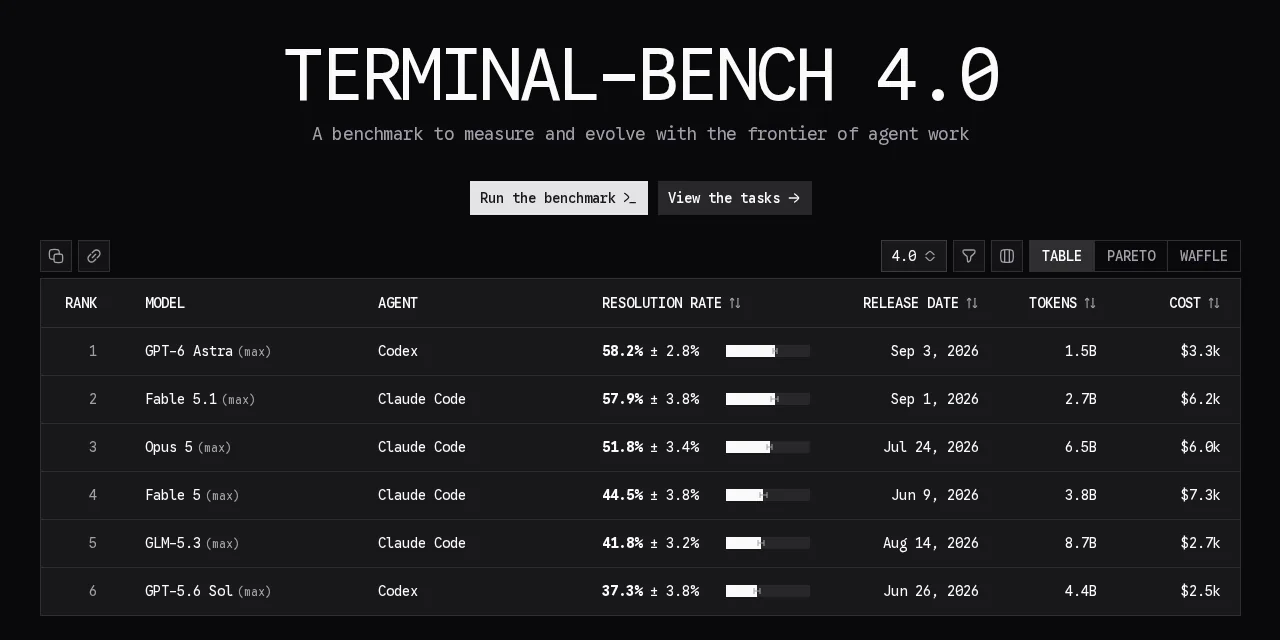
Table of contents
- Key takeaways
- How the three differ, beyond the score
- What the Terminal-Bench board really says
- What each harness gives you: MCP, hooks, subagents and permissions
- What each one actually costs
- Who is actually using them
- Which one to pick for your profile
- Frequently asked questions
- Is it true that Codex CLI beats Claude Code on Terminal-Bench?
- Is Muse Code's contributor tier worth it?
- Can I run all three on the same repository?
- Conclusion
- Sources
Picking a terminal agent in 2026 has become a three-way decision. Claude Code and OpenAI’s Codex CLI have been splitting the ground between them for months, and since 5 August Meta has been in the race with Muse Code in beta. This article compares all three using what the vendors publish themselves and what the official Terminal-Bench board actually contains, rather than the summaries doing the rounds.
Key takeaways
- All three now ship MCP, hooks, subagents, an operating-system sandbox and approval modes. The feature checklist stopped being the deciding factor.
- The comparison everyone repeats (89.5% against 89.1% on Terminal-Bench 2.1) is not on the official board. The top two rows there read 83.82% and 83.15%, with different models.
- Terminal-Bench 2.1 shipped on 6 May 2026. The current version is 4.0, from 28 August, and there the gap is 14.5 points rather than half a point.
- That lead is paid for: $18.09 per trial against $7.70, and about 80 minutes of wall clock against 40.
- Muse Code has submitted results to no version of the benchmark. What it offers is price: $1.25 and $4.25 per million tokens.
- On the $20 Pro plan, Claude Code does not start on Opus 5 but on Sonnet 5, the row with the worst accuracy-to-spend ratio on the whole board.
How the three differ, beyond the score
On paper all three do the same job: read your repository, edit files, run commands and hand you back a reviewable change. The difference is what they expect from you while they work.
Codex CLI is built for hand-off and review. Its documentation describes the /permissions command as the way to "choose when Codex can edit files or run commands without asking", and the welcome screen printed in those same docs starts on gpt-5.6-sol at medium effort. It is fast, cheap per task, and the natural flow is to launch it, walk away and read the diff.
Claude Code is built as scaffolding for long jobs. The documentation defines it as "an agentic coding tool that reads your codebase, edits files, runs commands, and integrates with your development tools", and around that sentence sits an ecosystem of CLAUDE.md files, skills, hooks, coordinating subagents and an SDK for building your own agents. It spends more time and more money per task, and in exchange it finishes work the other two give up on.
Muse Code arrives aimed at large repositories. Meta presents it as an agent where "Multiple agents coordinate on every task. Workers in parallel, reviewers in the background", with subagents that each work in their own isolated Git worktree so your checkout is never touched. It is the youngest of the three and the cheapest.
What the Terminal-Bench board really says
This is worth slowing down for, because one figure has spread without a source. The comparison printed in dozens of articles is Codex CLI at 89.5% and Claude Code at 89.1% on Terminal-Bench 2.1. We queried the data the benchmark’s own site serves, and neither number exists on the official 2.1 board. Neither does the 86.7% that circulates attached to Opus 5.
What Terminal-Bench 2.1 actually contains, over 445 trials (89 tasks at five passes each):
There is no Opus 5 row on 2.1 at all. The distance between the top two is 0.67 points, inside their own declared error bars.
There is a second problem with citing 2.1 at this point: it was published on 6 May 2026, and 3.0 and 4.0 have shipped since. The benchmark team explains why they retire tasks: "We considered a task ‘saturated’ when all classes within all families of the latest generation of models solve it 5/5 times. Such a task no longer meaningfully differentiates between models". In other words, the high percentages on 2.1 are partly measuring tasks that no longer separate anything.
On the current version, 4.0 from 28 August 2026, over 330 trials, the picture changes completely.
Cost per trial is not given in the board: we worked it out by dividing each run’s total cost by its trial count, two fields the board publishes itself. With harder tasks, the distance between first and fourth goes from half a point to 14.5, and the price of that distance is on display.
The last row deserves separate attention. Sonnet 5 solves 12.42% and is simultaneously the most expensive per trial on the entire list. The 4.0 announcement puts that down to consumption: 21.6 billion tokens on its leaderboard run against 6.5 billion for Opus 5.
Muse Code appears on none of the four boards. Not 2.0, not 2.1, not 3.0, not 4.0. Meta’s only presence is the Muse Spark 1.1 model run under a different agent, mini-SWE-agent, on 2.1. Anyone quoting a Terminal-Bench score for Muse Code is inventing it or repeating someone who did.
What each harness gives you: MCP, hooks, subagents and permissions
This is the part that changed most in 2026 and gets told least. A year ago an extensibility comparison made sense because the gaps were obvious. Now all three tick nearly every box.
| Capability | Claude Code | Codex CLI | Muse Code |
|---|---|---|---|
| MCP servers | Yes | Yes (codex mcp) |
Yes |
| Project hooks | Yes | Yes | Yes |
| Parallel subagents | Yes | Yes | Yes, in isolated Git worktrees |
| Operating-system sandbox | Yes | Yes | Yes, on from first run |
| Approval modes | Yes | Yes (/permissions) |
Yes |
| Repository instruction file | CLAUDE.md |
AGENTS.md |
Workspace rules |
| Auditable record of actions | Yes | Yes | Replayable event log |
| Non-interactive mode for CI | Yes | Yes | Yes |
| Surfaces beyond the terminal | Terminal, VS Code, JetBrains, desktop, web | Terminal, IDE, desktop apps | Terminal only |
| Operating systems | macOS, Linux, Windows | macOS, Linux, Windows | macOS, Linux and Windows (native since 16 September 2026) |
Where real differences survive is at the ends of the table. Claude Code is the only one that lives outside the terminal on the same configuration: the same CLAUDE.md and the same MCP servers apply in the editor, the desktop app and the browser. Muse Code has run natively on Windows since 16 September 2026, without WSL, but Meta still ships it for the terminal only.
If you want a window around it, community clients drive the same muse CLI. One example is Helicon[1] (MIT licensed), with a desktop app for Windows, macOS and Linux plus a VS Code extension. They are unofficial, Meta does not endorse them, and their installers are not code-signed yet.
If you are going to build your own integration, the piece common to all three is MCP. We have a guide to building your own MCP server that works the same with any of them.
What each one actually costs
The prices below are the ones the vendors publish on their own pages, read on 30 August 2026. They are vendor figures, not our measurements, and what you pay depends heavily on how well the cache hits.
| Model | Input | Cached input | Output |
|---|---|---|---|
| Opus 5 (Anthropic) | $5.00 | $0.50 | $25.00 |
| Sonnet 5 (Anthropic) | $2.00 | $0.20 | $10.00 |
| GPT-5.6 Sol (OpenAI, short context) | $4.00 | $0.40 | $20.00 |
| GPT-5.6 Terra (OpenAI, short context) | $2.00 | $0.20 | $12.00 |
| muse-spark-1.2 (Meta) | $1.25 | $0.15 | $4.25 |
| muse-spark-1.2-contributor (Meta) | $0.10 | $0.002 | $0.20 |
All figures are per million tokens. Meta offers two versions of the same model with a twelvefold price difference on input and a twenty-onefold difference on output. The label separating them on Meta’s page is literal: muse-spark-1.2-contributor is marked "Used to improve our products" and muse-spark-1.2 is marked "Not used to improve our products". The discount is paid for with your code.
There is a detail in Anthropic’s subscription worth holding in mind before comparing list prices. Claude Code is included from the $20-a-month Pro plan. The documentation explains, though, that the default model depends on the plan.
Max, Team Premium and the API start on Opus 5, while Pro and Team Standard start on Sonnet 5. The cheap plan does not give you the model that tops the board, then, but the one with the worst accuracy-to-spend ratio on it.
Who is actually using them
The JetBrains Developer Ecosystem Survey, now in its tenth edition, is the least interested source in the sector. It describes itself as "a large-scale, globally representative survey of more than 15,000 professional developers worldwide", with fieldwork between May and July 2026, regional quotas, eight languages and statistical reweighting afterwards.
Its figures for that period:
- Claude Code: 39% of professional developers worldwide, and 47% in the United States.
- GitHub Copilot: 21%, down from 29% a year earlier.
- Codex: 16%, with growth JetBrains describes as "adoption growth of roughly 5x, from just 3% in January 2026".
- Cursor: 12%, down from 18% in January.
- OpenCode: 7%. Google Antigravity: 6%.
The study’s headline is that "90% of professional developers were using AI coding agents at work at least weekly", with 68% using them daily. Muse Code does not appear in the study for a simple reason: fieldwork closed before its 5 August launch.
Which one to pick for your profile
After all of the above, the recommendation can be given without hedging.
If you delegate bounded tasks and review diffs, take Codex CLI. It finishes in half the time, costs less than half per trial, and its flow is designed for exactly that. We have a dedicated guide to OpenAI’s Codex CLI if you are starting from scratch.
If the work is long, multi-step and governed by your own rules, take Claude Code. The 14.5-point lead on version 4.0 of the benchmark shows up precisely on the tasks the others abandon halfway. The scaffolding of hooks, subagents and CLAUDE.md is the most mature of the three. Budget accordingly, though, and do not buy the $20 plan expecting Opus 5.
If the bill hurts and your repository is enormous, try Muse Code. It costs a fraction of the other two and its design of subagents in isolated Git worktrees points in exactly that direction. Treat it as what it is: a beta with no independent published result. We look at it closely in Muse Code, Meta’s terminal agent.
If what you want is an agent inside the editor rather than in the terminal, this is not your comparison. The one you need is Claude Code against Cursor and GitHub Copilot, which measures the same work from the other side.
Frequently asked questions
Is it true that Codex CLI beats Claude Code on Terminal-Bench?
On the current official board, no. On Terminal-Bench 4.0, Claude Code with Opus 5 scores 51.82% and Codex with GPT-5.6 Sol scores 37.27%. The opposite claim comes from citations of version 2.1, where the top two places are separated by 0.67 points and belong to earlier models.
Is Muse Code’s contributor tier worth it?
It depends on what code you feed it. Meta labels it explicitly as data used to improve its products, and in exchange charges $0.10 per million input tokens instead of $1.25. For personal experiments or open projects, the arithmetic works. For a client’s code under an NDA, it does not.
Can I run all three on the same repository?
Yes, and it is not unusual. Each reads its own instruction file (CLAUDE.md, AGENTS.md and Muse Code’s workspace rules), so they do not collide. The conflict comes from Git: launch more than one agent at once on the same branch and you will be resolving merge conflicts by hand. That is exactly the problem Muse Code tries to avoid with separate worktrees.
Conclusion
The honest 2026 conclusion is that the feature list no longer decides anything: MCP, hooks, subagents, isolation and permissions are in all three. What decides is which model your plan ships by default, how much you will pay per finished task, and how much of a hurry you are in. Claude Code buys accuracy with money and clock time, Codex CLI buys speed and predictability, and Muse Code buys price at the cost of having not one independent measurement to show yet.
And before repeating any percentage about these tools, open it on the original board: the one quoted most right now is not there. The Spanish version of this article is at Claude Code vs Codex CLI vs Muse Code en 2026.
Sources: [1] Terminal-Bench, official results board[2], [2] Terminal-Bench 2.1 release announcement[3], [3] Terminal-Bench 4.0 release announcement[4], [4] Anthropic, Claude and Claude Code pricing[5], [5] OpenAI, API pricing[6], [6] Meta, Muse Code product and pricing[7], [7] Claude Code documentation, overview[8], [8] Claude Code documentation, model configuration[9], [9] OpenAI, Codex CLI documentation[10], [10] JetBrains Research, AI coding agent adoption in 2026[11].
Sources
- Helicon
- Terminal-Bench, official results board
- Terminal-Bench 2.1 release announcement
- Terminal-Bench 4.0 release announcement
- Anthropic, Claude and Claude Code pricing
- OpenAI, API pricing
- Meta, Muse Code product and pricing
- Claude Code documentation, overview
- Claude Code documentation, model configuration
- OpenAI, Codex CLI documentation
- JetBrains Research, AI coding agent adoption in 2026