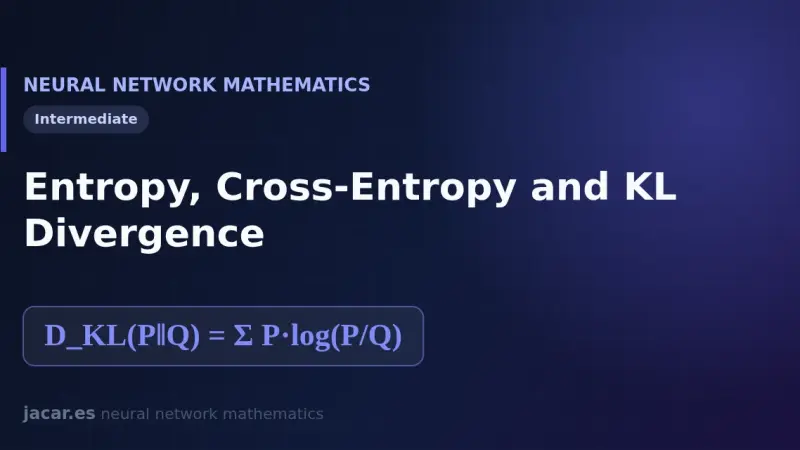
Entropy measures the average uncertainty of a distribution in bits, cross-entropy measures the cost of coding the real data with a wrong model, and KL divergence is the gap between the two. That is why minimising cross-entropy during training is the same as minimising the KL divergence from the labels.
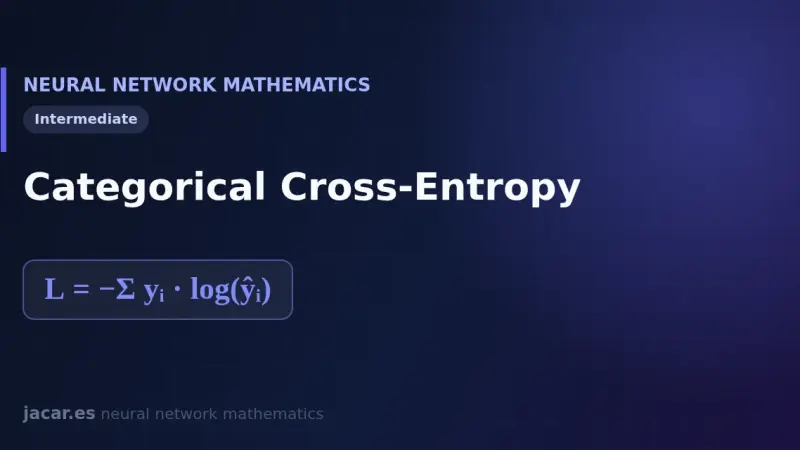
Categorical cross-entropy is the standard loss function for classifying into several mutually exclusive classes. It compares the distribution the network predicts, usually after a softmax, with the true label written in one-hot format, and it penalises heavily any low probability assigned to the correct class.
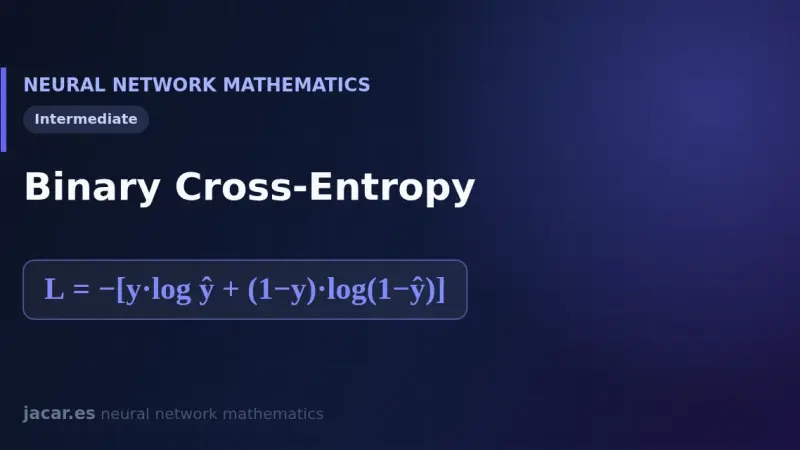
Binary cross-entropy is the standard loss function for two-class classification. It compares the probability returned by the sigmoid with the true label, 0 or 1, and punishes confident mistakes hard. Its formula comes from maximum likelihood, and its derivative combines with the sigmoid into a very simple gradient.
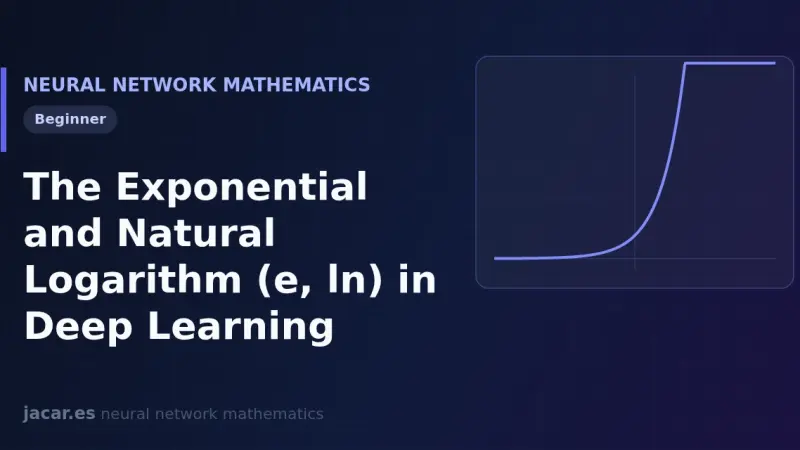
The exponential function eˣ and its inverse, the natural logarithm ln(x), appear again and again in deep learning. The exponential builds the sigmoid and softmax that turn numbers into probabilities, while the natural logarithm defines cross-entropy, the loss used to train almost every classifier in practice today.
7 min43
We use first- and third-party cookies to analyze site traffic. You can accept them, reject them, or configure your choice.
Learn more about cookies
Cookie preferences
NecessaryEssential for the site to work. Always on.
AnalyticsHelp us understand how the site is used (Google Analytics).