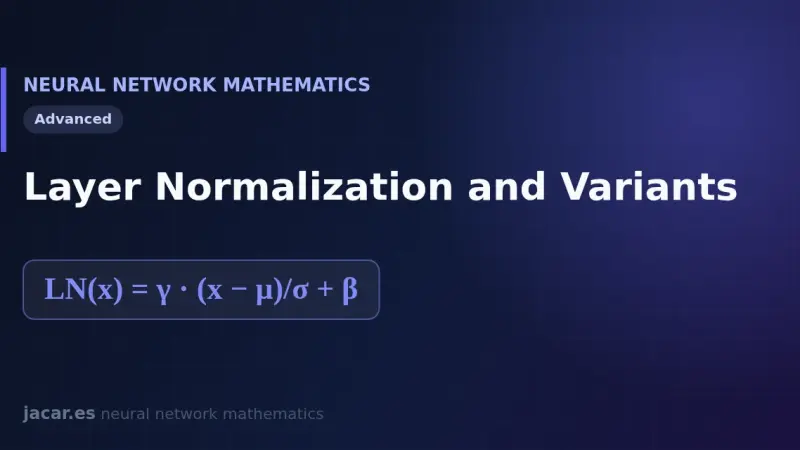
Layer normalization stabilizes training by normalizing each example on its own, using the mean and standard deviation of its own activations. Unlike batch normalization, it does not depend on the batch size, which is why transformers adopted it. RMSNorm is its lighter, most widely used variant today in large language models.
A learning rate schedule changes the value of η over the course of training instead of keeping it fixed. It starts with a warmup that raises η from near zero, holds a peak and then lowers it with step, exponential or cosine decay so the network converges faster and with far less oscillation.
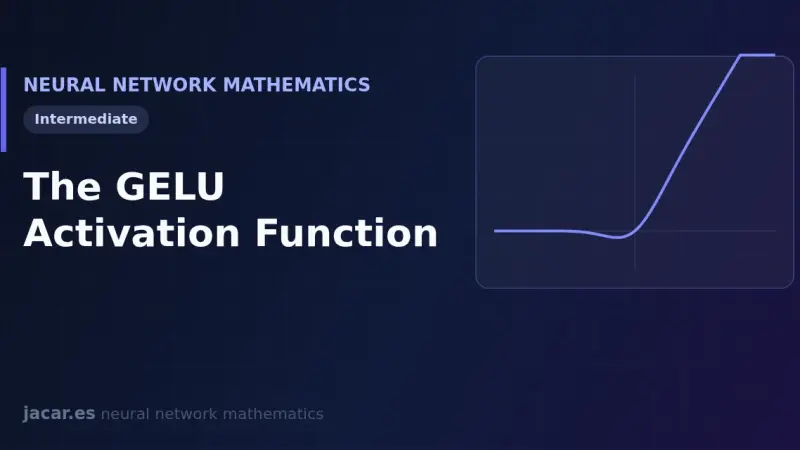
The GELU (Gaussian Error Linear Unit) function multiplies each input by the probability that a standard normal falls below that input. The result is a smooth curve with a continuous derivative that weights inputs by their magnitude, and it has become the default activation inside BERT and GPT.
Natural Language Processing (NLP) is the AI discipline that enables machines to understand, interpret, and generate human text and speech. Powered by the transformer architecture since 2017, NLP drives chatbots, automatic translation, and clinical diagnosis tools, with open challenges in causal reasoning, energy efficiency, and bias mitigation.
4 min2164.5
We use first- and third-party cookies to analyze site traffic. You can accept them, reject them, or configure your choice.
Learn more about cookies
Cookie preferences
NecessaryEssential for the site to work. Always on.
AnalyticsHelp us understand how the site is used (Google Analytics).