CVE-2026-123158, OpenSSH sshole on Alpine and musl: am I affected and how to patch
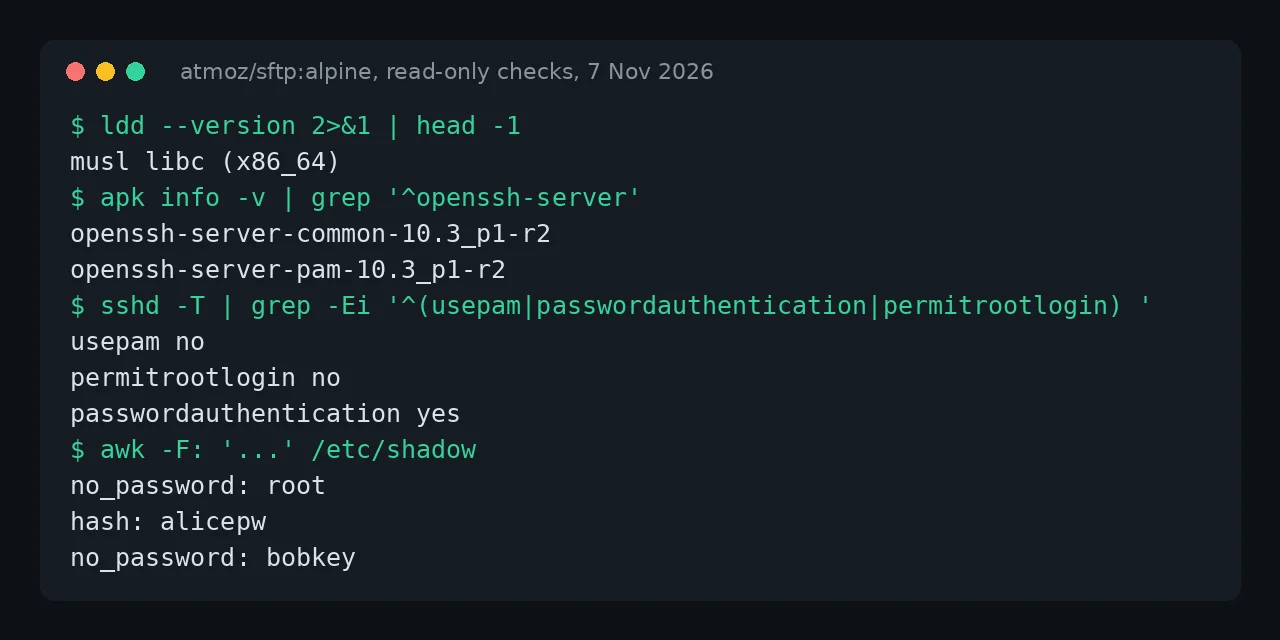
Table of contents
- Key takeaways
- Am I affected by CVE-2026-123158?
- How to check with read-only commands
- Do common Alpine images ship sshd?
- Fixed versions per branch and distribution
- How to apply and confirm the fix
- In containers, the fix lives in the image
- Which mitigation Alpine publishes if you cannot upgrade yet
- Why Debian rates it unimportant and others rate it high
- Is CVE-2026-123158 being exploited?
- Which facts may change before you read this
- Frequently asked questions
- Is my Alpine container with nginx or postgres vulnerable to sshole?
- Do I need to patch on Debian, Ubuntu or RHEL?
- Does using only SSH keys protect me?
- Conclusion
- Sources
CVE-2026-123158, the OpenSSH "sshole" bug, affects you if you run sshd built with musl and without Pluggable Authentication Modules (PAM), with passwords enabled and a certain mix of accounts. That describes Alpine servers and some SSH or SFTP containers, not a typical Alpine container. If you are in that group, install your branch's fixed package and restart sshd. I checked all of this on 7 November 2026 with Docker 29.5.2 on Linux arm64, using read-only checks: I did not attempt the authentication bypass, not even against my own containers. There is also a Spanish version of this guide.
Key takeaways
- None of the 23 non-SSH Alpine images I checked (nginx, postgres, redis, node, traefik, grafana and others) ships
openssh-server. I picked the sample by hand, so it is not random. - Of eight images chosen because they ship
sshd, three still lack a fixed package on 13 November, but six start with passwords disabled. - Alpine published fixed packages for branches 3.16 to 3.24 and edge, and OpenSSH 10.6p2 has contained the original fix since 5 November.
- The version number misleads: Alpine 3.24's fixed package still says
OpenSSH_10.3p1. Read the package, not the banner. - Upgrading is not enough: after
apk upgrade, the running process still pointed at/usr/sbin/sshd (deleted)until I restarted it. - CISA added it to its catalog of exploited vulnerabilities on 9 November: attacks are real, so if you meet the conditions, do not leave it for your next patch cycle.
Am I affected by CVE-2026-123158?
You are affected if all five conditions below hold at once, taken from Alpine's security advisory[1]. If a single one fails, this bug does not reach you:
- You run
sshdfrom a package older than your branch's fixed version, or OpenSSH older than 10.6p2 that you built yourself on musl - It is an
sshdwithout PAM: theopenssh-serverpackage, oropenssh-server-pamwithUsePAM no PasswordAuthenticationisyes, which is the OpenSSH default- An account has
*in its password field, which is what key-only accounts created withadduserand no password have - Another local account has a
$5$or$6$hash
According to Alpine, one account with a password is enough to expose every account that has *. The root account has * in the base image (I saw it on 3.16, 3.20, 3.21, 3.22, 3.23 and 3.24), and the default PermitRootLogin prohibit-password protects it. That protection stops helping if another reachable account can become root, for example through doas. Directory users coming through musl-nscd have no shadow entry either, and Alpine counts them as exposed too.
How to check with read-only commands
Start with your containers. The loop below lists the ones with a running sshd process, without entering them or executing anything inside, so it also works for images with no shell:
for c in $(docker ps -q); do
  docker top "$c" | grep -q '[s]shd' &&
    docker inspect -f '{{.Name}} {{.Config.Image}}' "$c"
done
If it prints nothing, none of your running containers runs sshd, and only your hosts remain to review. For a host, or for a container that does appear, these three commands answer conditions 1, 2 and 3:
ldd --version 2>&1 | head -1
apk info -v | grep '^openssh-server'
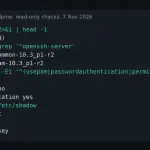
sshd -T | grep -Ei '^(usepam|passwordauthentication|permitrootlogin) '
ldd --version tells you the C library: it printed musl libc (aarch64) on Alpine on arm64 and ldd (Debian GLIBC 2.41-12+deb13u4) 2.41 on Debian. The PAM check has a catch: ldd on the binary does not help, because neither Alpine's sshd.pam nor Debian 13's sshd links libpam in that file. sshd -T is the reliable signal: with Alpine's openssh-server the usepam line does not appear (I saw this on 3.16, 3.21, 3.24 and edge), and with openssh-server-pam it appears as usepam no unless you change it.
Run sshd -T as root, and add -f path_to_your_config if your image uses another path. With openssh-server-pam the binary may be named sshd.pam: that is the case on a clean 3.24 install and in the LinuxServer image.
Conditions 4 and 5 live in /etc/shadow. This awk prints account names and never the hash:
awk -F: '$2=="*"{print "no_password: "$1}
  $2~/^\$[56]\$/{print "hash: "$1}' /etc/shadow
Here is the output from the atmoz/sftp:alpine image, which only publishes amd64 and ran emulated, with one password user and one key user. It meets conditions 2 to 5, and the only thing keeping it off the list is the fixed package:
musl libc (x86_64)
openssh-server-common-10.3_p1-r2
openssh-server-pam-10.3_p1-r2
usepam no
permitrootlogin no
passwordauthentication yes
no_password: root
hash: alicepw
no_password: bobkey
Do common Alpine images ship sshd?
No: the 23 general-purpose Alpine images I checked on 7 November ship neither openssh-server nor an sshd binary. Alpine says so in its advisory too, listing among those not affected "Docker and other container users that do not run sshd in the container". If your service is an nginx, a database or an application on Alpine, this bug does not touch it, and you need not rebuild anything because of it.
I inspected them with docker create and docker export, without running their code, except alpine, which I opened with sh. The list is alpine (seven tags), nginx, redis, postgres, node, python, php, httpd, traefik, caddy, memcached, golang, rabbitmq, haproxy, docker:cli, docker:dind, eclipse-temurin, nextcloud, grafana, vaultwarden, pihole, adguardhome and gitea:latest-rootless. For scale, Docker Hub counted 13,564,734,167 pulls of nginx and 12,484,312,810 of alpine that day.
The people actually at risk are those who add an SSH server on purpose. I looked up eight known images that ship one, started them with no network and no published ports, and read their effective configuration:
| Image (build date) | Package | Fixed? | Passwords by default | Reading |
|---|---|---|---|---|
gitea:latest (1 Nov) |
10.3_p1-r1 |
No | no |
Not exposed by default; git:* with no hashed account |
forgejo:17 |
10.3_p1-r1 |
No | no |
Same as Gitea |
gogs:latest (12 Nov) |
9.9_p2-r1 |
Yes | no |
Fixed on 12 November |
panubo/sshd:latest (2 Apr 2023) |
8.6_p1-r3 |
Branch 3.14, outside the advisory | no |
root locked; no builds since 2023 |
hermsi/alpine-sshd:latest (9 Nov) |
10.3_p1-r2 |
Yes | yes |
Fixed on 9 November; review your accounts |
atmoz/sftp:alpine (6 Nov) |
10.3_p1-r2 |
Yes | yes |
An older copy with mixed accounts is exposed |
linuxserver/openssh-server (5 Nov) |
10.3_p1-r2 |
Yes | no |
root locked, no accounts with * |
jenkins/ssh-agent:alpine (6 Nov) |
10.3_p1-r2 |
Yes | no |
Not exposed by default |
The case that deserves your attention is atmoz/sftp:alpine, with 1,032,978,129 pulls on Docker Hub. Its script creates passwordless users with usermod -p "*", so mixing key and password users meets the conditions.
The 6 November build already has the fixed package, and that protection only arrives if you pull it again and recreate the container. Its configuration forces ForceCommand internal-sftp and a chroot, which limits what someone gets after entering, not the entry itself. That image's latest tag is Debian 11, not Alpine.
On hermsi/alpine-sshd I tried two configurations and neither met the conditions: by default there is only root:*, and with root unlocked there is a hashed root and an extra user with an empty field. Since the 9 November build it ships the fixed package, but it starts with passwords on. If you run a Gitea or Forgejo service, their template sets PasswordAuthentication no, and that is what protects you today, not the package. Gitea's -rootless variants ship no openssh-server.
Outside Docker, Alpine points at another specific group: its tiny-cloud cloud images from 3.18.11 to 3.24.3 ship an alpine user with * and passwordless doas. They become exposed as soon as a hashed account appears on the machine, unless cloud-init wrote PasswordAuthentication no.
Fixed versions per branch and distribution
Alpine's table matches what apk installs today. I ran apk update and apk policy on 7 November in one container per branch, and the openssh-server and openssh-server-pam packages both returned the advisory's version:
| Alpine branch | Fixed version | Alpine version seen | Supported? |
|---|---|---|---|
| edge | 10.6_p2-r0 |
3.25.0_alpha20260805 | Development branch |
| 3.24 | 10.3_p1-r2 |
3.24.4 | Yes |
| 3.23 | 10.2_p1-r1 |
3.23.8 | Yes |
| 3.22 | 10.0_p1-r11 |
3.22.8 | Yes |
| 3.21 | 9.9_p2-r1 |
3.21.10 | Ended 1 November 2026 |
| 3.20 | 9.7_p1-r6 |
3.20.10 | No |
| 3.19 | 9.6_p1-r3 |
3.19.9 | No |
| 3.18 | 9.3_p2-r4 |
3.18.12 | No |
| 3.17 | 9.1_p1-r7 |
3.17.10 | No |
| 3.16 | 9.0_p1-r6 |
3.16.9 | No |
Do not trust /etc/alpine-release. The LinuxServer image says 3.24.3 and has the fixed package, while the Gitea image also says 3.24.3 and does not. The other distributions stand as follows on 13 November:
| Distribution | Vendor status | What I saw |
|---|---|---|
| Debian 12 and 13 | Tracker: vulnerable, urgency unimportant |
Debian 13: glibc, libpam in sshd-session, usepam yes |
| Debian forky and sid | Fixed in 1:10.6p2-1 |
Not tested |
| Ubuntu | High priority; every release Not affected (page dated 11 Nov) |
24.04: glibc, libpam, usepam yes, 1:9.6p1-3ubuntu13.20 |
| RHEL 6 to 10 | Red Hat: not affected | Not tested |
| SUSE | SUSE: not affected[2] across its products | Not tested |
| Void Linux musl | No advisory found | musl with libpam, UsePAM yes, already on 10.6p2_1 |
| Wolfi | No advisory found | glibc, 10.6_p1-r0 |
| OpenWrt | No advisory found | musl, ships dropbear and no sshd |
Red Hat explains its verdict in one sentence: its builds "link OpenSSH against the GNU C Library (glibc) and use PAM by default". If you are comparing image bases, Wolfi versus Alpine and distroless measures that library difference. If you built OpenSSH on musl without PAM yourself, your fixed version is 10.6p2, because no package fixes it for you.
How to apply and confirm the fix
On an Alpine host, upgrade with the advisory's command and restart the service. Upgrading only openssh-server did not work for me: in my test on 3.24, apk upgrade openssh-server refused the change with breaks: openssh-client-default-10.3_p1-r2, and the package stayed on r1.
apk upgrade -U -a
rc-service sshd restart
apk info -v | grep '^openssh-server'
readlink /proc/$(cat /run/sshd.pid)/exe
I tested the sequence in containers, not on a real host. In the one with sshd as process 1, the package went from 10.3_p1-r1 to 10.3_p1-r2. Before the restart, readlink printed /usr/sbin/sshd (deleted), and afterwards /usr/sbin/sshd: that difference confirms the new binary is running.
In another container with OpenRC and no real init, rc-service sshd restart failed the first time with sshd failed to stop and worked the second time. I do not know whether that happens on a host, and it is one more reason not to assume the restart worked: always read the readlink.
Alpine warns about this in these words: "Upgrading the package alone does not replace the running daemon." The version number does not help you confirm it either, because sshd -V printed OpenSSH_10.3p1 before and after. Stable branches apply a patch on top of their version, so a scanner comparing the banner against 10.6p2 will flag a server that is already fixed. If you run Trivy or Grype on your images, check their result against the package version.
In containers, the fix lives in the image
An apk upgrade inside a container lasts as long as that container does. I checked: the fixed package survived docker restart, and a new container from the same image went back to r1. Pull the new image and recreate the service, here called sftp:
docker compose pull
docker compose up -d
docker compose exec sftp apk info -v | grep '^openssh-server'
If the image is still unfixed, as Gitea's was on 13 November, a fresh pull changes nothing. Rebuild it with these two lines, which left 10.3_p1-r2 in my test, and watch for the maintainer's next release:
FROM gitea/gitea:latest
RUN apk upgrade --no-cache -a
Which mitigation Alpine publishes if you cannot upgrade yet
Alpine gives a single mitigation: disable password authentication. Before you touch anything, make sure you can log in with a key, and keep your current session open until you have tested a new login. These are the advisory's commands, run as root:
mkdir -p /etc/ssh/sshd_config.d
echo 'PasswordAuthentication no' > \
  /etc/ssh/sshd_config.d/00-no-passwords.conf
sed -i.bak -e '1i PasswordAuthentication no' \
  -e 's/^\(\s*PasswordAuthentication[^y#]*\)yes/\1no/i' \
  /etc/ssh/sshd_config
sshd -t && rc-service sshd restart
sshd -T | grep -i passwordauthentication
The first block creates a drop-in file, which Alpine only reads by default from 3.19 onward. The sed covers older releases, including inside Match blocks, and saves the original as /etc/ssh/sshd_config.bak. In my 3.24 container, sshd -t accepted the result and the last line printed passwordauthentication no.
Alpine lists other unaffected cases, such as openssh-server-pam with UsePAM yes or accounts locked with !, but does not present them as mitigations. According to the advisory, either route, upgrading or disabling passwords, closes the bug.
Why Debian rates it unimportant and others rate it high
The vendors do not contradict each other: some score the bug in the abstract and others score their own package. The CVE record, assigned by MITRE, gives it a Common Vulnerability Scoring System (CVSS) score of 8.1 with high attack complexity, as SUSE reflects[2]. OpenSSH talks about a critical fix in its 10.6p2 release notes[3]: "This release contains a critical security workaround that affects Linux systems that use the musl libc and PAM disabled." The 6 November INCIBE-CERT advisory[4] rates it high importance.
The Debian tracker[5] marks it with urgency unimportant, while listing bookworm and trixie as vulnerable; forky already has the fixed version. The tracker does not state the reason: its notes contain only links.
Its documentation[6] does define the label, for when "the problem does not affect the Debian binary package(s)". That explanation fits what I saw on Debian 13, where the binary uses glibc and PAM, so the bug's combination does not occur. That reading is mine, not Debian's.
Alpine's urgency[7] is also right for Alpine users: its advisory describes the bug as "It takes one connection, works every time, and needs no retries." That sentence weighs more than the high-complexity label if you meet the conditions. Note that the cause is not OpenSSH's alone: Alpine attributes it to how sshd without PAM interacts with musl's crypt(). I do not detail the mechanism here.
Is CVE-2026-123158 being exploited?
Yes. CISA added it on 9 November to its catalog of exploited vulnerabilities, which only lists bugs with evidence of real attacks. A public proof of concept also exists, and I do not link it here. These are the data points, each with its date:
- CISA's KEV catalog[8], short for Known Exploited Vulnerabilities: added on 9 November (version 2026.11.10, with 1,779 entries), with a 12 November deadline for US federal agencies
- CISA's SSVC analysis in the CVE record (updated 10 November):
Exploitation: active,Automatable: no,Technical Impact: total - INCIBE-CERT[4] (6 November): exploitation field set to
No; the notice was still not updated on 13 November - European Vulnerability Database:
EUVD-2026-117552, exploited since 9 November according to its record - Exploit Prediction Scoring System (EPSS)[9]: 0.189 on 12 November, 97th percentile, up from 0.00976 on 7 November
With attacks confirmed, review the logs on any machine that met the conditions. Alpine asks you to search for Accepted password for lines on accounts that have no password, and to review doas use, created users, recent files and authorized keys:
grep 'sshd.*Accepted password' /var/log/messages
docker logs your_container_name 2>&1 | grep 'Accepted password'
I ran both against my own containers with no logins, and they returned nothing, as expected. According to Alpine, if you cannot rule out a login, treat the machine as compromised. If logs do not outlive the container, an empty search proves nothing.
Which facts may change before you read this
This article reflects what I saw on 7 November 2026, with sources and images checked again on 13 November, and four things can move soon. Check these before you decide:
- Notices that do not reflect the exploitation yet, such as INCIBE-CERT's, and the EPSS value
- The unfixed images:
giteaandforgejomay have published a new build - Debian's stable branches, bookworm and trixie, which still have no fixed version
- New Alpine package versions, especially on edge, which tracks OpenSSH releases
Frequently asked questions
Is my Alpine container with nginx or postgres vulnerable to sshole?
Not through this bug, unless you added an SSH server to it yourself. The official images I checked ship neither openssh-server nor sshd. The docker top loop in this guide confirms it for your running containers in seconds.
Do I need to patch on Debian, Ubuntu or RHEL?
Not in a hurry for this bug, which requires musl without PAM, because those builds use glibc and PAM. Red Hat and SUSE declare them not affected, and Debian rates it unimportant. Ubuntu rates it high priority, but since 11 November it declares every release not affected.
Does using only SSH keys protect me?
Yes, if sshd -T prints passwordauthentication no. Having your accounts set up with keys is not enough by itself: a key account with * in shadow is exactly what the bug needs while passwords stay enabled in sshd. Check the effective configuration, not your habit.
Conclusion
Sshole is serious for a specific group and leaves everyone else alone. Run the docker top loop on your hosts, and use sshd -T and the awk on whatever appears. If you meet the conditions, run apk upgrade -U -a, restart, and confirm with readlink that the new binary is running.
In containers, recreate from a fixed image, and then review the logs of the machines that were exposed. For another example of this same check, see October's PHP CVEs.
Sources: [1] Alpine Linux security advisory[1], [2] Alpine 3.21.10, 3.22.8, 3.23.8 and 3.24.4 release[7], [3] OpenSSH release notes[3], [4] Debian security tracker[5], [5] Debian tracker documentation[6], [6] SUSE status[2], [7] INCIBE-CERT advisory[4], [8] CISA KEV catalog[8], [9] FIRST EPSS[9].