Caddy 2.11 File not found after a caddy:2 update: what 2.11.8 and 2.11.9 broke
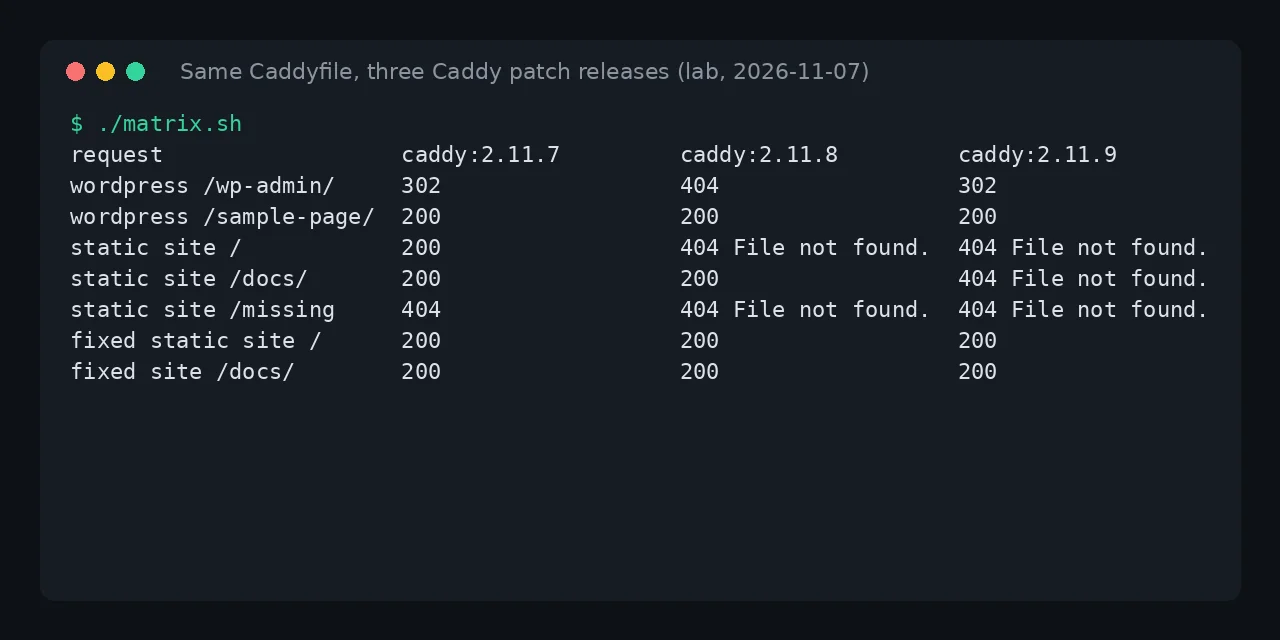
Table of contents
- Key takeaways
- Why does Caddy 2.11 answer File not found on a static site?
- What changed in Caddy 2.11.8 and 2.11.9, version by version
- How to tell which change hit you
- How to fix File not found on a site without index.php
- Do not apply this fix to WordPress
- If you protect a script with path, review the rule
- The other changes: 400, 413 and Caddyfiles that no longer start
- 400 with an invalid Host
- Early 413 with request_body
- Caddyfiles that no longer start
- How to pin the Caddy version in Docker
- Frequently asked questions
- Should I go back to 2.11.7 until this is fixed?
- When can I remove the try_files?
- Is this related to the Caddy 431 error?
- What could you not reproduce?
- Conclusion
- Sources
If your home page answers File not found. after a Caddy update, your site uses php_fastcgi and has no index.php in its root: since 2.11.8, those requests go to PHP-FPM instead of file_server. Add try_files {path} {path}/index.php {path}/ inside php_fastcgi. If /wp-admin/ fails with an empty 404 instead, you are on 2.11.8 and moving to 2.11.9 fixes it. I reproduced this on 7 November 2026 in Docker with all three versions and the same Caddyfile. This guide is also available in Spanish.
Key takeaways
- On 7 November 2026,
caddy:2andcaddy:latestpoint to 2.11.9. The official image definition moved to 2.11.8 on 4 November and to 2.11.9 on the 5th. - A static site with
php_fastcgiand noindex.phpchanged on 5 of the 9 paths I tested between 2.11.7 and 2.11.9, the home page included. - WordPress 7.1.3 lost
/wp-admin/only on 2.11.8. On 2.11.9, the 16 URLs I tested answer the same as on 2.11.7. - The
Host400 hit 3 of the 18 values tested over HTTP/1.1, all of them made only of dots.my_serviceandapp..teststill pass. - The early 413 only changes anything when nothing reads the body. With
reverse_proxy, all three versions already answered 413 to a 2 MB body with a 1 MB limit. - The underlying fix, PR 8372, was merged on 8 November, but as of 16 November it has not shipped in any release. 2.11.7 is no refuge: 2.11.8 carries 9 security fixes and 2.11.9 another 6.
Why does Caddy 2.11 answer File not found on a static site?
This is the most visible failure, because it takes the home page away from a site that used to work. The php_fastcgi directive tries three candidates: {path}, {path}/index.php and index.php, under the first_exist_fallback policy. On 2.11.7, if that last index.php did not exist, the request continued to file_server.
Since 2.11.8, that last candidate matches even when the file is missing, and the request ends up in PHP-FPM. Kévin Dunglas sums it up in PR 8372[1]: "Since v2.11.8, the final entry of first_exist_fallback matches even when the file doesn't exist." This is what the client gets on 2.11.9, with index.html in the root:
HTTP/1.1 404 Not Found
Content-Type: text/html; charset=UTF-8
Status: 404 Not Found
Via: 0.0 Caddy
X-Powered-By: PHP/8.4.27
Content-Length: 16

File not found.
The 2.11.8 notes only warn about paths that do not exist. In my test the home page went too, even though it exists as index.html, and 2.11.9 added /docs/ to the list. Your handle_errors pages do not fire either, because that 404 is a PHP response, not a Caddy error.
What changed in Caddy 2.11.8 and 2.11.9, version by version
The table sums up what I saw with the same Caddyfile on all three versions. I ran Caddy in front of a Python echo server, PHP-FPM 8.4.27 and a real WordPress 7.1.3 with pretty permalinks on. The 2.11.9 cells are also what caddy:2 gives you today.
| Case | 2.11.7 | 2.11.8 | 2.11.9 |
|---|---|---|---|
WordPress /wp-admin/ |
302 to login | Empty 404 | 302 to login |
Site without index.php, / |
200 | 404 File not found. |
404 File not found. |
Site without index.php, /docs/ |
200 | 200 | 404 File not found. |
Site without index.php, /docs |
308 | 404 File not found. |
404 File not found. |
Site without index.php, missing path |
Your 404 | 404 File not found. |
404 File not found. |
Host: .. |
200 | Empty 400 | Empty 400 |
2 MB POST to respond with max_size 1MB |
200 | 413 | 413 |
2 MB POST to reverse_proxy with max_size 1MB |
413 | 413 | 413 |
Two expression lines in one matcher |
Starts | Exits with code 1 | Exits with code 1 |
Different client_auth for the same host |
Starts | Starts | Exits with code 1 |
Client header against env HTTP_X_AUTH_USER |
Client wins | Client wins | Caddyfile wins |
encode gzip with Cache-Control: no-transform |
Not compressed | Gzip | Gzip |
The warning in the 2.11.8 notes proved optimistic for PHP sites: "Most of them reject configs or requests that never did what they looked like they did, so most setups won't notice." 2.11.9 does fix the WordPress failure, and its notes[2] call it a regression from 2.11.8.
How to tell which change hit you
Start with the real version, not the tag in your compose.yml. A caddy:2 image can be any of the recent ones, depending on when you pulled it:
docker compose exec caddy caddy version
curl -si http://127.0.0.1:33290/
Then compare the response with these four symptoms:
- Body
File not found.and anX-Powered-Byheader: the response comes from PHP-FPM. It is thephp_fastcgichange, on 2.11.8 or later - 404 with
Content-Length: 0andServer: Caddyon a URL ending in/: it is the 2.11.8 regression, and the request never reaches PHP - Empty 400: the
Hostcontains only dots, or has/or\over HTTP/2 - The container exits with code 1: it is the stricter validation, and the log gives the cause and sometimes the line
The PHP-FPM log confirms the first case. Each home page visit leaves a line asking for an index.php you do not have:
172.23.0.2 - 07/Nov/2026:19:09:38 +0000 "GET /index.php" 404
How to fix File not found on a site without index.php
The fix is to declare try_files by hand, because your own try_files stops using first_exist_fallback. It was proposed in issue 8367[3], and I tested it on Caddy 2.11.9 with this site: index.html, docs/index.html, contact.php and shop/index.php.
http://:80 {
    root * /srv
    php_fastcgi php:9000 {
        try_files {path} {path}/index.php {path}/
    }
    file_server
    handle_errors {
        rewrite * /404.html
        file_server
    }
}
Apply it without a restart with docker compose exec caddy caddy reload --config /etc/caddy/Caddyfile --adapter caddyfile. This script walks the paths that tend to break, and it also works for testing any future update:
#!/bin/sh
base=${1:-http://127.0.0.1:33290}
for path in / /docs/ /contact.php /shop/ /no-such-page; do
  printf '%-16s ' "$path"
  curl -s -o /dev/null -w '%{http_code}\n' "$base$path"
done
Before the change, / and /docs/ returned 404. After it, all five paths answer as expected, and /no-such-page shows your error page again:
/                200
/docs/           200
/contact.php     200
/shop/           200
/no-such-page    404
I tried two other variants, index off and php_fastcgi with an @php path *.php matcher. Both bring the home page back but lose /shop/ and /contact.php/extra, so I stick with try_files.
Do not apply this fix to WordPress
try_files with no final fallback removes exactly what a front controller such as WordPress needs: sending URLs that are not files to index.php. With this block on my WordPress 7.1.3, on 2.11.9, /sample-page/ and /hello-world/ went from 200 to 404. If your app has an index.php in its root, leave the Caddyfile alone and use 2.11.9. There, the 16 URLs tested returned the same as on 2.11.7, and the dashboard also loaded with a logged-in session.
If you protect a script with path, review the rule
This fix makes visible again a flaw that 2.11.7 also had. With a path /secret.php /secret.php/* rule, requests to /secret.php.php and /secret.phpx/y.php ran secret.php on all three versions. PR 8372 also describes and fixes this.
Until it ships, block by prefix. With this rule, all three versions answered 403 on those two paths and on /secret.php:
@denied path /secret.php*
respond @denied "denied" 403
The safest place for a private script is outside the public directory.
The other changes: 400, 413 and Caddyfiles that no longer start
None of these three changes affected an everyday config in my tests, unless you already had one of these cases. The distinction matters, because a Caddy 413 or 400 does not always have anything to do with the update.
400 with an invalid Host
2.11.8 rejects hosts made only of dots with an empty 400: ., .. and ... in my test. Over HTTP/2, also foo/bar and foo\bar. Over HTTP/1.1, those two already gave 400 Bad Request: malformed Host header on 2.11.7.
I tried 18 values and the other 15 did not change, including my_service, app..test, app.lab.test. and [::1]:8080. If you see this 400 in your logs, it is most likely probes rather than real clients, and there is nothing to fix.
Early 413 with request_body
2.11.8 answers 413 as soon as Content-Length exceeds max_size, even if nothing would read the body. Only the respond case changed; it used to give 200. reverse_proxy already gave 413 and now skips reading the body: bytes_read went from 1,000,001 to 0 in the log.
A 2 MB chunked body gave the same on all three versions: 413 with reverse_proxy and 200 with respond. If a 413 surprises you, raise max_size for that route.
Caddyfiles that no longer start
Here the container exits with code 1, and with restart: unless-stopped it goes into a loop. These are the three errors I reproduced:
repeated expression matchers are not supported, combine them
into one expression with &&, at /etc/caddy/Caddyfile:4

invalid IPv4 mask: 33 (must be between 0 and 32)

two policies with same match criteria have conflicting
client auth configuration
Fix the first by joining the conditions, as the message asks: @m expression `{method} == "GET" && {path}.startsWith("/a")`. Fix the second with a valid mask.
The third only appears on 2.11.9: I triggered it with two blocks for the same host using the request and require modes. A single block with client_auth and the routes under handle passes validation. Check the result in practice too, because the change forces you to decide which mode you meant.
How to pin the Caddy version in Docker
These updates arrived on their own because caddy:2 and latest move with every patch, and 2.11.9 came out one day after 2.11.8. Pin the exact version and, if you want an immutable image, add the digest too:
services:
  caddy:
    image: caddy:2.11.9@sha256:4e2425f6009577e7c651010f16679c28f7d12df3e7b1914f941a7a3370746b3c
Get the digest of your copy with docker inspect --format '{{index .RepoDigests 0}}' caddy:2.11.9. Tags get rebuilt without a version change: on 13 November, caddy:2 and caddy:2.11.9 both moved to sha256:4e2425f6…, and caddy version still prints v2.11.9.
Before moving up a version, run caddy validate with the new image. It catches Caddyfiles that will not start, but not behaviour changes: my broken Caddyfile printed Valid configuration on 2.11.9 while the home page gave 404. That is why you should also run the script above.
If you update with Watchtower, exclude Caddy. With Renovate or Dependabot, the digest reaches you as a change you can review before applying it.
Frequently asked questions
Should I go back to 2.11.7 until this is fixed?
Only as a stopgap for a few hours. image: caddy:2.11.7 restored everything in my test, but it leaves out the 9 security fixes in 2.11.8 and the 6 in 2.11.9, 6 of those 15 in FastCGI. With try_files, a site without index.php works on 2.11.9, so you do not need to stay behind.
When can I remove the try_files?
When a published release includes PR 8372, which makes a missing index.php stop matching. The PR was merged on 8 November 2026 and closed issue 8367, but as of 16 November 2.11.9 is still the latest release, and the caddy:2 image rebuilt on 13 November still answers "File not found." without the try_files. Check the Caddy release notes[4] before removing it, and run the check script.
Is this related to the Caddy 431 error?
No. The 431 Request Header Fields Too Large comes from the 2.11.6 header limit and has not changed. If you come from a version before 2.11.6 with an old caddy:2, you can have both problems at once, and each one has its own fix.
What could you not reproduce?
The 2.11.9 notes say FastCGI answers 400 when the escaped and decoded paths select different scripts. With an @pub path /public/*%2f* matcher and their example path, I got an empty 200 on all three versions, so I cannot confirm that 400. I also saw no difference in PATH_INFO with my test paths, and I did not test HTTP/3 or Windows.
Conclusion
Two Caddy patches changed how php_fastcgi behaves, and the fix depends on your site. If you have an index.php in the root, like WordPress, use 2.11.9 and leave the Caddyfile alone. If it is a static site with loose PHP files, add try_files {path} {path}/index.php {path}/ and block private scripts by prefix. Either way, pin the exact version in your compose.yml and run a check script before changing it.
Sources: [1] Caddy, v2.11.8 release notes[5], [2] Caddy, v2.11.9 release notes[2], [3] Caddy, PR 8372 on first_exist_fallback[1], [4] Caddy, issue 8367 on file_server in 2.11.9[3], [5] Caddy, issue 8353 on the directory 404[6], [6] Caddy docs, php_fastcgi directive[7], [7] Docker Hub, official Caddy image[8], [8] Docker official-images, library/caddy definition[9].
Sources
Source code
Access all the source code for this post on GitHub.
View on GitHub