Docker Agent is a Docker CLI plugin for building and running AI agents from a declarative YAML file, no code required: you define one or more agents, give them MCP tools, run them with docker agent run, and share them through any OCI registry, on OpenAI, Anthropic, Gemini or other providers.
Open GSD (Git. Ship. Done.) is an open-source, MIT-licensed toolkit for steering coding agents without losing context: it splits work into five phases (discuss, plan, execute, verify and ship) and delegates the heavy lifting to subagents that each start with a clean context. Its core is the gsd-core engine and the gsd-pi terminal agent.
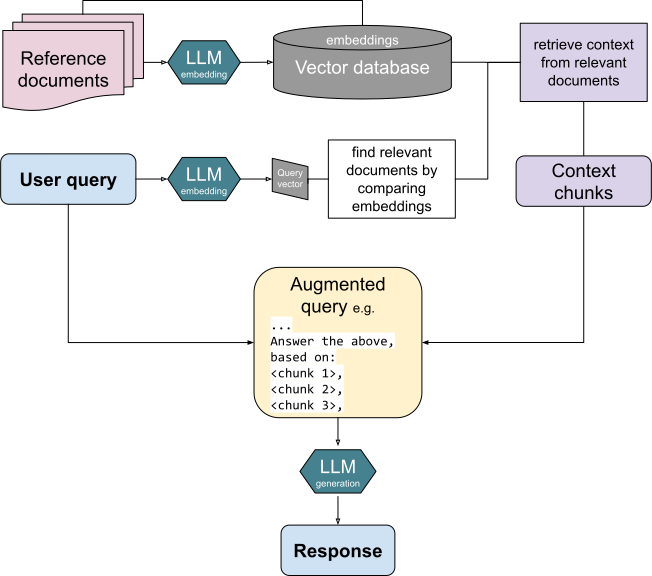
A vector embedding is a list of real numbers that represents the semantic meaning of a piece of text, an image, or any other data. Two sentences with the same meaning produce vectors that are close together; two unrelated ones produce vectors that are far apart. Semantic search, RAG, and recommendation systems are all built on this principle.
Tested May 2026 recipe: oMLX 0.3.8 on Mac M5 Max with 128 GB, TurboQuant at 3.5-bit, Qwen 3.6 35B-A3B model stack, Claude Code wiring and real benchmarks.
This guide shows how to build a production-ready agent with the Anthropic SDK in Python: the tool-use loop with the Messages API, streaming with backpressure via a bounded queue, prompt caching with cache_control, your own MCP server registered with the Claude Agent SDK, OTel GenAI traces, and a non-root Docker container ready for production.
After eighteen months of multi-vendor adoption, MCP is the de facto standard for connecting models to tools. The complete guide: architecture, servers, policies, authentication, composition, and the antipatterns we’ve already seen in production.
Opus 4.7 launched as Anthropic's most capable model, with emphasis on long-horizon agentic work. After two months of intensive use, these are the practical changes versus Opus 4.6.
The first invoice for a production agent usually runs double or triple the estimate. This article walks through five real levers, in priority order, caching, routing, context control, batching, and telemetry, to cut cost without touching perceived quality.
While OpenAI and Anthropic dominate headlines with rounds worth hundreds of millions, a growing group of niche AI startups generates one to ten million dollars in revenue with teams of two to ten people. They share five patterns: narrow vertical focus, 70-80% margins, community distribution, iteration cycles in days, and AI as an internal lever.
The idea of UI generated on the fly instead of pre-built reached production in 2025. After a year of real-world use, the balance is more nuanced than the initial enthusiasm suggested.
Direct Preference Optimization (DPO) and its variants, IPO, KTO, and SimPO, have displaced RLHF as the preferred alignment method for language models: they drop the separate reward model, cut training cost, and are easier to reproduce. RLHF still has an edge only for frontier models with very large budgets.
Skills package reusable capabilities; subagents isolate bounded-task execution. Together they form the most effective pattern for composing complex agents in 2026.
Synthetic data has moved from a precarious substitute for real data to a central component of modern model training: the most reliable pattern expands a real core of 500 examples with thousands of synthetic paraphrases, provided you validate diversity, correctness, and distribution, and keep at least 30% real data to avoid model collapse.
The Model Context Protocol, proposed by Anthropic in late 2024 and adopted through 2025-2026 by Anthropic, OpenAI, Google, and the open-source community, already has proven operational patterns: separating generic servers from custom ones, explicit per-tool policies, credentials kept outside the model, prefixed composition, and contract tests. This is the state of the art in 2026.
Using an LLM to judge another LLM became widespread in 2024 and remains, in 2026, the only scalable way to evaluate qualitative quality in LLM systems. It is reliable when judge-human correlation exceeds 0.7 on 30 cases and gets recalibrated quarterly; below that threshold, do not trust the number.
Claude Sonnet 4.6 is the default model for most 2026 production workloads: it covers 80% of traffic with quality indistinguishable from Opus 4.7 in blind tests, at roughly 60% of Opus per-token price. Opus is still needed for complex reasoning and agentic coding on large codebases.
Hybrid RAG in 2026 combines dense and lexical search fused with RRF, cross-encoder reranking over the top-50 candidates, structure-aware chunking, and continuous evaluation with Ragas or TruLens. It is the pattern that survives in serious production systems three years after the initial embeddings boom.
AI agents fail in production, and what matters is how you respond in the first twenty minutes. This runbook covers severity classification, isolating before investigating, purging contaminated memory, communicating without inventing facts, and turning every incident into a regression test before closing it as done.
LLM red teaming has gone from an esoteric activity to a mandatory practice. With the OWASP Agentic Top 10 and the CSA Agentic AI Red Teaming Guide converging on shared vocabulary, this is the operational playbook any team deploying agents needs to have.
Después de año y medio llenando tableros con agentes en producción, la pregunta que separa equipos que envían fiable de los que van a ciegas sigue siendo la misma: ¿cómo mides que el agente está funcionando?
Prompt engineering has moved from viral tricks to a discipline with reproducible patterns: few-shot, chain-of-thought, and structured output with function calling. Teams treating prompts like code (versioned, tested, and monitored) get consistently better results than those who improvise.
El concepto de Agent OS pasó del slide al despliegue en 2025. Seis meses en producción dejan patrones visibles: qué arquitecturas funcionan, dónde se rompe el modelo y qué aporta frente a correr agentes sobre pila existente.
Ollama 0.5 or newer runs Llama 3.3 70B and Mistral Large 2 locally on Ubuntu 24.04: Q4_K_M quantization lets a single NVIDIA GPU with 24 GB of VRAM, an RTX 4090 for example, handle the full model. This guide installs the drivers, sets up Open WebUI, and exposes the service behind Traefik with TLS.
A year after GraphRAG left the lab, one statistic holds: it works where corporate information has dense relational structure, fails where there are only loose documents. Patterns, ingestion costs, and architectural decisions that have survived a year of real deployment.
The Model Context Protocol has gone from proposal to de facto standard for connecting editors with external tools. This practical guide walks through standing up a local MCP server, wiring it into VS Code or your client of choice, and understanding exactly what you are exposing.
After two years of pilots and a year of agents in production, governance has moved from an aspirational committee to an operational control. What audits ask for, what broke in 2025, and which guardrails absorb most incidents.
Durante 2025 cientos de equipos pusieron agentes IA en producción real. A principios de 2026, con datos suficientes, emergen lecciones consistentes sobre qué falla, qué funciona, cuánto cuesta y qué tareas no encajan. Repaso ordenado para equipos que empiezan ahora.
Twenty months after the initial announcement, Model Context Protocol went from curiosity to de-facto standard among agent clients and servers. What is available, which servers are worth it, which problems remain open, and how it compares to earlier protocol maps.
La Ley de IA europea iba a entrar en aplicación plena para sistemas de alto riesgo en agosto de 2026. El Digital Omnibus, aprobado por el Parlamento y el Consejo en junio de 2026, retrasa esa fecha 17 meses, hasta diciembre de 2027. Qué obligaciones rigen ya y qué cambia de verdad.
La factura de IA en las empresas ha dejado de ser anecdótica. Entre tokens de modelos frontera, GPUs reservadas que nadie usa y pipelines RAG con cachés mal configuradas, muchos equipos pagan diez veces lo que deberían. Guía de FinOps específico para IA sin relatos promocionales.
Sixteen months after Anthropic first shipped computer use, with browser-use, OpenAI Operator and Gemini Computer Use all pushing in parallel, agents that drive the browser and desktop have moved from demo to real workflows. Time to review which patterns survive when you run them daily in production.
A selection of postmortems published between 2025 and 2026 by teams running AI systems in production reveals repeated patterns: guardrail failures, silent model drift, hidden vendor dependency, and a collection of near-misses worth distilling.
Tres años de valoraciones vertiginosas han empezado a corregirse sin estrépito pero con firmeza: rondas abajo, despidos selectivos y consolidación en torno a propuestas con ingresos reales. Una lectura ordenada de qué sobrevive, qué se quema y qué aprende el ecosistema.
Anthropic publicó Haiku 4.5 en octubre de 2025 y el modelo ha madurado rápido: rendimiento cercano a Sonnet 4 en tareas estructuradas a un tercio del coste, ventana amplia y latencia baja. Es la pieza que faltaba para desplegar agentes a escala sin quemar presupuesto.
Knowledge graphs spent two decades waiting for their moment. With LLMs now bridging free text and formal ontology, and the GraphRAG pattern already mature, the technology is back in the spotlight. Time to look at why it finally fits and where it actually pays off.
After two years watching every product invent its own interface for talking to an agent, by January 2026 a stable design consensus is emerging about which patterns work, which do not, and what the average user already expects. Time to write down what has settled.
Six months after A2A landed at the Linux Foundation, and after several implementation cycles from Google, Microsoft, and open projects, what version 1 of the protocol means and whether it is safe to build on yet.
European sovereign AI discourse has spent three years fueling headlines, public investment, and interstate agreements. We are starting to see which part of the promise has real technical substance and what a technical team expecting alternatives outside the US ecosystem can actually count on.
With MCP solving the agent-to-tool layer, a parallel problem surfaces: how do two agents from different vendors communicate with each other. Google's Agent2Agent protocol, donated to the Linux Foundation in June 2025, tries to fill that gap with an open standard.
Phi-3 es la familia de modelos pequeños de lenguaje que Microsoft viene puliendo desde abril de 2024 con variantes de 3.800 millones, 7.000 millones y 14.000 millones de parámetros. Después de año y medio, el panorama del edge con SLM abiertos se ha vuelto serio y Phi-3 ocupa un sitio claro.
Large language models have spent two years promising effortless documentation for code, APIs and architecture. After watching dozens of projects try it, clear patterns emerge for where it works and where it just becomes more debt.
Guardrails frameworks promise to filter language-model inputs and outputs to block data leaks, harmful content, or hallucinations. After evaluating four of the most popular ones in production, I cover what they actually do, what latency and billing cost they add, and when they pay off over simpler controls.
Agents that chain calls to models, tools and memory are hard to debug without instrumentation designed for them. After a long year running agents in production, I cover what to measure first, which standards are consolidating, and which costly mistakes are avoided by getting the traces right from the start.
8 min256
We use first- and third-party cookies to analyze site traffic. You can accept them, reject them, or configure your choice.
Learn more about cookies
Cookie preferences
NecessaryEssential for the site to work. Always on.
AnalyticsHelp us understand how the site is used (Google Analytics).