Hugging Face TGI: Serving Open Models at Scale

Table of contents
- Key takeaways
- What TGI is
- Minimal deployment
- Where TGI shines
- Where others surpass
- High-impact optimisations
- OpenAI-compatible API
- Production operation
- Alternatives to consider
- Conclusion
- Frequently asked questions
- Does TGI still have a restrictive licence?
- Can I use TGI with the OpenAI SDK, LangChain or LiteLLM without changing code?
- When should I choose vLLM or llama.cpp instead of TGI?
- Sources
Serving an open LLM in production is not trivial. Keeping the GPU saturated, batching requests without blocking, applying quantization without losing quality, and exposing an OpenAI-compatible API are four problems at once. Text Generation Inference (TGI)[1] from Hugging Face tries to resolve them with a coherent stack. It is one of the more mature options in the open ecosystem, with a somewhat bumpy licensing past worth knowing before you adopt it.
Versión en español de este artículo
Key takeaways
-
TGI supports continuous batching, FlashAttention v2, tensor parallelism, and quantization (bitsandbytes, GPTQ, AWQ) with minimal configuration.
-
For Hugging Face Hub models, TGI is the lowest-friction path: load by ID, no format conversion.
-
TGI briefly switched to a restrictive licence (HFOIL) between 2023 and early 2024, then reverted to Apache 2.0 in version 2.0: today it is as open as vLLM or llama.cpp[2].
-
For raw throughput on high-end GPUs, vLLM wins on its better-implemented PagedAttention. For CPU or Apple Silicon, llama.cpp is better.
-
The OpenAI-compatible API (
/v1/chat/completions) enables hosted-to-self-hosted transitions without code changes.
What TGI is
TGI is an inference server specialised in text generation, written mostly in Rust (the router) and Python (the worker using PyTorch). It supports the most popular hub models: Llama 2, Mistral, Falcon, StarCoder, BLOOM, CodeLlama, Yi, MPT, Phi, and variants.
Key capabilities:
-
Continuous batching: groups concurrent requests without waiting for the slowest. Maximises GPU utilisation.
-
FlashAttention v2: optimised attention implementation reducing memory and accelerating computation.
-
PagedAttention: KV-cache memory management inspired by vLLM (though vLLM implements it better).
-
Tensor parallelism: split the model across multiple GPUs.
-
Quantization: bitsandbytes (NF4, FP4, INT8), GPTQ, AWQ, EETQ. 4-bit or 8-bit inference with minimal effort.
-
SSE streaming: tokens sent to client as generated.
-
Guided generation: grammars, regex, JSON schema via Outlines.
-
OpenAI-compatible API:
/v1/chat/completionsas an additional layer.
Minimal deployment
docker run --gpus all --shm-size 1g -p 8080:80
  -v $PWD/data:/data
  ghcr.io/huggingface/text-generation-inference:latest
  --model-id mistralai/Mistral-7B-Instruct-v0.2
  --quantize bitsandbytes-nf4
After a few minutes loading, the endpoint responds at POST /generate with streamed tokens. On Kubernetes, the official chart covers deployments with GPU operator; pods need nvidia.com/gpu: 1 (or more for tensor parallelism).
 NVIDIA logo, manufacturer of the GPUs on which TGI runs in production for large language model inference (Image: Nvidia, Apache License 2.0, via Wikimedia Commons)
Where TGI shines
TGI is the right option for:
-
Direct Hugging Face Hub models: load by ID, no format conversion.
-
bitsandbytes-quantized models: native NF4, FP4, INT8 support.
-
High-quality SSE streaming: low first-token latency, stable throughput.
-
Hugging Face Inference Endpoints: TGI is the engine behind their managed service.
-
Transformers integration: same tool family, proven compatibility.
If you’re already in the HF ecosystem, TGI is the lowest-friction path.
Where others surpass
-
Raw throughput: vLLM[3] squeezes more tokens/second on high-end GPUs thanks to its well-implemented PagedAttention, and is Apache 2.0.
-
CPU or Apple Silicon: llama.cpp[2] / Ollama[4] are better for GPU-less inference.
-
Exotic models: TGI covers the popular ones; less common or new models may be unsupported.
-
The 2023 licence scare, now over: Hugging Face released TGI v1.0 under HFOIL[5], a licence that blocked reselling it as a managed service. A fair number of teams got spooked and some migrated to vLLM at the time. But version 2.0 reverted the licence to Apache 2.0[6], so the argument no longer holds. If someone tells you TGI "has a restrictive licence," they are quoting a 2023 headline that is no longer true.
High-impact optimisations
Three small tunings with large effect:
-
--max-batch-prefill-tokens: total token cap in prefill phase (the costliest). Higher means more concurrency but more VRAM. -
--max-total-tokens: maximum context window per request. Tighter means less memory use. -
--quantize gptqor--quantize awq: better than bitsandbytes if you have a pre-quantized model.
Measure throughput before and after with locust[7] or vegeta[8] to validate real impact.
OpenAI-compatible API
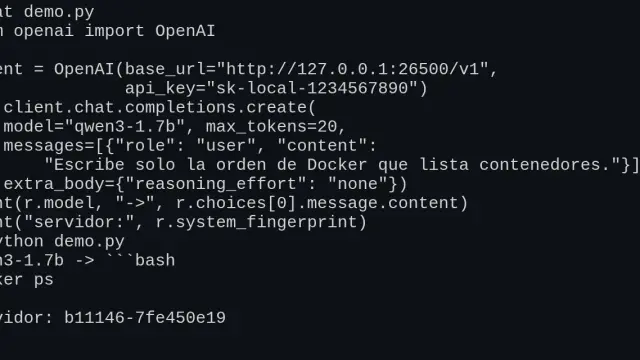
curl http://localhost:8080/v1/chat/completions
  -H "Content-Type: application/json"
  -d '{
    "model": "tgi",
    "messages": [{"role": "user", "content": "Hello"}],
    "stream": true
  }'
This lets you use LangChain[9], LiteLLM[10], and OpenAI SDKs without code changes. The transition from a hosted model to self-hosted goes from weeks to minutes.
Production operation
Checklist for serious TGI ops:
-
Health checks against
/health. -
Prometheus metrics at
/metrics, which expose latency, throughput, and VRAM usage. -
Limit concurrency at router level to avoid OOM in spikes.
-
Backup the downloaded model: if the hub is unreachable you can’t start.
-
Monitor GPU temperature: above 90°C it degrades and fails.
-
Plan for CUDA and driver updates, since TGI is version-sensitive.
 PyTorch logo, the deep learning framework used by TGI’s worker for language model inference (Image: PyTorch, BSD, via Wikimedia Commons)
Alternatives to consider
-
vLLM[3]: better general throughput, active community, Apache 2.0.
-
llama.cpp[2] / Ollama[4]: CPU and Apple Silicon, simpler deployment.
-
TensorRT-LLM[11]: performance ceiling on NVIDIA GPUs, but high operational complexity.
-
LMDeploy[12]: good performance on certain models.
Conclusion
TGI remains a robust, sensible choice for a team serving open models: support for popular hub models, easy quantization, familiar API, and HF-ecosystem integration. And contrary to what a lot of people still repeat, the licence is no longer a hurdle: since version 2.0 it is Apache 2.0 again. For absolute throughput on top GPUs, vLLM wins on its better-implemented PagedAttention; for maximum simplicity on CPU, llama.cpp. If you are in the HF ecosystem, TGI remains the lowest-friction option, without the fine print it carried back in 2023.
Sources:
- text-generation-inference: official Hugging Face GitHub repository[1]
- Issue #726: HFOIL 1.0 licence announcement (2023)[5]
- Commit reverting the licence to Apache 2.0 in version 2.0[6]
- Official Text Generation Inference documentation[13]
- vllm-project/vllm: official GitHub repository[3]
Frequently asked questions
Does TGI still have a restrictive licence?
No: Hugging Face released TGI v1.0 under HFOIL, a licence that blocked reselling it as a managed service. That spooked a fair number of teams between 2023 and early 2024, and some migrated to vLLM. Version 2.0 reverted the licence to Apache 2.0, so today TGI is as open as vLLM or llama.cpp. Anyone claiming otherwise is quoting a 2023 headline that is no longer true.
Can I use TGI with the OpenAI SDK, LangChain or LiteLLM without changing code?
Yes. TGI exposes an OpenAI-compatible API at /v1/chat/completions as an additional layer, with stream: true for SSE token streaming. Point the client at the TGI server, with "model": "tgi" in the request, and LangChain, LiteLLM and the OpenAI SDKs work without modification. That is why moving from a hosted model to a self-hosted one goes from weeks to minutes.
When should I choose vLLM or llama.cpp instead of TGI?
vLLM when you want raw throughput on high-end GPUs: it squeezes more tokens per second thanks to its better-implemented PagedAttention, and it is also Apache 2.0. llama.cpp or Ollama when inference runs on CPU or Apple Silicon without a GPU. TGI wins on friction if you are already in the Hugging Face ecosystem. It loads Hub models by ID with no format conversion, with native bitsandbytes NF4, FP4 and INT8 quantization plus GPTQ and AWQ.