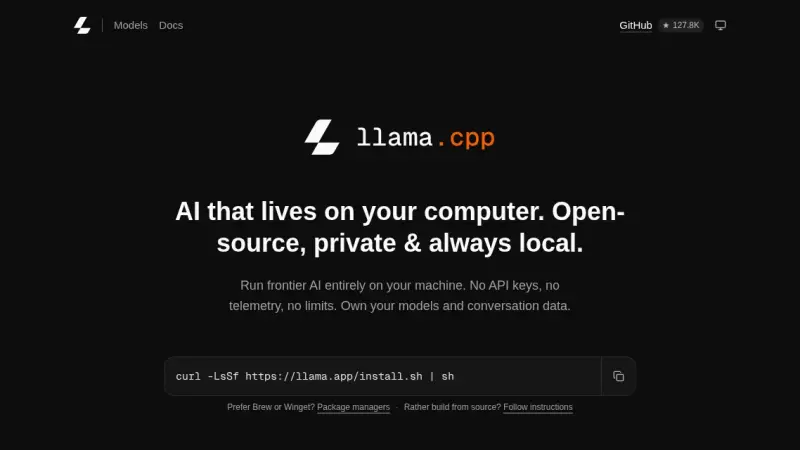
There are four ways to install llama.cpp: the llama.app script, which drops a 15 MB llama binary into ~/.local/bin; Homebrew; the server-v0.4.1 Docker image; or CMake. I tested them on 14 September 2026 on Linux arm64 with Gemma 4 E2B, in the terminal with llama cli and as an OpenAI-compatible API.
NVIDIA still dominates frontier-model training in 2026, but inference tells a different story. AMD MI300X/MI325X with mature ROCm, Intel Gaudi 3, Google TPU v6, and AWS Trainium/Inferentia deliver 20 to 50% lower cost per token without sacrificing quality. Here is when to choose each option.
NPUs stopped being an accessory and became the component that defines real performance in laptops, phones, and small servers. A practical look at the hardware that rules 2026, which workloads pay off, and where the traditional GPU still wins.
An inference router decides which model answers each incoming request, weighing cost, latency and how hard the request actually is. Well-built inference routers cut total token spend by 30 to 70 percent with no quality loss the user can perceive. Four patterns cover most cases: length, task type, an auxiliary classifier, and learned routing.
TypeScript 5.5, released in late June 2024, is a low-risk upgrade whose main wins are inferred type predicates in filter callbacks, which delete dozens of trivial annotations, and regular expressions checked at compile time. A year of daily use separates those from the cosmetic changes and from the spots where existing code needs adjusting.
vLLM remains the reference engine for serving LLMs on GPU in 2025: automatic prefix caching sharply cuts latency for repeated prompts, speculative decoding speeds up large models, and multi-LoRA support lowers the cost of multi-tenant SaaS, though multi-GPU support and non-NVIDIA hardware remain weak points.
TensorRT-LLM is the NVIDIA inference engine that compiles each model into a binary optimized for the exact GPU and batch size it will serve. It uses hand-written CUDA kernels and native FP8 quantization on H100. Against vLLM it can run 2 to 3 times faster in the best case, at the cost of a 30 to 90 minute build.
vLLM serves language models on GPU using PagedAttention and continuous batching, two techniques that multiply throughput compared with a naive server. It exposes an OpenAI-compatible API, so migrating an existing application only requires changing the base URL and deploying the right binary.
A model trained in PyTorch or TensorFlow, running the same way on a server, a phone, a browser tab, or an ARM gateway on the factory floor: that is what ONNX Runtime solves. It turns the ONNX format into a genuinely portable artifact, exported once, at the cost of some peak performance versus a platform-native runtime.
Text Generation Inference (TGI) is the Hugging Face stack for serving open LLMs in production: continuous batching, 4-bit and 8-bit quantization, streaming, and an OpenAI-compatible API. After a brief restrictive-licence episode in 2023, it returned to Apache 2.0 in version 2.0.
7 min3204.4
We use first- and third-party cookies to analyze site traffic. You can accept them, reject them, or configure your choice.
Learn more about cookies
Cookie preferences
NecessaryEssential for the site to work. Always on.
AnalyticsHelp us understand how the site is used (Google Analytics).