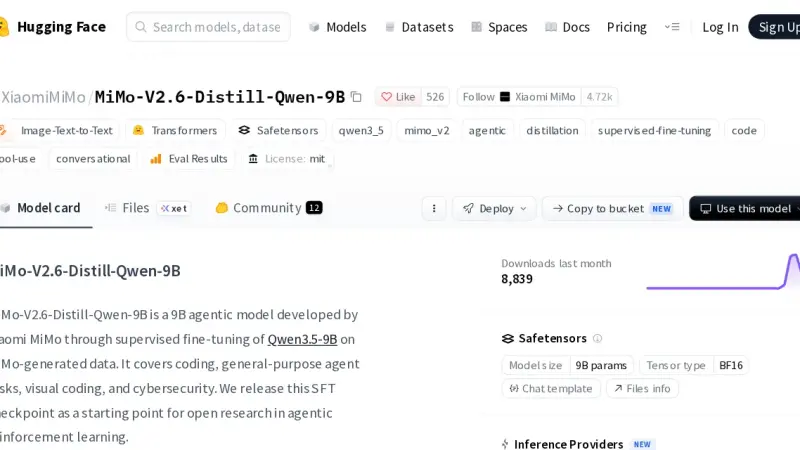
September 2026 produced few open models of home-machine size. The one worth disk space is Xiaomi's MiMo-V2.6-Distill-Qwen-9B, MIT licensed: in my CPU tests it got tool calls and JSON right. MiniCPM5-2B remains the small option, and DFM Mimir is only useful in Danish or English.
Agent Lightning is the Microsoft Research framework that applies reinforcement learning to the model behind an agent you already wrote. The agent points its OpenAI client at the Agent Lightning proxy instead of the model, and the proxy records requests, responses and rewards while the agent keeps its tools and control flow.
August 2026 produced about a dozen models with genuinely downloadable weights, and several names that exist only as a hosted API. The ones that change what fits on your own machine are Muse Glimmer 30B and Qwen3.8-27B, both Apache 2.0, plus Ling-3.0-tiny for smaller hardware.
A vector embedding is a list of real numbers that represents the semantic meaning of a piece of text, an image, or any other data. Two sentences with the same meaning produce vectors that are close together; two unrelated ones produce vectors that are far apart. Semantic search, RAG, and recommendation systems are all built on this principle.
Crunchbase and CB Insights first-quarter data confirm that global startup funding has rebounded, but nearly all of the growth is concentrated in startups presenting themselves as AI. The rest of the ecosystem remains in correction.
The hyperbolic tangent (tanh) is an activation function that squashes any real value into the interval (-1, 1) with zero-centred output, which removes the systematic gradient bias seen with sigmoid. It is the standard activation inside the LSTM and GRU memory cells used in recurrent networks.
The sigmoid function maps any real number to a value between 0 and 1, which makes it the natural activation function for expressing probabilities in a neural network. It is differentiable across its whole domain, though it suffers from saturation and vanishing gradients in deep networks, so today it is mostly reserved for the output layer.
Leaky ReLU is an activation function derived from ReLU that replaces the zero output for negative inputs with a small slope, typically 0.01. This keeps the gradient from ever reaching zero, which prevents the dying neuron problem and stabilizes training in very deep convolutional, recurrent, and GAN networks.
ReLU (Rectified Linear Unit, f(x) = max(0, x)) has been the dominant activation function in deep learning since AlexNet popularised it in 2012: cheap to compute, resistant to vanishing gradients, and with one well-known weakness, dying ReLU.
The step function, or Heaviside function, is the simplest activation function in a neural network: it maps any input to a binary output, 0 or 1, depending on whether it crosses a fixed threshold. It was the core decision mechanism of Rosenblatt's perceptron in 1958, but its derivative is zero almost everywhere, so modern networks use sigmoid or ReLU instead.
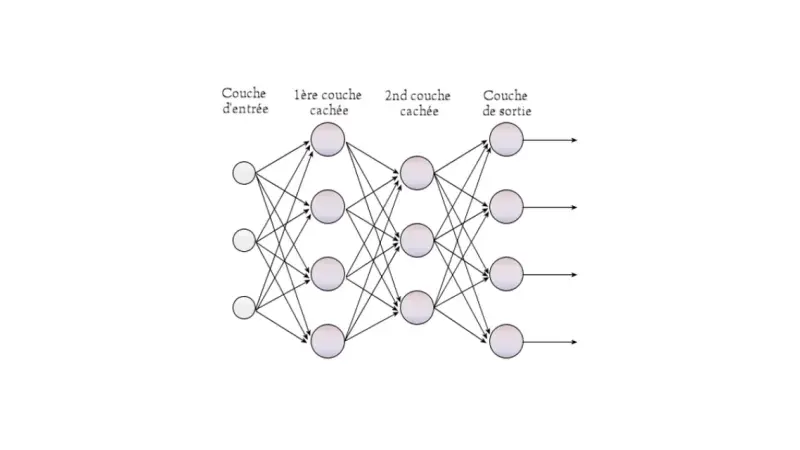
A fully connected neural network, also called a dense network, is the fundamental architecture of deep learning: every neuron in a layer connects to all neurons in the previous and next layer. This total connectivity lets it approximate any continuous function, though its computational cost grows quadratically with the number of neurons.
A multilayer neural network consists of an input layer, one or more hidden layers, and an output layer, where each neuron weights its inputs and applies a non-linear activation function before passing the result to the next layer. Through forward propagation and backpropagation, the network adjusts millions of weights to learn hierarchical representations capable of classifying images, translating text, or generating language.
ChatGPT 4 combines advanced natural language processing with deep learning to deliver conversations that are more natural, coherent, and personalised than earlier chatbots. It understands intent and accumulated context, handles multiple intents in a single turn, and reduces escalations to human agents, though it still requires careful design and human oversight.
Reinforcement learning is the AI technique in which an agent learns to make optimal decisions through trial and error, without labelled data: it acts in an environment, receives a reward or penalty based on the outcome, and adjusts its strategy to maximise long-term cumulative reward.
Intelligent automation combines AI, machine learning, and physical robots that perceive, decide, and adapt in real time instead of following a fixed script. It is transforming manufacturing, logistics, healthcare, and food processing, and by 2024 there were already more than 4.6 million industrial robots active worldwide, per the IFR.
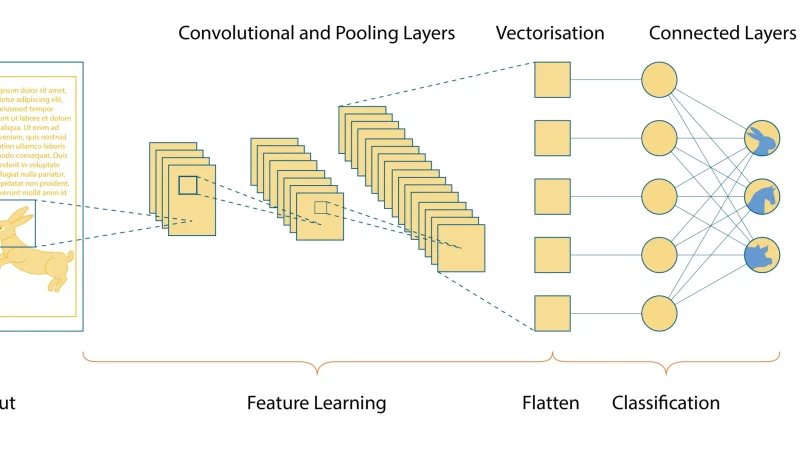
Computer vision is the branch of artificial intelligence that lets machines interpret digital images: detecting objects, segmenting regions and recognising patterns through convolutional neural networks. Since 2012, when AlexNet cut ImageNet classification error to 15.3%, it has spread into manufacturing, medicine, transport and precision agriculture.
Natural Language Processing (NLP) is the AI discipline that enables machines to understand, interpret, and generate human text and speech. Powered by the transformer architecture since 2017, NLP drives chatbots, automatic translation, and clinical diagnosis tools, with open challenges in causal reasoning, energy efficiency, and bias mitigation.
Deep neural networks are today the foundation of almost every artificial intelligence application: from facial recognition to machine translation. Built on architectures like CNNs, RNNs, and Transformers, deep learning has transformed computer vision, speech recognition, and natural language processing over the last decade.
The financial sector is undergoing a deep transformation: blockchain, artificial intelligence, mobile payments, open banking, and big data are redefining who provides financial services and how. The World Bank estimates 76% of adults worldwide now hold a bank or mobile-money account, up from 51% in 2011, and these five technologies explain much of that progress.
Modern artificial intelligence rests on three pillars: machine learning, deep neural networks, and natural language processing. These techniques have pushed image recognition and machine translation past human-level precision on specific tasks, though the overall system still depends on quality data and constant human oversight.
GitHub Copilot is an AI-powered coding assistant that suggests code as you type, built into VS Code, JetBrains, and Neovim. It speeds up repetitive tasks and API exploration, but it also generates plausible code with real errors: studies document security vulnerabilities in a meaningful share of its suggestions, so every suggestion still needs human review.
Industry 4.0 is the Fourth Industrial Revolution: the convergence of IoT, artificial intelligence, big data, advanced robotics, and cybersecurity that connects factories to digital networks. The goal is the smart factory, able to adjust its production in real time from the data it collects, gaining productivity, quality, and energy efficiency.
5 min1924.5
We use first- and third-party cookies to analyze site traffic. You can accept them, reject them, or configure your choice.
Learn more about cookies
Cookie preferences
NecessaryEssential for the site to work. Always on.
AnalyticsHelp us understand how the site is used (Google Analytics).