Robotics and Intelligent Automation: The New Industrial Era

Table of contents
- Key takeaways
- What distinguishes intelligent automation from classical automation
- Sectoral impact: manufacturing, logistics, and healthcare
- The employment factor: simultaneous destruction and creation
- Robotics and Industry 4.0
- Conclusion
- Frequently asked questions
- How does a cobot differ from a classic industrial robot?
- How many industrial robots are installed per year, and which sectors lead adoption?
- Does intelligent automation destroy jobs on a net basis?
- Sources
Robotics and intelligent automation have stopped being exclusive to large automotive plants and become accessible infrastructure for companies of all sizes. The combination of AI, machine learning, and physical robots is redefining what people do and what machines do in industry.
Key takeaways
-
Intelligent automation integrates AI and machine learning into physical robotic systems, surpassing purely mechanical automation.
-
Classic industrial robots are giving way to cobots, designed to work alongside people without safety barriers.
-
The most transformed sectors are manufacturing, logistics, healthcare, and food processing.
-
The employment impact is dual: it eliminates repetitive tasks but creates new supervision, maintenance, and programming roles.
-
Integration with digital twins and IoT allows optimising robots without stopping production.
What distinguishes intelligent automation from classical automation
Industrial automation has existed since the Industrial Revolution. What makes it "intelligent" today is the addition of perception, decision-making, and adaptation layers that did not previously exist:
-
Perception: vision, lidar, tactile, and force sensors that give robots real-time environmental information.
-
Decision: machine learning models that allow robots to adapt their behaviour based on what they perceive, not just follow a fixed script.
-
Adaptation: capacity to retrain on new data or adjust operating parameters without full manual reprogramming.
This distinguishes a traditional welding robot, which repeats the same arc in the same position every time, from an intelligent assembly system that adjusts its force based on component variability.
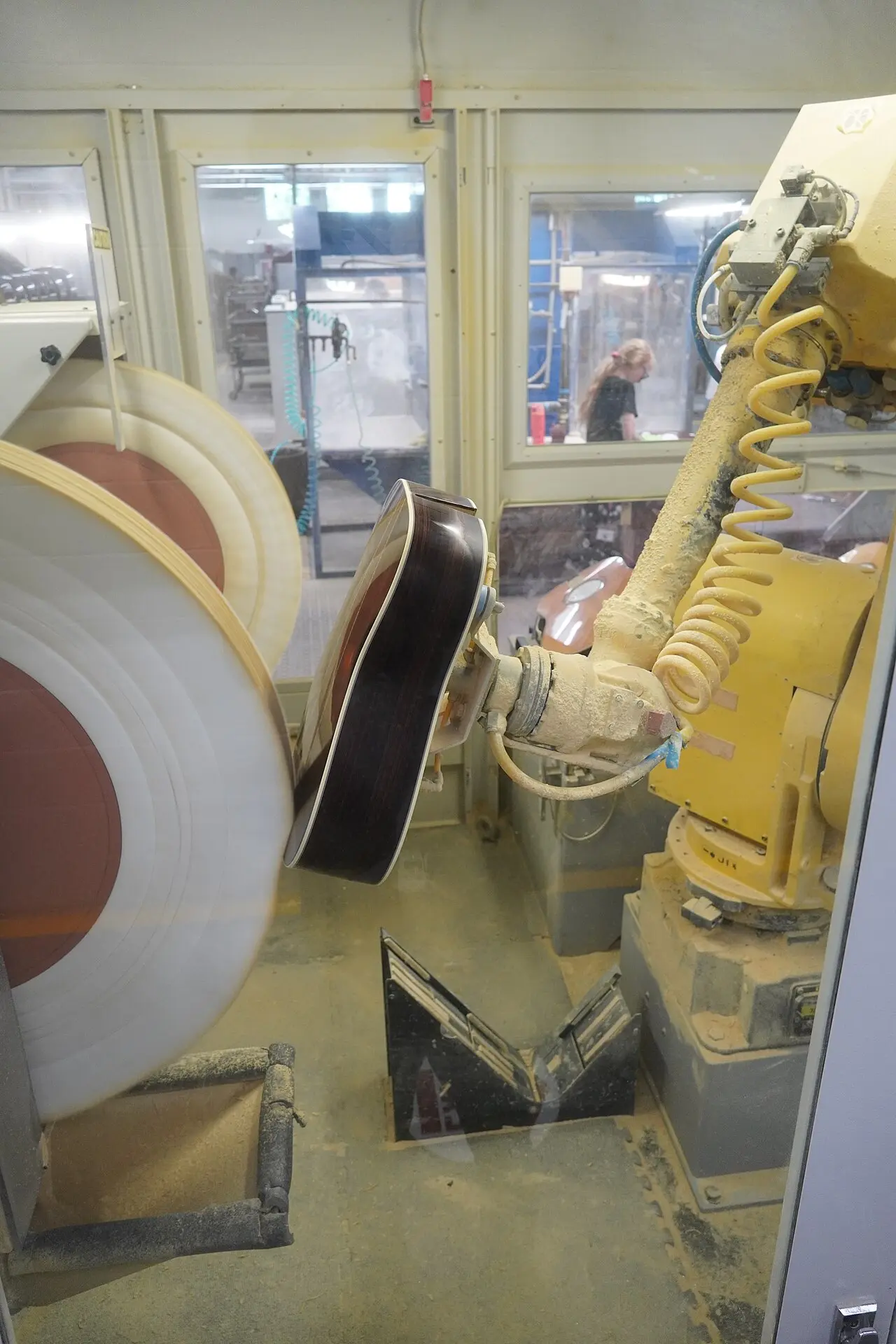 Industrial robotic arm on a production line performing precision operations (Image: Henrysz, CC BY 4.0, via Wikimedia Commons)
Sectoral impact: manufacturing, logistics, and healthcare
Manufacturing. High-mix production lines, those blending different part numbers on the same line, are the natural domain of cobots (collaborative robots). Companies like Universal Robots[1] have popularised 6-axis arms that any operator can reprogram in hours; the company passed 100,000 cobots sold worldwide in 2025. Machine-vision quality inspection detects surface defects that would escape human inspection at line speed.
Logistics and warehouses. Amazon, DHL, and Ocado have redesigned their distribution centres around fleets of autonomous mobile robots (AMRs) that bring shelves to picking stations instead of making the person walk to them. Amazon states it has deployed[2] more than a million robots across its operations network since 2012.
Coordinating fleets of dozens of robots in the same warehouse requires real-time path-planning algorithms. This infrastructure ties directly to IoT and the intelligent connection of the world.
Healthcare. Surgical robots (da Vinci, from Intuitive Surgical, is the best known) amplify surgeon precision in minimally invasive procedures. In 2024 alone, about 2.68 million procedures were performed with da Vinci systems[3] worldwide, 17% more than the year before.
Automated pharmacy robots manage dispensing and drug traceability with error rates below one in ten thousand. Rehabilitation robots assist patients with neurological damage through repetitive exercises that physiotherapists could not sustain.
Food processing. Handling irregular products, fruit, cuts of meat, has historically been a challenge for robots. Advances in adaptive grippers and 3D vision are enabling automation of palletising and sorting tasks that previously required exclusively human hands.
According to the IFR’s World Robotics 2025 report[4], 542,000 new industrial robots were installed worldwide in 2024, double the figure a decade earlier. The total operational stock reached 4.66 million units.
The employment factor: simultaneous destruction and creation
The debate about automation’s employment impact tends to be more polarised than the data warrants. The McKinsey Global Institute report "Jobs lost, jobs gained"[5] estimates that 75 to 375 million workers will need to change occupation by 2030, 3-14% of the global workforce. In parallel, rising incomes could generate 250 to 280 million new jobs from consumer spending alone. Historical evidence shows that automation eliminates tasks, not jobs on a net basis, and creates new roles:
-
Robot maintenance and programming technicians.
-
Integration and commissioning engineers.
-
Production data analysts to optimise line performance.
-
Human supervision roles for the parts of the process that remain non-automated.
What does happen is polarisation: medium-difficulty, high-repetitivity tasks are most affected, while complex manual tasks (plumbing, civil works, artisan cooking) and high-level cognitive tasks (design, management, strategy) resist better.
Robotics and Industry 4.0
Intelligent automation is one of the pillars of Industry 4.0, which also integrates M2M communication, big data, and additive manufacturing. In this framework, robots are not isolated islands but nodes in a network that includes:
-
Digital twins that simulate robot behaviour to optimise parameters without stopping the line. See digital twins of the organisation.
-
RPA platforms that automate the management processes around the physical robot (orders, maintenance, reporting). See the 10 best RPA tools.
-
Vision and AI systems for inspection, guidance, and classification.
Conclusion
Robotics and intelligent automation are neither a binary threat to employment nor a productivity panacea: they are a deep transformation in the nature of industrial work. Companies that integrate these technologies with a clear strategy, starting by identifying real bottlenecks rather than deploying robots for fashion, gain cost, quality, and speed advantages that are hard to replicate. The time to study what to automate is not when your competitor has already done it, but before.
Spanish version: Robótica y Automatización Inteligente: La Nueva Era Industrial.
Sources:
- International Federation of Robotics: World Robotics 2025: global robot demand in factories doubles over 10 years[4]
- McKinsey Global Institute: Jobs lost, jobs gained: workforce transitions in a time of automation[5]
- Universal Robots: company history and milestones[1]
- About Amazon: Robots in Amazon fulfillment centers[2]
- MassDevice: Intuitive da Vinci procedures increased 17% in 2024[3]
Frequently asked questions
How does a cobot differ from a classic industrial robot?
It can work alongside people without safety barriers and can be reprogrammed by any operator in hours. Its natural domain is high-mix production lines that run different part numbers on the same line. A traditional welding robot, by contrast, repeats the same arc in the same position every time. Universal Robots has popularised 6-axis arms of this kind and passed 100,000 cobots sold worldwide in 2025.
How many industrial robots are installed per year, and which sectors lead adoption?
According to the IFR's World Robotics 2025 report, 542,000 new industrial robots were installed worldwide in 2024, double the figure a decade earlier; the total operational stock reached 4.66 million units. The most transformed sectors are manufacturing, logistics, healthcare and food processing. Amazon states it has deployed more than a million robots across its network since 2012. About 2.68 million procedures were performed with da Vinci surgical systems in 2024, 17% more than the year before.
Does intelligent automation destroy jobs on a net basis?
Historical evidence shows it eliminates tasks, not jobs on a net basis. The McKinsey Global Institute report Jobs lost, jobs gained estimates that 75 to 375 million workers will need to change occupation by 2030, 3-14% of the global workforce. In parallel, rising incomes could generate 250 to 280 million new jobs from consumer spending alone. What does happen is polarisation: medium-difficulty, high-repetitivity tasks are the most affected.