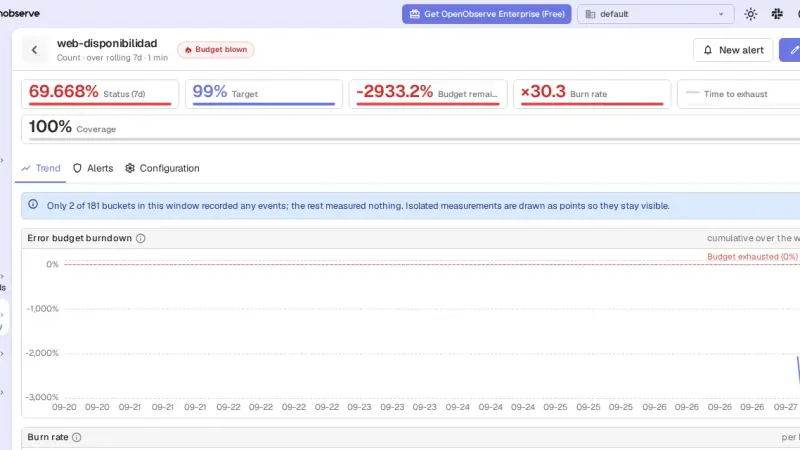
OpenObserve 1.0 is a single binary that stores logs, metrics and traces, and its AGPL edition ships SLOs with burn-rate alerts. With Docker Compose, Vector and the v1.0.4 image I had it ingesting nginx logs within minutes; the SLO and its alert worked after four traps that this guide explains.
Seven years on, the Site Reliability Workbook still earns its place in small teams through a handful of patterns: SLOs set slightly below what you already achieve, so the error budget is real and negotiable; a 28 to 30 day rolling window; and blameless postmortems that drop punishment while keeping accountability.
SLOs and error budgets only work when the budget drives real decisions. A feature freeze that triggers on exhaustion, deploy velocity that adjusts to consumption. With two or three well-chosen SLIs, a clear freeze policy, and simple tools like Prometheus with Sloth, a team can sustainably balance velocity and reliability in production.
Google's SRE book (2016) is canonical reading, but it is written for thousands of engineers and in-house datacenters: applying it literally on a small team creates friction. Five principles do travel (SLOs, error budgets, blameless postmortems, toil management, humane on-call); what does not scale is Google's infrastructure and dedicated roles.
To write Prometheus alerts that won't get ignored, alert on customer-observable symptoms (latency, error rate, saturation) instead of internal causes like CPU or memory, define SLOs with multi-window burn rate to scale severity, add a watchdog alert that confirms the system is still alive, and review the signal-to-noise ratio every quarter.
7 min3023.9
We use first- and third-party cookies to analyze site traffic. You can accept them, reject them, or configure your choice.
Learn more about cookies
Cookie preferences
NecessaryEssential for the site to work. Always on.
AnalyticsHelp us understand how the site is used (Google Analytics).