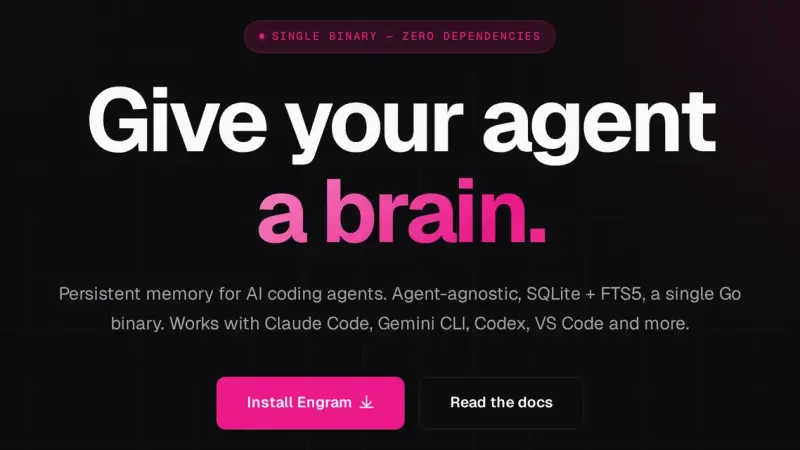
Engram is a Go binary backed by SQLite and FTS5 that gives coding agents persistent memory over MCP. It stores decisions and conventions between sessions, syncs through git and needs no Node, Python or Docker. Its search is lexical rather than semantic, and that shapes what you should save.
SQLite in production is a sound choice for small and mid-sized web applications once WAL mode is enabled, since concurrency on typical web loads improves by roughly two orders of magnitude. Litestream streams the WAL to S3-compatible object storage for point-in-time restore, and NVMe disks on cheap VPS plans removed the old disk objection.
Litestream is an open-source tool that replicates a SQLite database to an S3 bucket in near real time by reading the WAL SQLite already writes. It offers point-in-time recovery, overhead of only 1 to 3% CPU, and replaces the need for a separate database server in small apps.
SQLite in production is more viable than most teams assume. WAL mode removes read contention, Litestream replicates the WAL to S3 in near-realtime, and LiteFS adds multi-node replication. Without a separate database server, apps like Tailscale and PocketBase already do this in production. This article explains when it makes sense and its real limits.
SQLite and DuckDB are both embedded databases that work from a single file, no server needed. Their architecture differs: SQLite stores rows and excels at short transactions (OLTP); DuckDB stores columns and shines at large-scale analytics (OLAP). Choosing the right one, or combining both, delivers a genuine technical edge.
16 min4034.5
We use first- and third-party cookies to analyze site traffic. You can accept them, reject them, or configure your choice.
Learn more about cookies
Cookie preferences
NecessaryEssential for the site to work. Always on.
AnalyticsHelp us understand how the site is used (Google Analytics).