Industrial predictive maintenance rarely needs deep learning: classic models such as random forests, SVMs, or survival models solve 80% of cases. The key lies in feature engineering over vibration, temperature, and power-consumption signals, with pipelines that run on as little as 50 MB of RAM without a GPU.
An ensemble combines the predictions of several models, through bagging, boosting, or stacking, to reach a more accurate and stable result than any single model. Random Forest and XGBoost dominate tabular data because they exploit that idea: diversity between models reduces error, as long as their mistakes are not correlated with each other.
The linear function f(x) = ax + b is the simplest activation a neural network can use: in its identity form, f(x) = x, it is the standard choice for the output layer in regression, because it does not bound the range of possible values. In hidden layers it fails, because composing several linear functions collapses the whole network into one equivalent linear layer.
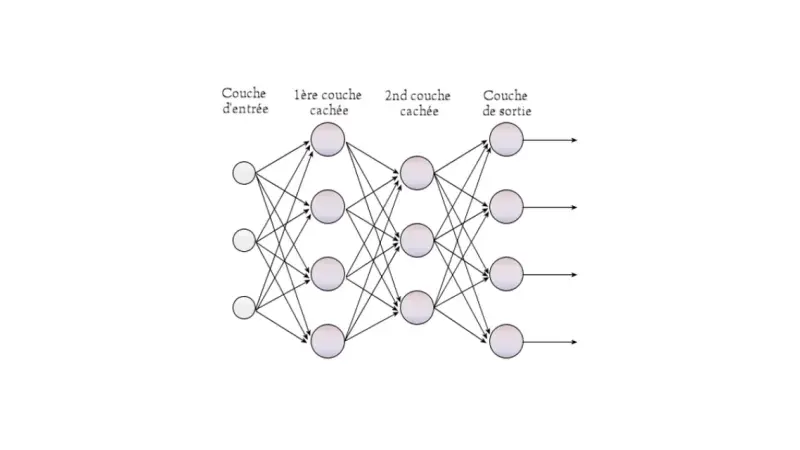
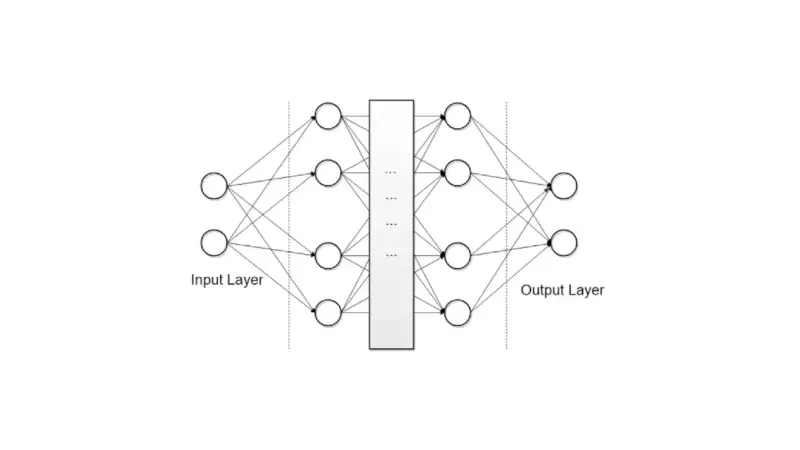
A fully connected neural network, also called a dense network, is the fundamental architecture of deep learning: every neuron in a layer connects to all neurons in the previous and next layer. This total connectivity lets it approximate any continuous function, though its computational cost grows quadratically with the number of neurons.
A multilayer neural network consists of an input layer, one or more hidden layers, and an output layer, where each neuron weights its inputs and applies a non-linear activation function before passing the result to the next layer. Through forward propagation and backpropagation, the network adjusts millions of weights to learn hierarchical representations capable of classifying images, translating text, or generating language.
LazyPredict is a Python library that automatically evaluates dozens of scikit-learn classification and regression models on your dataset in seconds, without writing training code for each one. LazyClassifier and LazyRegressor return a comparative metrics table that shows which models are worth tuning further.
Transfer learning lets you reuse a model already trained on a massive dataset, such as ImageNet or a large text corpus, to solve a new task with far less proprietary data and compute time. It works through fine-tuning, feature extraction, or prompting, and it performs best when the source and target domains are similar to each other.
Adversarial machine learning studies deliberate attacks on AI systems (evasion, poisoning and model extraction) and the defenses used to resist them, chiefly adversarial training, robustness certification and monitoring the distribution of production input data.
Recommendation systems are the invisible engine behind Netflix, Amazon, and Spotify. Collaborative filtering predicts individual preferences by analysing the behaviour of millions of users without examining item content: 80% of what Netflix viewers watch and 35% of Amazon sales come from algorithmic recommendations.
Explainable AI (XAI) is the set of techniques that open the black box of AI models and answer why they made a given decision. Methods such as LIME, SHAP and Grad-CAM activation maps are the most widely used. Its adoption is mandatory in regulated environments: healthcare, justice, and financial services.
Reinforcement learning is the AI technique in which an agent learns to make optimal decisions through trial and error, without labelled data: it acts in an environment, receives a reward or penalty based on the outcome, and adjusts its strategy to maximise long-term cumulative reward.
Natural Language Processing (NLP) is the AI discipline that enables machines to understand, interpret, and generate human text and speech. Powered by the transformer architecture since 2017, NLP drives chatbots, automatic translation, and clinical diagnosis tools, with open challenges in causal reasoning, energy efficiency, and bias mitigation.
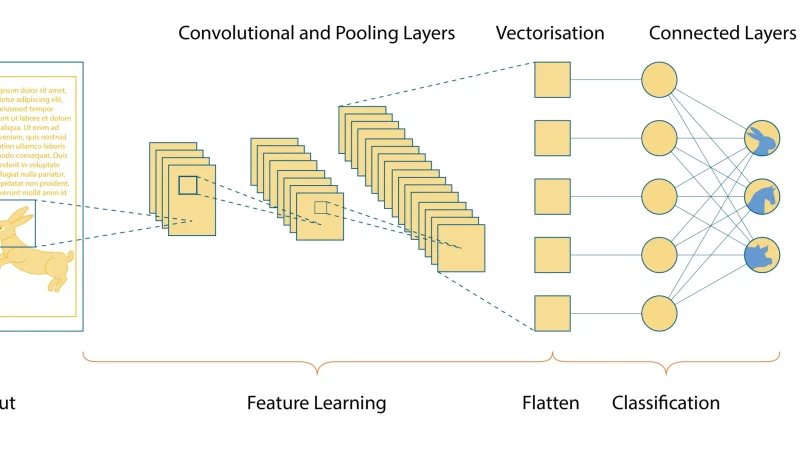
Deep neural networks are today the foundation of almost every artificial intelligence application: from facial recognition to machine translation. Built on architectures like CNNs, RNNs, and Transformers, deep learning has transformed computer vision, speech recognition, and natural language processing over the last decade.
Modern artificial intelligence rests on three pillars: machine learning, deep neural networks, and natural language processing. These techniques have pushed image recognition and machine translation past human-level precision on specific tasks, though the overall system still depends on quality data and constant human oversight.
6 min2164.3
We use first- and third-party cookies to analyze site traffic. You can accept them, reject them, or configure your choice.
Learn more about cookies
Cookie preferences
NecessaryEssential for the site to work. Always on.
AnalyticsHelp us understand how the site is used (Google Analytics).