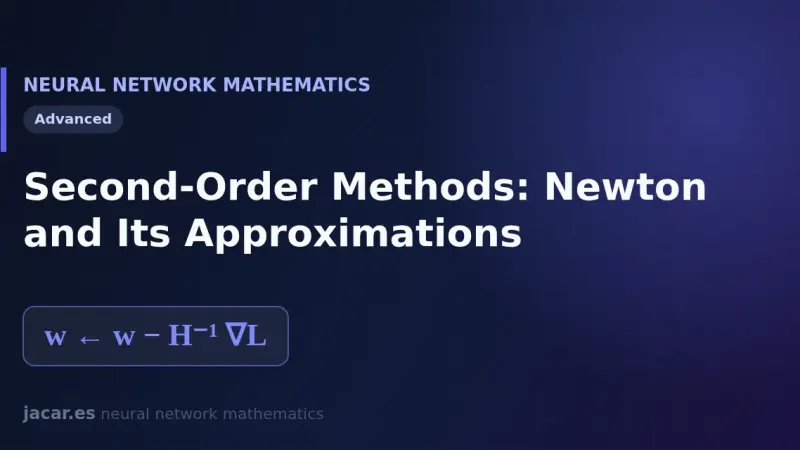
Second-order methods use the Hessian, the matrix of second derivatives of the loss, to orient each step better than the gradient alone. Newton's method updates the weights by subtracting the inverse Hessian times the gradient, but inverting it is far too costly in large networks, so practitioners fall back on quasi-Newton approximations.
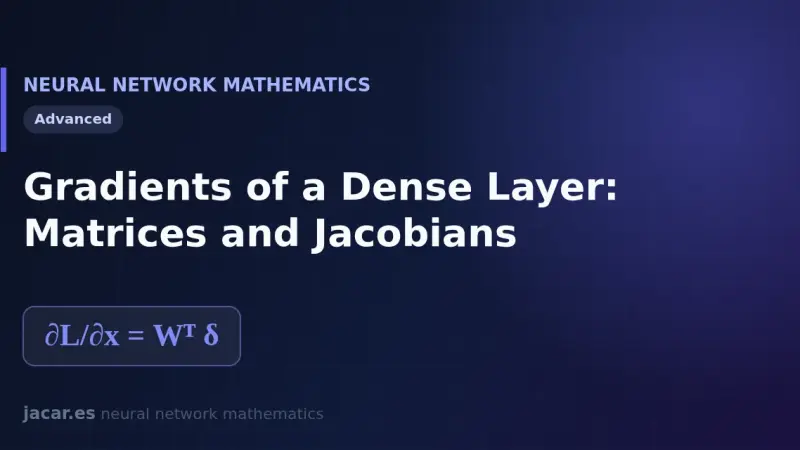
In a dense layer with z equal to Wx plus b, the Jacobian matrix of the output with respect to the input is the weight matrix W itself. From it come the two training rules: the gradient with respect to the weights is delta times x transposed, and the gradient with respect to the input is W transposed times delta.
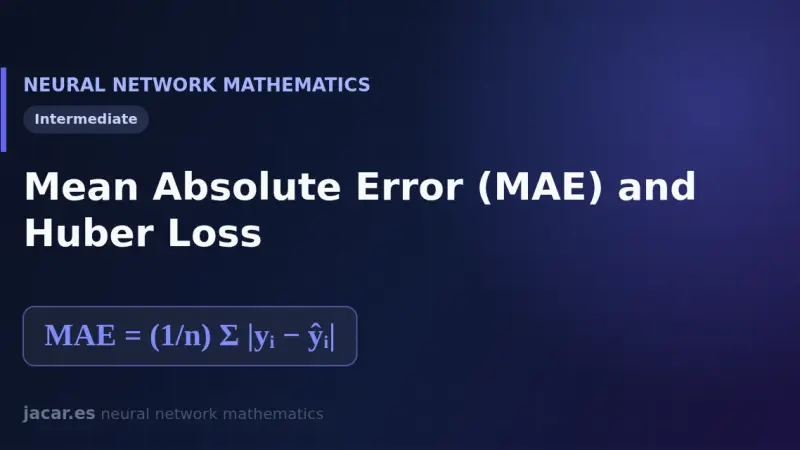
Mean absolute error (MAE) averages the absolute difference between prediction and reality, so a single outlier weighs only its fair share and never blows up the loss. Huber loss combines that robustness with the smoothness of mean squared error through a delta parameter that decides where the behaviour switches over.
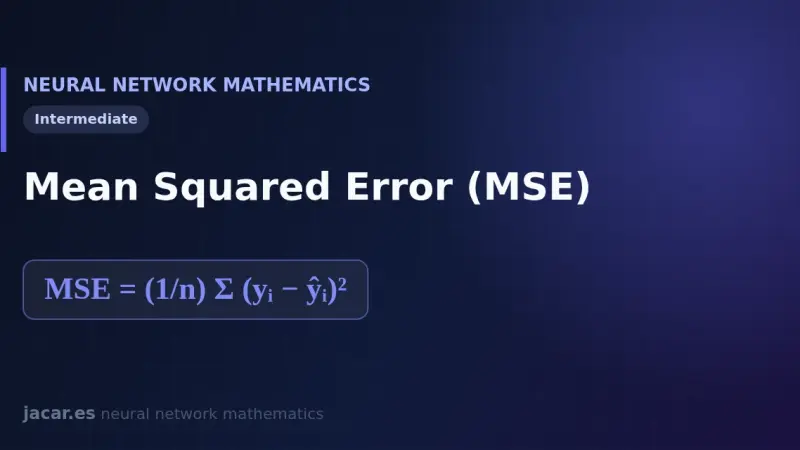
Mean squared error (MSE) is the most common loss function in regression: it averages the square of the gap between each true value and its prediction. Squaring punishes big mistakes hard, keeps the function differentiable and gives gradient descent a clear, smooth target to minimise while training a model.
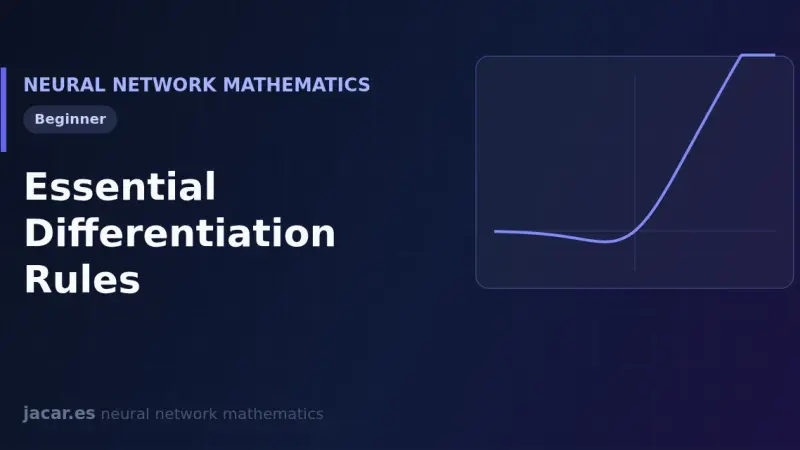
The essential differentiation rules are a handful of formulas that turn any function into its derivative: the power rule, the product and quotient rules, and the rules for the exponential and the logarithm. With them, plus the chain rule, a neural network computes gradients and learns by adjusting its weights.
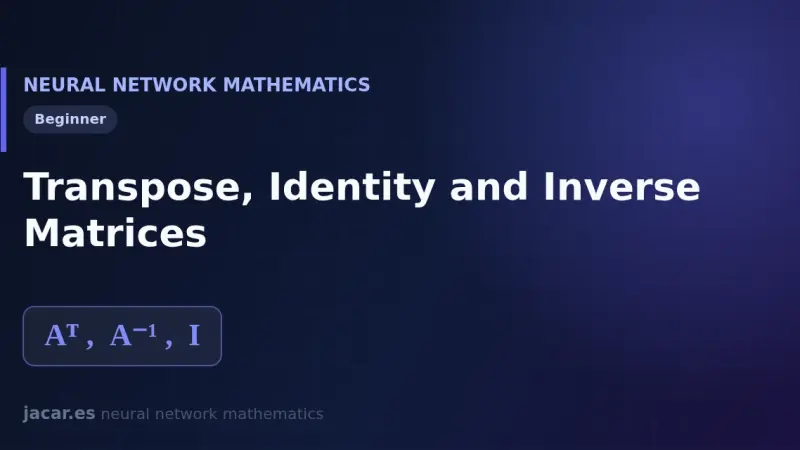
The transpose swaps rows for columns and shows up at every step of backpropagation; the identity matrix acts as the 1 of matrix algebra and leaves any vector unchanged, and the inverse matrix undoes a transformation, though it only exists when the matrix is square and its determinant is not zero. Three operations that hold up the maths of a network.
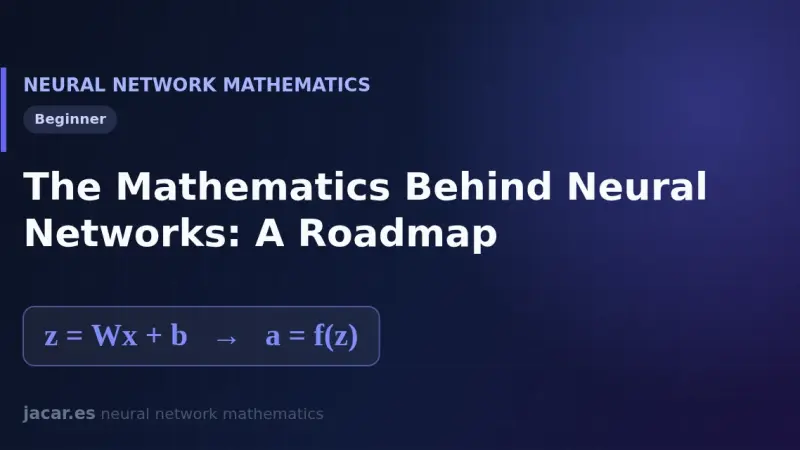
The mathematics of neural networks rests on three blocks: linear algebra represents data and weights as vectors and matrices, calculus with derivatives and the chain rule lets the network learn through gradient descent, and probability shapes the loss functions. This roadmap walks that path from beginning to end so you know what to study and in what order.
6 min2
We use first- and third-party cookies to analyze site traffic. You can accept them, reject them, or configure your choice.
Learn more about cookies
Cookie preferences
NecessaryEssential for the site to work. Always on.
AnalyticsHelp us understand how the site is used (Google Analytics).