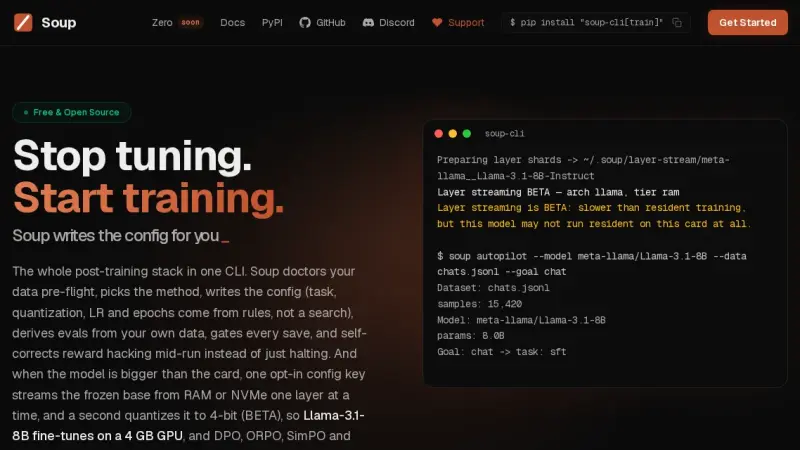
Soup is an open-source CLI (Apache 2.0) that covers LLM post-training end to end: it decides whether training is worth it, writes the config, trains with LoRA, DPO or GRPO and returns a SHIP or DON'T SHIP verdict. I tested version 0.76.1 on 15 October 2026 on Linux arm64 with no GPU.
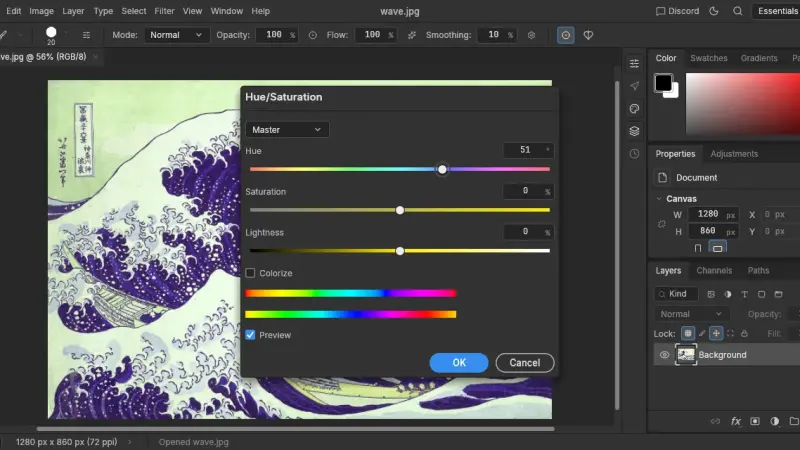
ArtCraft's Crafting Apps are twelve open-source creative apps written in Rust, licensed MIT or Apache 2.0, that you can also drive from a CLI and over MCP. I tested them on 13 October 2026 on Linux arm64: PhotoCraft 0.8.2 and PdfCraft 0.7.1 work from the terminal, over MCP and in the browser, but they are still early alpha.
Docker Agent is a Docker CLI plugin for building and running AI agents from a declarative YAML file, no code required: you define one or more agents, give them MCP tools, run them with docker agent run, and share them through any OCI registry, on OpenAI, Anthropic, Gemini or other providers.
Open GSD (Git. Ship. Done.) is an open-source, MIT-licensed toolkit for steering coding agents without losing context: it splits work into five phases (discuss, plan, execute, verify and ship) and delegates the heavy lifting to subagents that each start with a clean context. Its core is the gsd-core engine and the gsd-pi terminal agent.
PegaProx 0.9.x is an AGPL-3.0 panel that manages several Proxmox VE 8 and 9 clusters, plus XCP-ng, from a single screen. It adds live migration across clusters, OIDC with Entra ID, a CVE scanner and one-click hardening on top of the stock GUI, which only covers one cluster at a time.
Twenty months after the initial announcement, Model Context Protocol went from curiosity to de-facto standard among agent clients and servers. What is available, which servers are worth it, which problems remain open, and how it compares to earlier protocol maps.
OSV-Scanner is Google's dependency scanner, announced in 2022, that queries the open OSV.dev database rather than raw CVE advisories. Because OSV pins each vulnerability to precise commit or semantic version ranges, matching against your actual dependencies becomes deterministic and produces far less noise. It reads npm, Python, Go, Ruby, PHP, Rust and Maven manifests.
Spotify announced Backstage Plus, its own commercial offering built on top of the open Backstage project. The result is a de facto fork that raises uncomfortable questions about governance of company-donated CNCF projects. A look at the practical implications and what teams already running Backstage in production can do.
Google released Gemma 2 in mid-2024, and it has since seen real production use. A look at how it competes in the open-model ecosystem, which sizes actually make sense, and where its adoption has settled in.
Redis moved to dual SSPL/RSAL licensing in March 2024, no longer meeting the OSI open-source definition. Valkey emerged as a BSD 3-Clause fork backed by AWS, Google Cloud, Oracle, and the Linux Foundation, fully protocol-compatible with Redis 7.2. Migrating is almost always trivial: swap the binary or the Docker image.
nomic-embed-text-v1.5 from Nomic AI is an embedding model with weights, code and training data released under Apache 2.0: 137 million parameters, up to 8192 tokens of context, and an MTEB score of 62.4, almost matching the 62.3 of OpenAI's text-embedding-3-small, at 768 dimensions instead of 1536.
On 10 August 2023, HashiCorp changed Terraform from MPL 2.0 to Business Source License v1.1, which prohibits building competing products. For 95% of teams using Terraform internally, the practical impact is nil. Teams building SaaS products on top of Terraform need to review their situation or consider OpenTofu.
OpenTofu is the community fork of Terraform, born in 2023 after HashiCorp switched to the Business Source License. With full file compatibility and Linux Foundation governance, it is the legally safe alternative for organisations with strict open-source policies or for those building products on Terraform.
The Grafana stack combines three open source projects: Loki for logs, Tempo for traces, and Mimir for metrics. All three keep data in object storage (S3/GCS) with a minimal index instead of indexing everything like Elasticsearch, which cuts cost sharply at high volume and lets you correlate metric, log, and trace from a single Grafana panel.
Meta released LLaMA 2 on July 18, 2023 with a royalty-free commercial licence, in three sizes (7B, 13B, 70B parameters). The 70B model matches or beats GPT-3.5 on standard benchmarks. For 99.9% of organisations the licence allows download, modification, and production use with full data privacy and no fine-tuning restrictions.
Stable Diffusion XL marks a leap in open-licence image generation quality. What changes versus SD 1.5/2.1, the hardware requirements, and when to pick SDXL over Midjourney or DALL-E 3 for your workflow.
Cerebras-GPT is a family of 7 open-source language models, ranging from 111 million to 13 billion parameters, trained by Cerebras Systems on its CS-2 processors with the standard GPT-3 architecture. Released on Hugging Face and GitHub under the Apache 2.0 license, they suit fine-tuning, research, and local inference, though they understand only English.
RustDesk is an open-source remote desktop tool released under the AGPL-3.0 licence, with more than 113,000 stars on GitHub. It offers end-to-end encryption, clients for Windows, macOS, Linux, iOS and Android, and the option to run your own signalling server with Docker instead of relying on RustDesk's public infrastructure.
5 min2554.1
We use first- and third-party cookies to analyze site traffic. You can accept them, reject them, or configure your choice.
Learn more about cookies
Cookie preferences
NecessaryEssential for the site to work. Always on.
AnalyticsHelp us understand how the site is used (Google Analytics).