Terraform’s License Change and Its Implications

Table of contents
- Key takeaways
- What the BSL says exactly
- Why HashiCorp did it
- Precedents from other companies
- Real impact for typical users
- The intangible loss
- Recommendations for technology leaders
- Conclusion
- Frequently asked questions
- Can my company keep using Terraform for free after the BSL change?
- When does Terraform code under the BSL become open source again?
- What alternative do I have if my product cannot accept Terraform's BSL?
On 10 August 2023, HashiCorp announced the licence change of Terraform and the rest of its product suite to the Business Source License v1.1 (BSL). Beyond the technical news, this move deserves analysis: it reflects a growing tension between companies that create infrastructure software and cloud providers that monetise it without contributing. We break down what legally changed, why HashiCorp did it, and what precedents exist in the industry.
Key takeaways
-
The BSL isn’t strict open source (not OSI-approved): it prohibits building products that compete directly with HashiCorp.
-
For the 95% of teams using Terraform internally, the practical impact is nil.
-
The change follows a pattern already seen at MongoDB, Elastic, CockroachDB, and Sentry.
-
The real loss isn’t technical but trust-based: the implicit open-source contract is altered unilaterally.
-
The existence of OpenTofu reduces technical impact for those who can’t accept the BSL.
What the BSL says exactly
The Business Source License isn’t an open-source licence in the strict sense (not OSI-approved). Key points:
-
Free use permitted for any purpose that isn’t "production usage that competes with HashiCorp commercial offerings".
-
Broad competition definition: offering a managed service or product whose principal value derives from software under BSL.
-
Automatic revert to MPL 2.0 after 4 years. August 2023 code returns to MPL in August 2027.
-
Unrestricted code access, including the right to modify and redistribute, within the competition clause limits.
In practice: for a company using Terraform internally to manage its infrastructure, nothing changes. For a company building a product on Terraform, it depends on how close that product is to HashiCorp’s business.
Why HashiCorp did it
HashiCorp isn’t the first company on this path. The publicly stated and underlying motivations converge:
-
Cloud-provider free-riding. AWS, Azure, and GCP offer managed services of Vault, Consul, and similar without contributing financially to development. For a publicly traded company, this is hard to justify long-term.
-
SaaS competition built on the core. Spacelift, env0, Terraform Cloud alternatives: all live off a core HashiCorp maintains at its expense.
-
Monetisation pressure. HashiCorp went public in 2021. Profitability matters more than at a private company.
It’s a business decision consistent with its incentives. If it angers you, that’s valid. But the "pure open source + vendor managed service" model has rarely worked long-term when hyperscalers are in the market.
Precedents from other companies
HashiCorp isn’t alone on this path. The pattern is recurring:
| Company | Year | Change |
|---|---|---|
| MongoDB | 2018 | AGPL → SSPL (non-OSI) |
| Elastic | 2021 | Apache 2.0 → Elastic License v2 + SSPL |
| CockroachDB | 2019 | BSL |
| Sentry | 2019 | BSL |
| MariaDB MaxScale | N/A | BSL |
Companies sustaining critical open-source software are migrating toward licences protecting their business against hyperscalers, accepting loss of the strict "open source" label. The ecosystem’s response is also predictable: each change generates a fork. AWS forked Elasticsearch creating OpenSearch. The Linux Foundation embraced OpenTofu in response to Terraform.
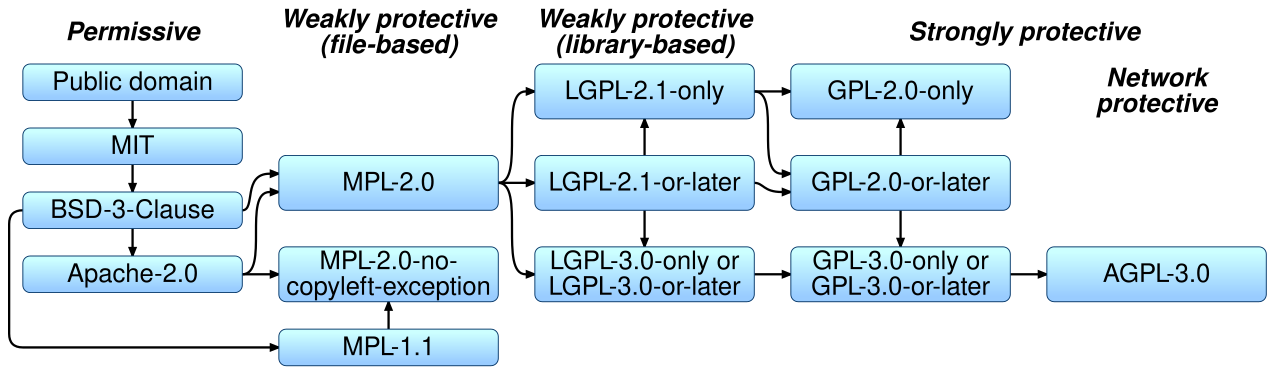 Mapa de licencias de software libre y open source: relaciones entre licencias permisivas y copyleft (Image: David A. Wheeler, et al., CC BY-SA 3.0, via Wikimedia Commons)
Real impact for typical users
The impact depends on how you use Terraform:
-
Internal IaC managing your own infra: nothing changes legally. You still get updates, providers, everything.
-
CI pipeline with Atlantis: nothing changes.
-
Applying Terraform templates at consulting clients: nothing changes as long as you don’t offer a managed Terraform service as such.
-
Building a SaaS product where Terraform is a main component: here yes: you need legal advice or to move to OpenTofu.
For 95% of teams, the change is a political footnote, not an operational issue.
The intangible loss
What is lost (and why many in the community feel it badly) is trust in open source’s implicit contract. Adopting Terraform in 2018 implied a community commitment: the code will always be free, you can fork it if HashiCorp disappears, you can contribute and benefit. The BSL alters that contract unilaterally, though existing versions keep their original licences.
For future infrastructure projects, this lesson matters: neutral governance (Linux Foundation, CNCF, Apache Foundation) offers guarantees a single vendor cannot, no matter their initial good faith. An observability stack or secrets management system built on projects in neutral foundations carries lower risk of unilateral term changes.
Recommendations for technology leaders
Two concrete actions following this change:
-
Audit your critical open-source dependencies. Who controls them? What happens if they change licences? Is there a reasonable alternative?
-
Prefer projects in neutral foundations for new critical infrastructure. Legal stability over five or more years matters, especially in regulated sectors.
Conclusion
Terraform’s licence change is a symptom of structural tension between creators and monetisers of infrastructure software. It’s legitimate and predictable from a business standpoint; it’s painful from a community standpoint. OpenTofu’s existence reduces the technical impact, but the debate over what "open source" means in hyperscaler environments remains open, and will affect more infrastructure projects in the coming years.
Frequently asked questions
Can my company keep using Terraform for free after the BSL change?
Yes. The Business Source License permits free use for any purpose that is not production usage competing with HashiCorp's commercial offerings. If you manage your own infrastructure with internal IaC, run a CI pipeline with Atlantis, or apply Terraform templates at consulting clients, nothing changes legally: you still get updates and providers. You only need legal advice if you build a SaaS product where Terraform is a main component.
When does Terraform code under the BSL become open source again?
The BSL automatically reverts code to MPL 2.0 four years after each release: code published in August 2023 returns to MPL in August 2027. In the meantime, code access is unrestricted, including the right to modify and redistribute within the limits of the competition clause, and versions released before the change keep their original licences.
What alternative do I have if my product cannot accept Terraform's BSL?
OpenTofu, the fork embraced by the Linux Foundation in response to the licence change, reduces the technical impact for anyone who cannot accept the BSL. It follows the same pattern as OpenSearch, the Elasticsearch fork AWS created. For new critical infrastructure, prefer projects under neutral governance (Linux Foundation, CNCF, Apache Foundation) and audit who controls your critical open-source dependencies.