What PegaProx adds over the Proxmox VE 9 GUI
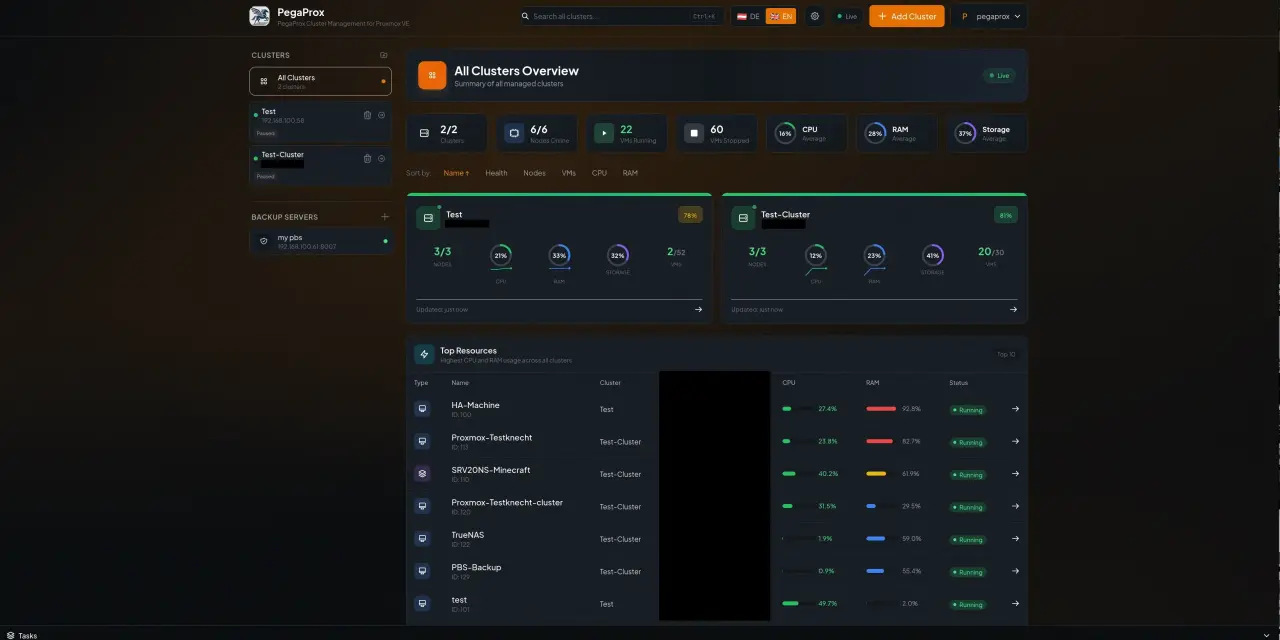
Table of contents
- Key takeaways
- What has changed since 0.9.10.2
- What the Proxmox VE 9 GUI already does
- What PegaProx adds
- Comparison table
- When it fits and when it doesn't
- Honest risks
- Quick install
- Verdict
- Frequently asked questions
- What is PegaProx?
- Is PegaProx free?
- Does PegaProx work with Proxmox VE 9?
- How does PegaProx differ from the Proxmox VE 9 GUI?
- Is PegaProx production-ready?
- Sources
Updated: 2026-09-02
Key takeaways
-
PegaProx[1] 1.1.0 (released 31 August 2026; the stable 1.0 shipped on 1 August 2026; 1.5k stars on GitHub) is an AGPL-3.0 web control panel. It manages multiple Proxmox VE 8/9 and XCP-ng clusters from a single screen.
-
What the stock Proxmox VE 9 GUI already does is underrated. Before adding layers, get clear on what the native one already covers.
-
PegaProx adds three things the stock GUI does not have out of the box: live migration across separate clusters, OIDC with Entra ID and 2FA TOTP, and a CVE scanner plus one-click hardening.
-
The intelligent balancing comes from ProxLB[2] (author: gyptazy), incorporated as a community contribution. Fair to name it.
-
Not a single-node tool. If you have one Proxmox in a homelab, the native GUI is enough. PegaProx starts to make sense from two clusters upward, or when VMware/XCP-ng enters the mix.
What has changed since 0.9.10.2
This analysis was written against PegaProx 0.9.10.2 (13 May 2026) and its central reservation was that the project had not reached 1.0. That is no longer the case. Checked on 2 September 2026 against the repository releases[3]:
- PegaProx 1.0, 1 August 2026: out of beta[4]. A post-release penetration test closed a BMC-credential exfiltration, ESXi/XCP passwords landing on a process command line (now passed over stdin or
SSHPASS), a BMC/Redfish SSRF oracle and an SSH-amplification path in the Ceph mirror views. The TLS bootstrap now fails closed: if it cannot load or generate a certificate, it refuses to start in plaintext. - New in 1.0: cross-cluster EVPN vNets (create, membership and drift detection with optional reconcile) and an opt-in confirmation gate before cutover on ESXi migrations.
- 1.0.1 (9 August) and 1.0.2 (17 August 2026): two fix releases between 1.0 and 1.1.0.
- PegaProx 1.1.0, 31 August 2026: 67 commits since 1.0.2[5]. It closes 15 BOLA/IDOR/token-scope findings from a fresh Aikido re-triage, propagates API-token effective roles into cluster, search and VMware access, and scopes the live resources SSE stream to each client’s per-VM ACLs. It adds a usable phone layout, re-pinning of SSH host keys after hardening and an optional FQDN suffix on “open in Proxmox” links. Among the fixes: rolling updates no longer burn 120 s on a benign Ceph
WARN, the noVNC console works under gevent on Python 3.13, and ESXi-to-Proxmox migrations accept non-krbd Ceph RBD targets. - Installation: the README now documents an APT repository maintained by gyptazy with packaged releases, which it recommends for production; the one-line
deploy.shpulls the head ofmainand may include unreleased changes. Requirements are unchanged: Python 3.8 or higher, Proxmox VE 8.0+ or 9.0+, XCP-ng 8.2+.
The screenshots and the table below still describe what PegaProx adds over the native GUI; what has expired is the “wait for 1.0” objection, and the verdict and FAQ now say so.
What the Proxmox VE 9 GUI already does
First, the baseline. The interface that ships with Proxmox VE 9[6] out of the box is more capable than someone who last saw it on 6.x would remember:
-
Datacenter view with aggregated CPU, RAM, storage and HA status per cluster.
-
HA and replication configurable from the UI, with groups and fencing policies.
-
Ceph integrated (pools, OSDs, monitors) and ZFS from the UI itself.
-
Backup and restore via Proxmox Backup Server, with per-job retention and periodic verification.
-
SDN (Software Defined Networking) with zones, VNets and subnets that cover most enterprise network patterns.
-
ESXi importer since 8.2 to move VMware machines without going through an intermediate OVF.
-
Mobile UI functional enough to shut something down from the car.
Where it falls short: one cluster, one session. Native authentication covers PAM, LDAP/Active Directory and 2FA TOTP, but modern OIDC (Entra ID, Keycloak with OIDC flows) only appears via community plugins. And inter-node balancing within a cluster is manual unless you install ProxLB separately.
What PegaProx adds
PegaProx sits one layer above the individual cluster. Its real differentiators on today’s release line:
-
Multi-cluster pane. You see every Proxmox in the organisation (plus XCP-ng, in tech preview) from a single URL, with live metrics over SSE.
-
Live migration across separate clusters. Native Proxmox allows live migration within the same cluster. PegaProx extends it across separate clusters, which opens evacuation work, scheduled hardware maintenance, and consolidation without service downtime.
-
OIDC and Entra ID natively, on top of traditional LDAP/AD. Integrated 2FA TOTP and custom roles above the Proxmox privileges schema.
-
Intelligent balancing based on ProxLB, gyptazy’s project already known in the community. PegaProx ships it as the automatic balancing engine, redistributing load by CPU, RAM and usage patterns.
-
Integrated CVE scanner that crosses installed packages against public vulnerability feeds and flags affected nodes.
-
One-click PVE hardening, replicating practices that in the stock GUI go in by hand (SSH config, sysctl, journald, fail2ban, kernel parameters).
-
ESXi and XCP-ng bridge to import and migrate machines from VMware and Xen without building the pipeline by hand.

Live migration between separate clusters in PegaProx. It is the most visible difference vs the stock Proxmox VE 9 GUI, which only supports live migration within the same cluster. Screenshot from the official PegaProx site.

User and RBAC management in PegaProx, with OIDC and Entra ID on top of the native Proxmox privileges schema. Screenshot from the official PegaProx site.
Comparison table
| Capability | Proxmox VE 9 GUI (stock) | PegaProx 1.x |
|---|---|---|
| Scope | ||
| Clusters per pane | One | Many |
| Live migration across clusters | No (manual / CLI) | Yes |
| Multi-tenant view | Partial (via ACL realms) | Native |
| Authentication | ||
| PAM + local users | Yes | Yes |
| LDAP / Active Directory | Yes | Yes |
| OIDC / Entra ID | No (community plugins only) | Yes |
| 2FA TOTP | Yes | Yes |
| Custom roles | Limited (via privileges) | Yes |
| Operations | ||
| Automatic load balancing | No (manual) | Yes (ProxLB engine by gyptazy) |
| ESXi importer | Yes (since 8.2) | Yes, with live migration |
| XCP-ng support | No | Yes (tech preview) |
| Ceph + OSD dashboard | Yes | Yes |
| Security | ||
| Integrated CVE scanner | No | Yes |
| One-click hardening | No (manual / scripts) | Yes |
| Support and licence | ||
| Vendor support contract | Yes (Proxmox subscription) | No (community + sponsors) |
| Licence | AGPL-3.0 | AGPL-3.0 |
| Release stage | 9.x stable | 1.1.0 (stable since 1.0, August 2026) |
When it fits and when it doesn’t
Fits well when:
-
You operate two or more Proxmox clusters and the friction of jumping between URLs and audit dialects starts to cost real time.
-
Your organisation requires OIDC with Entra ID or Keycloak, and community plugins for Proxmox feel too fragile for production.
-
You’re migrating from VMware or XCP-ng and prefer a web tool to a hand-rolled
qm importovfandxe vm-exportpipeline. -
You want automatic inter-node balancing without installing ProxLB separately and maintaining its config on the side.
Does not fit when:
-
You run a single Proxmox or a small cluster and the stock GUI covers your needs. Adding another layer is net complexity with no payoff. For a small homelab, a Docker-based PaaS like Coolify tends to cover what you need without touching the hypervisor panel.
-
You plan to redistribute PegaProx inside a closed product, embed its code, or build a SaaS on top without releasing derivatives. AGPL-3.0 is contagious.
-
You need a support contract with SLA and legal backing. PegaProx does not offer one. Proxmox does, via subscription.
Honest risks
The project is real and moving. 1.1.0 shipped on 31 August 2026, with the repository past 840 commits and 1.5k stars. Since 1.0 (1 August 2026) it no longer presents itself as beta. Still, a few things to keep in mind before putting it on critical infrastructure:
-
No longer pre-1.0, but still young. 1.0 landed on 1 August 2026 and 1.1.0 (31 August) closed 15 authorisation findings from a pentest re-triage. There are 35 open issues and the team is still three people (Nico Schmidt, Marcus Kellermann, Laura Weber) under the SocialFurr organisation. Active and in a hardening phase, rather than mature.
-
No affiliation with Proxmox Server Solutions GmbH. The authors say so explicitly. It’s not an official tool and there’s no joint roadmap with upstream.
-
AGPL-3.0. If you plan to integrate it in a product you distribute to third parties or expose as SaaS, AGPL requires you to release derived code. It’s a legal decision more than a technical one.
-
Marketing aiming high. The site mentions use in Healthcare, Finance, Defense, Government, Law Enforcement. No public way to verify names or volumes. A claim, not a fact.
Quick install
Three ways, all documented in the repository:
Deploy script:
curl -sSL https://raw.githubusercontent.com/PegaProx/project-pegaprox/refs/heads/main/deploy.sh | sudo bashDebian 13 LXC template prebuilt, importable directly into a Proxmox cluster.
Debian VM image prebuilt if you prefer isolating PegaProx in its own virtual machine.
Requirements from the README: Python 3.8 or higher, Proxmox VE 8.0+ or 9.0+, XCP-ng 8.2+ if you want the bridge, modern browser. For those who’d rather not pipe sudo bash directly, the repository has deploy.sh readable and docker-compose.yml available to audit first.
Verdict
PegaProx delivers on the multi-cluster claim, and its ProxLB integration is honest. For infrastructure with two or more clusters, corporate OIDC and a need to migrate from VMware, installing it in pre-production and letting it run for a few weeks is a cheap test. For a single-node homelab or a small cluster where the stock GUI covers everything, no need.
The 1.0 this analysis told you to wait for landed on 1 August 2026 and 1.1.0 brings a full security pass, so the “pre-release” objection has expired. What still stands is running it in pre-production for a few weeks before handing it the keys. For production, install it from the APT repository with packaged releases rather than the script that pulls main. If what you want is lighter virtualisation for multi-tenant services, Firecracker microVMs is another path with different tradeoffs.
Frequently asked questions
What is PegaProx?
PegaProx is an open-source web control panel under the AGPL-3.0 licence for managing multiple Proxmox VE 8/9 and XCP-ng clusters from a single interface. It is maintained by a three-person team under the SocialFurr organisation and is not affiliated with Proxmox Server Solutions GmbH.
Is PegaProx free?
Yes. PegaProx is 100% free under the AGPL-3.0 licence, with no paid tiers and no registration required. The project is sustained by voluntary sponsors, and all features are available to every user.
Does PegaProx work with Proxmox VE 9?
Yes. According to the official README, PegaProx supports Proxmox VE 8.0+ and 9.0+, plus XCP-ng 8.2+. It requires Python 3.8 or higher and a modern browser.
How does PegaProx differ from the Proxmox VE 9 GUI?
The stock Proxmox VE 9 GUI manages one cluster at a time. PegaProx adds multi-cluster view, live migration across separate clusters, OIDC authentication with Entra ID, an integrated CVE scanner, one-click hardening, and a bridge to VMware ESXi and XCP-ng.
Is PegaProx production-ready?
PegaProx left beta with 1.0 on 1 August 2026 and the current version is 1.1.0 (31 August 2026), which includes a security pass after a penetration test. As of 2 September 2026 the repository is past 840 commits and 1.5k stars on GitHub. For production, the README itself recommends installing from the APT repository with packaged releases rather than from the script that pulls main.
Data verified on 2 September 2026 against the official PegaProx repository (releases 1.0 to 1.1.0) and the Proxmox VE documentation. First version of this analysis: 14 May 2026.
This article is also available in Spanish: Qué añade PegaProx sobre la GUI de Proxmox VE 9.
Sources:
- Official PegaProx repository[1]
- ProxLB, the balancing engine (gyptazy)[2]
- Official Proxmox VE 9 documentation[6]