Cerebras-GPT: 7 Open-Source LLM Models Ready to Use

Table of contents
- Key takeaways
- The 7 Cerebras-GPT Models
- The Hardware Behind It: CS-2 and the WSE-2 Chip
- Technical Characteristics and Performance
- Practical Uses of Cerebras-GPT
- Known Limitations
- Cerebras-GPT in the Open-Source LLM Ecosystem
- Conclusion
- Frequently asked questions
- Can I use Cerebras-GPT in Spanish?
- Which Cerebras-GPT model can I run on conventional hardware?
- Under which license are the weights released, and what can I use them for?
- Sources
Cerebras-GPT demonstrated that specialised hardware can change the training equation for large language models. While the community debated whether open-source LLMs could match proprietary performance, Cerebras Systems published a complete family of seven models. They range from 111M parameters to 13B, efficiently trained on their CS-2 processors.
Key takeaways
-
Cerebras-GPT is a family of 7 open-source language models, available on Hugging Face and GitHub.
-
Models range from 111 million to 13 billion parameters, all trained with the same scalable methodology.
-
The Cerebras CS-2 hardware enables training large models without the model fragmentation conventional GPUs require.
-
The models follow the standard GPT-3 architecture and are compatible with the Hugging Face ecosystem.
-
Known limitation at launch: trained only on English using the Pile dataset.
The 7 Cerebras-GPT Models
Cerebras Systems[1] published the following models on Hugging Face:
| Model | Parameters | Layers | Attention heads |
|---|---|---|---|
| Cerebras-GPT-111M | 111 million | 10 | 10 |
| Cerebras-GPT-256M | 256 million | 14 | 16 |
| Cerebras-GPT-590M | 590 million | 18 | 16 |
| Cerebras-GPT-1.3B | 1.3 billion | 24 | 16 |
| Cerebras-GPT-2.7B | 2.7 billion | 32 | 32 |
| Cerebras-GPT-6.7B | 6.7 billion | 32 | 32 |
| Cerebras-GPT-13B | 13 billion | 40 | 40 |
All models can be downloaded from:
-
Hugging Face[2]: Cerebras’ official organisation.
-
GitHub[3]: the Cerebras Model Zoo repository.
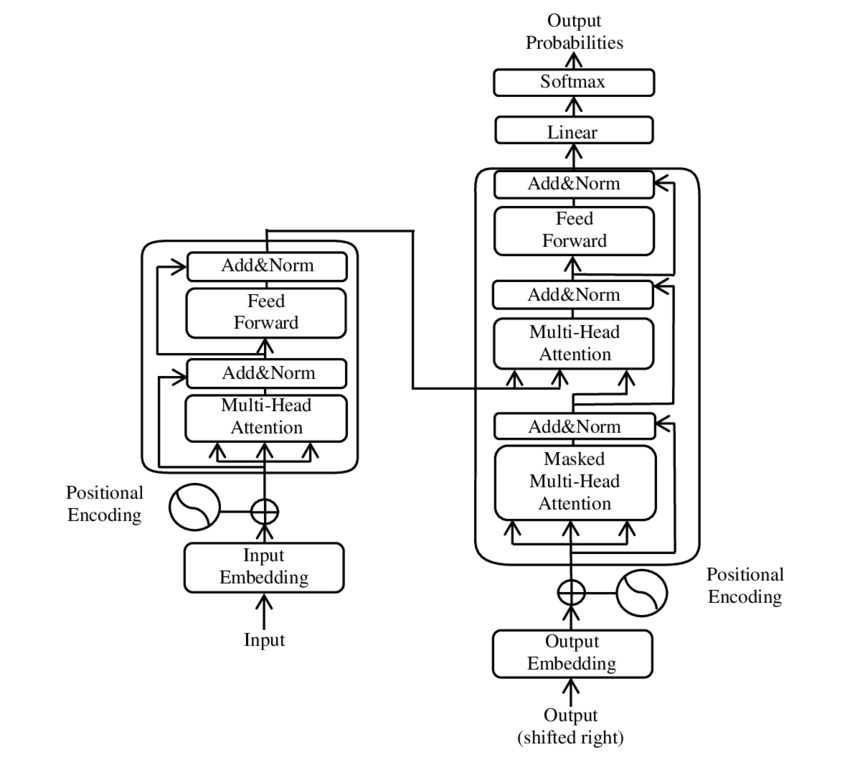 Standard Transformer architecture with encoder-decoder, attention mechanism, and feed-forward layers used by Cerebras-GPT (Image: Yuening Jia, CC BY-SA 3.0, via Wikimedia Commons)
The Hardware Behind It: CS-2 and the WSE-2 Chip
The Cerebras proposition is not limited to the model: it also includes the training infrastructure. The Wafer-Scale Engine 2 (WSE-2) chip is the largest AI processor ever manufactured on a single silicon die. It packs 2.6 trillion transistors and 850,000 AI cores on a single wafer-sized chip.
This architecture solves a fundamental problem in GPU-based LLM training: the need to fragment the model across multiple devices (model parallelism) and manage the communication between them, which becomes a bottleneck at scale. The WSE-2 can host complete models with billions of parameters on a single chip, removing that friction.
The result is that Cerebras-GPT can scale training almost linearly as model size grows, which is reflected in the scaling-law curves published alongside the models.
Technical Characteristics and Performance
Cerebras-GPT follows the standard GPT-3 architecture (decoder-only transformer) with:
-
A BPE tokenizer compatible with GPT-2.
-
A context length of 2048 tokens.
-
Training on the Pile dataset (825 GB of English text from diverse sources).
-
Training hyperparameters published in the official paper[4].
On standard LLM evaluation benchmarks (HellaSwag, PIQA, Winogrande, ARC), Cerebras-GPT shows that a well-trained 6.7B model can match or beat larger proprietary models on certain tasks. This supports the authors’ hypothesis: training efficiency matters as much as model size.
Practical Uses of Cerebras-GPT
As open-source models with published weights under the Apache 2.0 license, Cerebras-GPT can be used for:
-
Supervised fine-tuning: adapting the base model to a specific domain (legal, medical, code, customer support) with your own datasets.
-
NLP research: studying model behaviour at different scales using the same family.
-
Local inference: running small models (111M-590M) on conventional hardware for applications with strict privacy or latency requirements.
-
Scaling comparisons: the simultaneous release of 7 sizes with the same methodology makes it easier to study scaling laws.
For broader context on the LLM and pretrained-model ecosystem, see pretrained AI models and advances in NLP. For LLM-based code-assistance tools, see GitHub Copilot.
Known Limitations
Language: all models are trained exclusively on English. They have no comprehension or generation capability in Spanish or other languages.
Training dataset: the Pile includes text from the internet, books, and code, with the biases inherent to that kind of data. The models can reproduce stereotypes or inaccurate information present in the dataset.
Alignment: the base models are not instruction-aligned (RLHF). Production use as conversational assistants requires additional alignment fine-tuning.
Context window: 2048 tokens are enough for short prompts but limit applications that need to process long documents. Later models (Claude, GPT-4, Gemini) reach much larger context windows.
Cerebras-GPT in the Open-Source LLM Ecosystem
The release of Cerebras-GPT in 2023 coincided with a wave of open-source models that changed the LLM market: Meta’s LLaMA, the Technology Innovation Institute’s Falcon, and MosaicML’s MPT. They all share the same motivation: making LLM research and development accessible without depending on proprietary APIs.
This trend connects directly to the development of applications that use open models for tasks such as development with GitHub Codespaces or advanced data analysis.
This article is also available in Spanish: Cerebras-GPT: 7 Modelos LLM Open-Source listos para su uso.
Conclusion
Cerebras-GPT contributed two valuable things to the AI ecosystem: quality open-source models and evidence that GPU-alternative hardware can change training efficiency. For teams needing controllable, auditable, and tuneable LLMs without depending on external APIs, this model family, together with the ones that came after it, represents a real alternative. The future of LLMs is not only about making them larger but making them more efficient, and Cerebras demonstrated there is more than one path to achieve that.
Sources:
Frequently asked questions
Can I use Cerebras-GPT in Spanish?
No. All seven models are trained exclusively on English using the Pile dataset (825 GB of text), and they have no comprehension or generation capability in Spanish or other languages. The base models are also not instruction-aligned (RLHF), so using them as conversational assistants in production requires additional alignment fine-tuning.
Which Cerebras-GPT model can I run on conventional hardware?
The small sizes, from 111M to 590M parameters (Cerebras-GPT-111M, 256M and 590M), are meant for local inference on conventional hardware in applications with strict privacy or latency requirements. The full family goes up to 13B parameters, all with a decoder-only GPT-3 architecture, a GPT-2-compatible BPE tokenizer and a 2048-token context. They download from Hugging Face and the Cerebras Model Zoo repository on GitHub.
Under which license are the weights released, and what can I use them for?
The weights are published under the Apache 2.0 license. That allows supervised fine-tuning to specific domains (legal, medical, code, customer support), NLP research across scales and local inference. And since the 7 sizes share the same methodology, they support scaling-law comparisons. The 2048-token window limits long-document processing compared with later models.