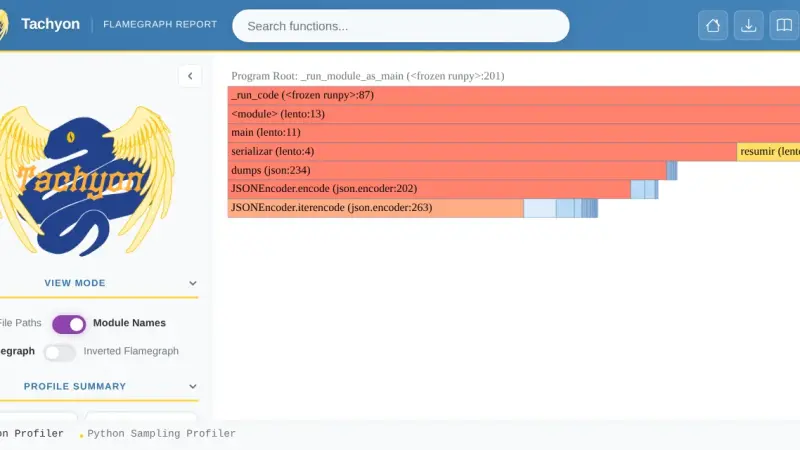
Python 3.15 adds lazy imports through the lazy keyword, the frozendict and sentinel builtins, UTF-8 as the default encoding, unpacking in comprehensions and Tachyon, a sampling profiler. In Docker, marking six imports as lazy cut a CLI's startup from 73.5 ms to 9.8 ms and the modules it loaded from 342 to 62.
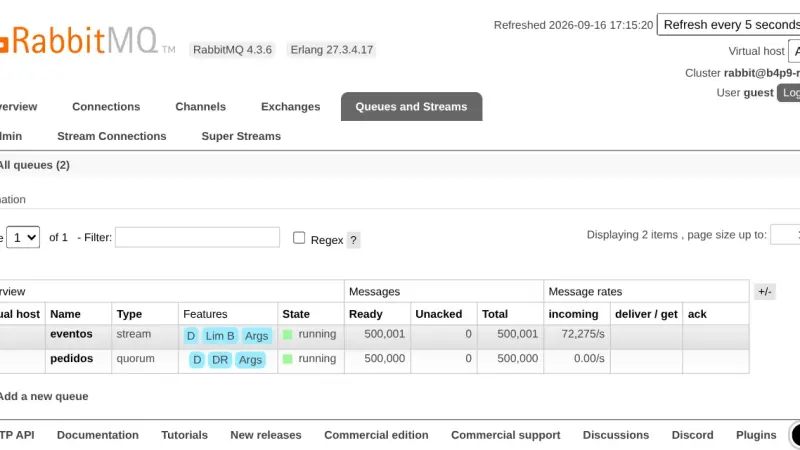
A RabbitMQ quorum queue deletes each message once it is acknowledged and fsyncs before accepting it; a stream keeps it for rereading. On RabbitMQ 4.3.6, with 1 KB messages, the quorum queue moved 45,156 msg/s and the stream, over its own protocol, 281,330 msg/s, using 9 KB of memory per million messages against 20.5 MB.
NPUs stopped being an accessory and became the component that defines real performance in laptops, phones, and small servers. A practical look at the hardware that rules 2026, which workloads pay off, and where the traditional GPU still wins.
A caching proxy in front of a language model can cut the token bill significantly, but it introduces subtle risks if the design is not careful. Which cache types work in production, where the usual traps sit, and how to add them without degrading the experience.
Garnet is the open-source cache server Microsoft Research published in March 2024. Written from scratch in .NET 8, it speaks the Redis wire protocol, so existing clients connect unchanged, and it stores data through a hybrid memory-and-disk backend called Tsavorite. Core-affinity threading is what lets the Garnet cache outrun Redis on many-core hardware.
Dragonfly is a Redis-protocol-compatible cache built on a multithreaded shared-nothing design with one thread per data shard, so an eight-core node uses all eight cores where Redis uses one. Its fork-free snapshot algorithm keeps latency flat while persisting. Ordinary clients work fine; modules like RedisSearch and RedisJSON are where compatibility frays.
Free threading in Python became real with 3.13 and PEP 703, which makes the GIL optional at build time: the standard binary keeps it, while the separate python3.13t binary removes it. Thread-heavy orchestration code gains most; NumPy-style work that already released the GIL barely changes. Single-thread performance on that build drops around 40 percent.
Redis 8.2 ships vector search as a native data type. The real question is whether it replaces a dedicated engine like Qdrant, Weaviate, or pgvector on workloads with millions of vectors and tight latency budgets, or only works as a bonus on top of the cache you already run.
Qwik has spent two years promising apps that start instantly because, instead of hydrating, they resume execution serialized on the server. With the 1.x series settled and real cases published, this guide checks whether resumability is worth the learning curve and which products benefit most from that client-side JavaScript saving.
I have spent six months using a MacBook Pro with M4 Pro as my main development machine. I lay out what has genuinely changed versus the previous M2 Pro, where the jump is noticeable, and where the investment is not justified if you already own a recent machine.
Polars runs 3 to 10 times faster than pandas on aggregations, joins, and filters over parquet datasets of 1 to 20 GB, and holds 40 to 60 percent less memory thanks to native Arrow columns. With the 1.x API frozen and Arrow interoperability, both libraries can coexist in one pipeline.
Continuous profiling with eBPF samples every process's execution stack every few milliseconds without touching the code, then stores the history so you can compare last week's performance with today's. The cost measured in production runs between 1% and 3% of CPU, and it pays off most in databases, API gateways and high-concurrency services.
The PostgreSQL 17 optimisations that change real query plans sit in the planner and executor, so existing SQL benefits untouched. SAOP scans fold an IN list into a single index pass, worth 30 to 50 percent off p99 latency for 20 to 100 IDs. Streaming I/O cuts cold sequential scans and ANALYZE by 15 to 40 percent.
Python 3.12, released in October 2023, brings inline generic syntax through PEP 695, tracebacks that pinpoint the exact error, and an average speedup of around 5% over 3.11 on pyperformance, plus experimental sub-interpreters with their own GIL. Migrating from 3.10 or 3.11 is straightforward: major libraries already ship compatible wheels.
Qwik bets on resumability instead of hydration: the server serialises state into the HTML itself and the client downloads nothing until the user actually interacts, so the initial application bundle is zero kilobytes. In Lighthouse that means a TTI below 0.5 seconds, though it does not pay off for teams already invested in React or for apps with heavy realtime collaborative state.
Parca is a continuous profiling tool based on eBPF that samples CPU usage across an entire Kubernetes cluster around the clock, without instrumenting application code and with under 1% overhead. It catches performance regressions before production and makes flame graphs practical for everyday debugging.
PostgreSQL 17, released in September 2024, cuts vacuum memory use by up to 20x, adds slot synchronization so logical replication survives a failover without a full resync, ships JSON_TABLE as standard SQL:2023 syntax, and introduces streaming I/O to speed up sequential scans. Teams running Postgres in production should start testing it in staging.
PostgreSQL 16, released in September 2023, adds logical replication from a standby, the pg_stat_io view for breaking down I/O by operation type and context, and parallel FULL OUTER JOIN support. Upgrading from 15 is straightforward; 13 loses support in November 2025, so plan the update soon.
Rust is no longer just a systems language: with tokio as the async runtime and axum as the HTTP framework, teams build high-performance backend services with compile-time type checking. It pays off in gateways, proxies and event processors; for typical CRUD over Postgres, Go or Node.js remain more productive.
Redis alone isn't a caching strategy, just an ingredient: picking the right pattern among cache-aside, read-through, write-through, and write-behind, sizing TTL to how fast data actually changes, invalidating explicitly for critical data, and mitigating thundering herd with jitter and locking are the decisions that actually matter in production.
6 min2254.4
We use first- and third-party cookies to analyze site traffic. You can accept them, reject them, or configure your choice.
Learn more about cookies
Cookie preferences
NecessaryEssential for the site to work. Always on.
AnalyticsHelp us understand how the site is used (Google Analytics).